QUESTION IMAGE
Question
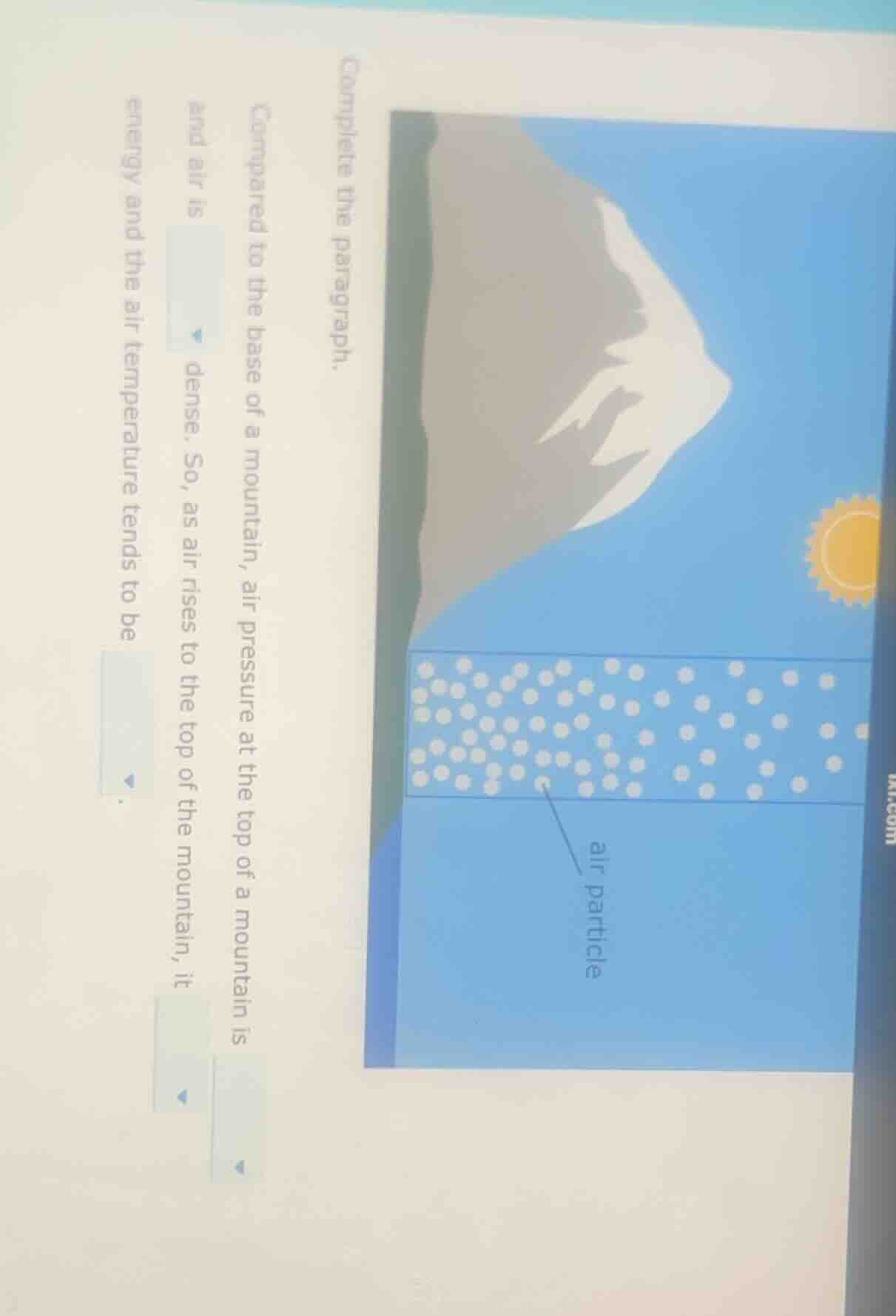
complete the paragraph. compared to the base of a mountain, air pressure at the top of a mountain is and air is dense. so, as air rises to the top of the mountain, it energy and the air temperature tends to be
Brief Explanations
- For air pressure at mountain top vs base: Air pressure decreases with altitude (less air above, so lower pressure). So "lower" than at base.
- For air density at top: With lower pressure, air molecules are more spread out, so density is "less" (or "less" dense).
- As air rises (to top), it expands (due to lower pressure) and does work, so it "loses" energy (internal energy decreases).
- Air temperature with lost energy: Lower internal energy means temperature "lower" (adiabatic cooling as air rises).

Snap & solve any problem in the app
Get step-by-step solutions on Sovi AI
Photo-based solutions with guided steps
Explore more problems and detailed explanations
Compared to the base of a mountain, air pressure at the top of a mountain is lower and air is less dense. So, as air rises to the top of the mountain, it loses energy and the air temperature tends to be lower.