QUESTION IMAGE
Question
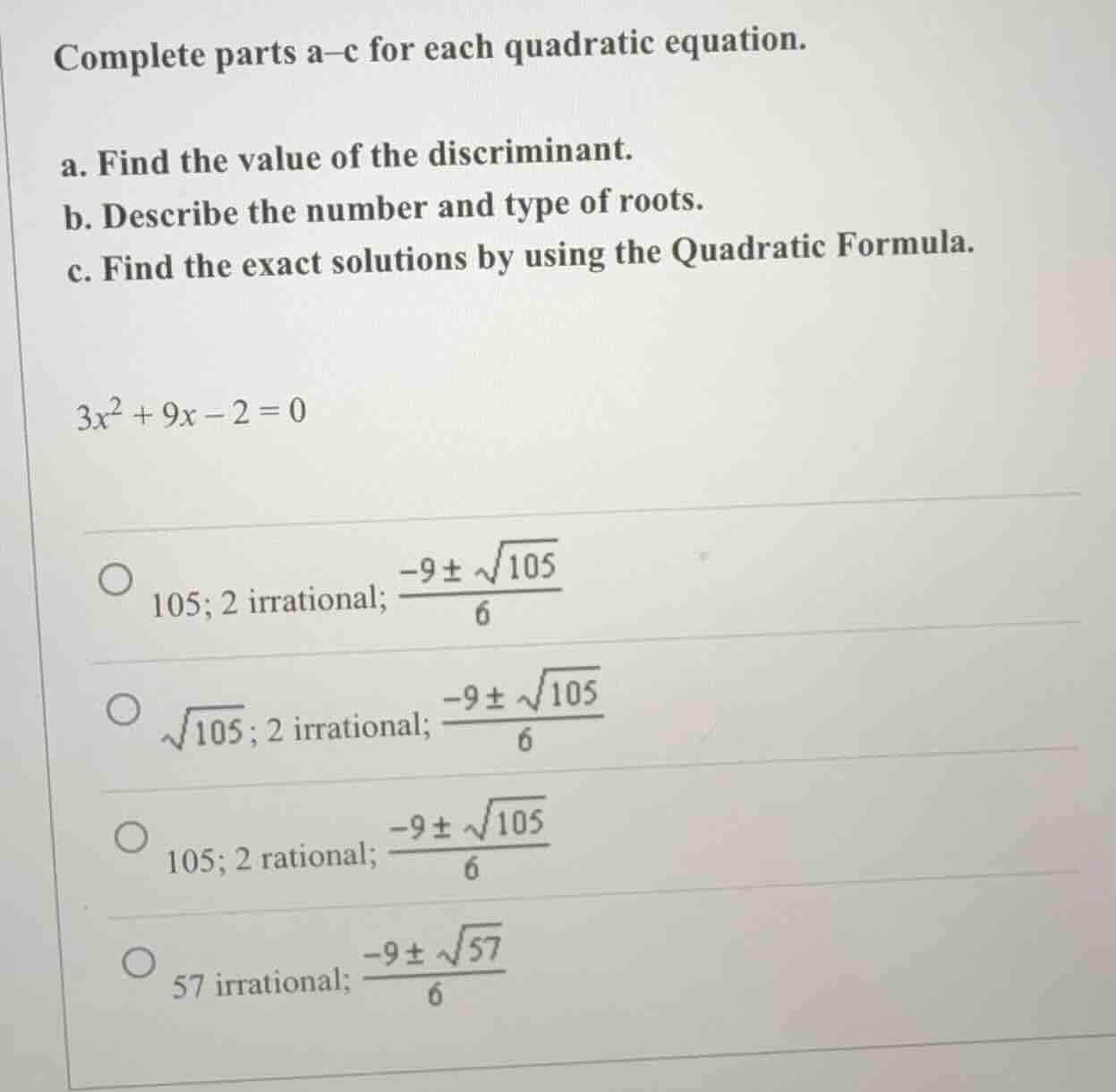
complete parts a–c for each quadratic equation.
a. find the value of the discriminant.
b. describe the number and type of roots.
c. find the exact solutions by using the quadratic formula.
$3x^2 + 9x - 2 = 0$
\bigcirc $105; 2$ irrational; $\dfrac{-9 \pm \sqrt{105}}{6}$
\bigcirc $\sqrt{105}; 2$ irrational; $\dfrac{-9 \pm \sqrt{105}}{6}$
\bigcirc $105; 2$ rational; $\dfrac{-9 \pm \sqrt{105}}{6}$
\bigcirc $57$ irrational; $\dfrac{-9 \pm \sqrt{57}}{6}$
Step 1: Recall the discriminant formula
For a quadratic equation \(ax^{2}+bx + c = 0\), the discriminant \(D=b^{2}-4ac\). In the equation \(3x^{2}+9x - 2=0\), we have \(a = 3\), \(b = 9\), and \(c=- 2\).
So, \(D=(9)^{2}-4\times3\times(-2)=81 + 24=105\).
Step 2: Analyze the nature of roots
Since the discriminant \(D = 105>0\) and \(\sqrt{105}\) is an irrational number (because \(105\) is not a perfect square), the quadratic equation will have two distinct irrational roots.
Step 3: Apply the quadratic formula
The quadratic formula is \(x=\frac{-b\pm\sqrt{b^{2}-4ac}}{2a}\). Substituting \(a = 3\), \(b = 9\), and \(D = 105\) (so \(\sqrt{b^{2}-4ac}=\sqrt{105}\)) into the formula, we get:
\(x=\frac{-9\pm\sqrt{105}}{2\times3}=\frac{-9\pm\sqrt{105}}{6}\)

Snap & solve any problem in the app
Get step-by-step solutions on Sovi AI
Photo-based solutions with guided steps
Explore more problems and detailed explanations
\(105\); \(2\) irrational; \(\boldsymbol{\frac{-9\pm\sqrt{105}}{6}}\) (corresponding to the first option: \(105; 2\) irrational; \(\frac{-9\pm\sqrt{105}}{6}\))