QUESTION IMAGE
Question
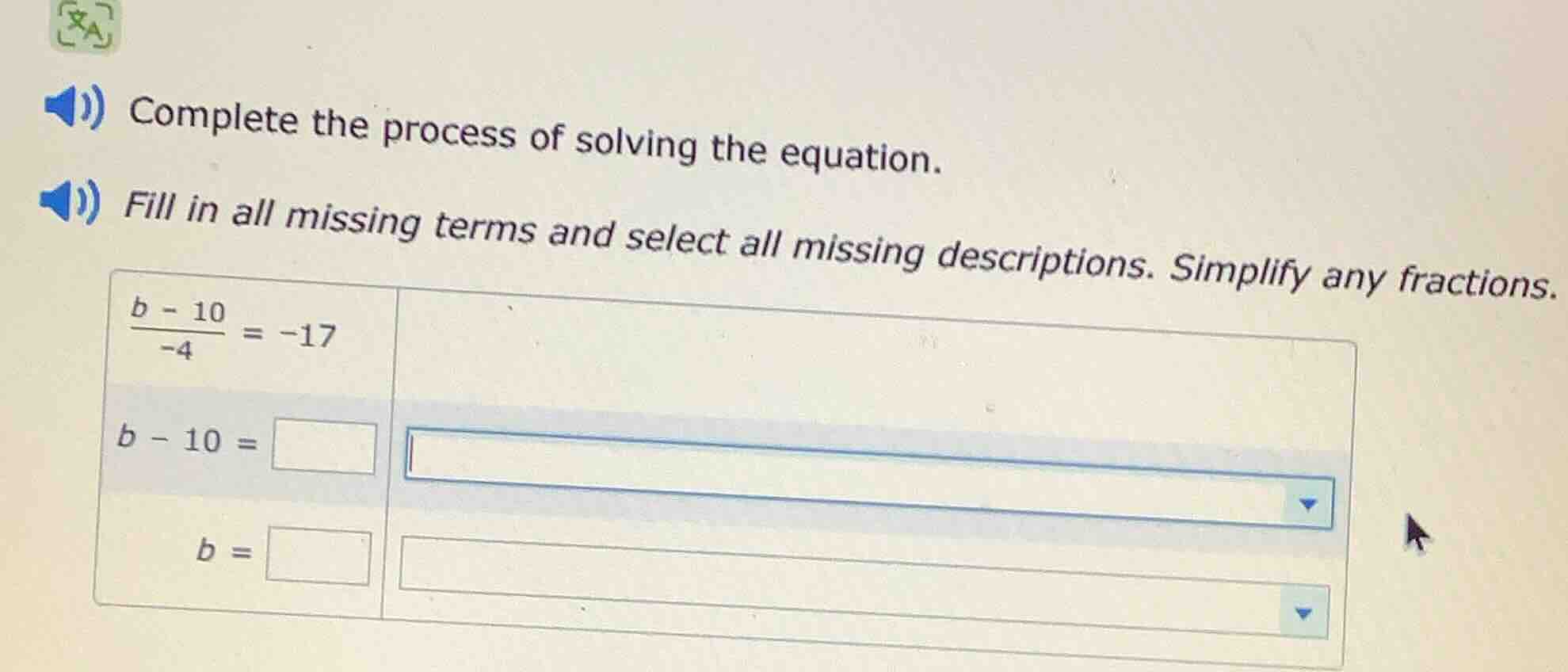
complete the process of solving the equation. fill in all missing terms and select all missing descriptions. simplify any fractions. \\(\frac{b - 10}{-4} = -17\\) \\(b - 10 = \square\\) \\(b = \square\\)
Step1: Multiply both sides by -4
To eliminate the denominator \(-4\) on the left side, we multiply both sides of the equation \(\frac{b - 10}{-4} = -17\) by \(-4\). Using the multiplication property of equality, if \( \frac{a}{c}=d \), then \( a = c\times d \). So we have:
\( b - 10 = -17\times(-4) \)
Calculating the right side: \(-17\times(-4)=68\), so \( b - 10 = 68 \)
Step2: Add 10 to both sides
To solve for \( b \), we add 10 to both sides of the equation \( b - 10 = 68 \). Using the addition property of equality, if \( a - c = d \), then \( a = d + c \). So:
\( b = 68 + 10 \)
Calculating the right side: \( 68+10 = 78 \), so \( b = 78 \)

Snap & solve any problem in the app
Get step-by-step solutions on Sovi AI
Photo-based solutions with guided steps
Explore more problems and detailed explanations
For the first missing term (in \( b - 10=\square \)): \( 68 \) (description: Multiply both sides by -4)
For the second missing term (in \( b=\square \)): \( 78 \) (description: Add 10 to both sides)