QUESTION IMAGE
Question
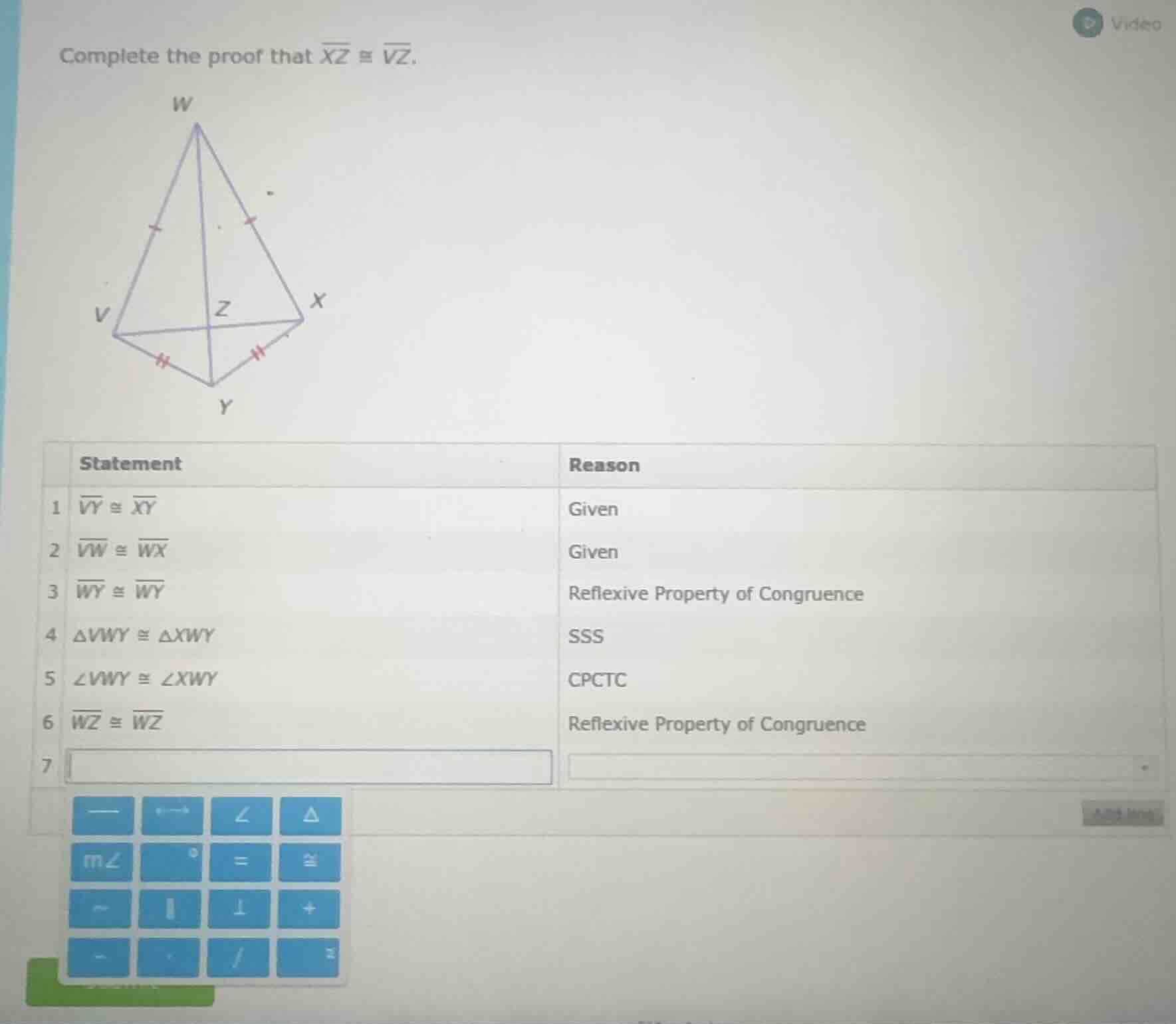
complete the proof that \\(\overline{xz} \cong \overline{vz}\\).
(image of a geometric figure with points w, v, x, y, z and a table with statements and reasons)
1 \\(\overline{vy} \cong \overline{xy}\\) given
2 \\(\overline{vw} \cong \overline{wx}\\) given
3 \\(\overline{wy} \cong \overline{wy}\\) reflexive property of congruence
4 \\(\triangle vwy \cong \triangle xwy\\) sss
5 \\(\angle vwy \cong \angle xwy\\) cpctc
6 \\(\overline{wz} \cong \overline{wz}\\) reflexive property of congruence
7 blank for statement blank for reason
Step1: Identify triangles for SAS
We have \( \overline{VW} \cong \overline{XW} \) (given, step 2), \( \angle VWY \cong \angle XWY \) (CPCTC, step 5), and \( \overline{WZ} \cong \overline{WZ} \) (reflexive, step 6). So triangles \( \triangle VWZ \) and \( \triangle XWZ \) have two sides and included angle congruent.
Step2: Apply SAS congruence
By SAS (Side - Angle - Side) Congruence Criterion, \( \triangle VWZ \cong \triangle XWZ \).
Step3: Use CPCTC for segments
Since \( \triangle VWZ \cong \triangle XWZ \), by Corresponding Parts of Congruent Triangles are Congruent (CPCTC), \( \overline{XZ} \cong \overline{VZ} \). So the statement for step 7 is \( \triangle VWZ \cong \triangle XWZ \) and the reason is SAS, then we get \( \overline{XZ} \cong \overline{VZ} \) from CPCTC. But for the statement in the table (step 7) to lead to \( \overline{XZ} \cong \overline{VZ} \), the statement should be \( \triangle VWZ \cong \triangle XWZ \) with reason SAS, and then the final conclusion (though the table step 7 is the statement before the final conclusion, but to complete the proof, step 7 statement is \( \triangle VWZ \cong \triangle XWZ \) and reason SAS, then the next step (implied) is \( \overline{XZ} \cong \overline{VZ} \) by CPCTC. But focusing on step 7:
The statement for step 7 is \( \triangle VWZ \cong \triangle XWZ \) and the reason is SAS (because \( \overline{VW} \cong \overline{XW} \), \( \angle VWZ=\angle XWZ \) (from \( \angle VWY \cong \angle XWY \) and \( Z \) is on \( WY \)), and \( \overline{WZ} \cong \overline{WZ} \)). Then from this congruence, \( \overline{XZ} \cong \overline{VZ} \) by CPCTC.

Snap & solve any problem in the app
Get step-by-step solutions on Sovi AI
Photo-based solutions with guided steps
Explore more problems and detailed explanations
Statement for step 7: \( \boldsymbol{\triangle VWZ \cong \triangle XWZ} \)
Reason for step 7: \( \boldsymbol{\text{SAS}} \) (and then \( \overline{XZ} \cong \overline{VZ} \) by CPCTC)