QUESTION IMAGE
Question
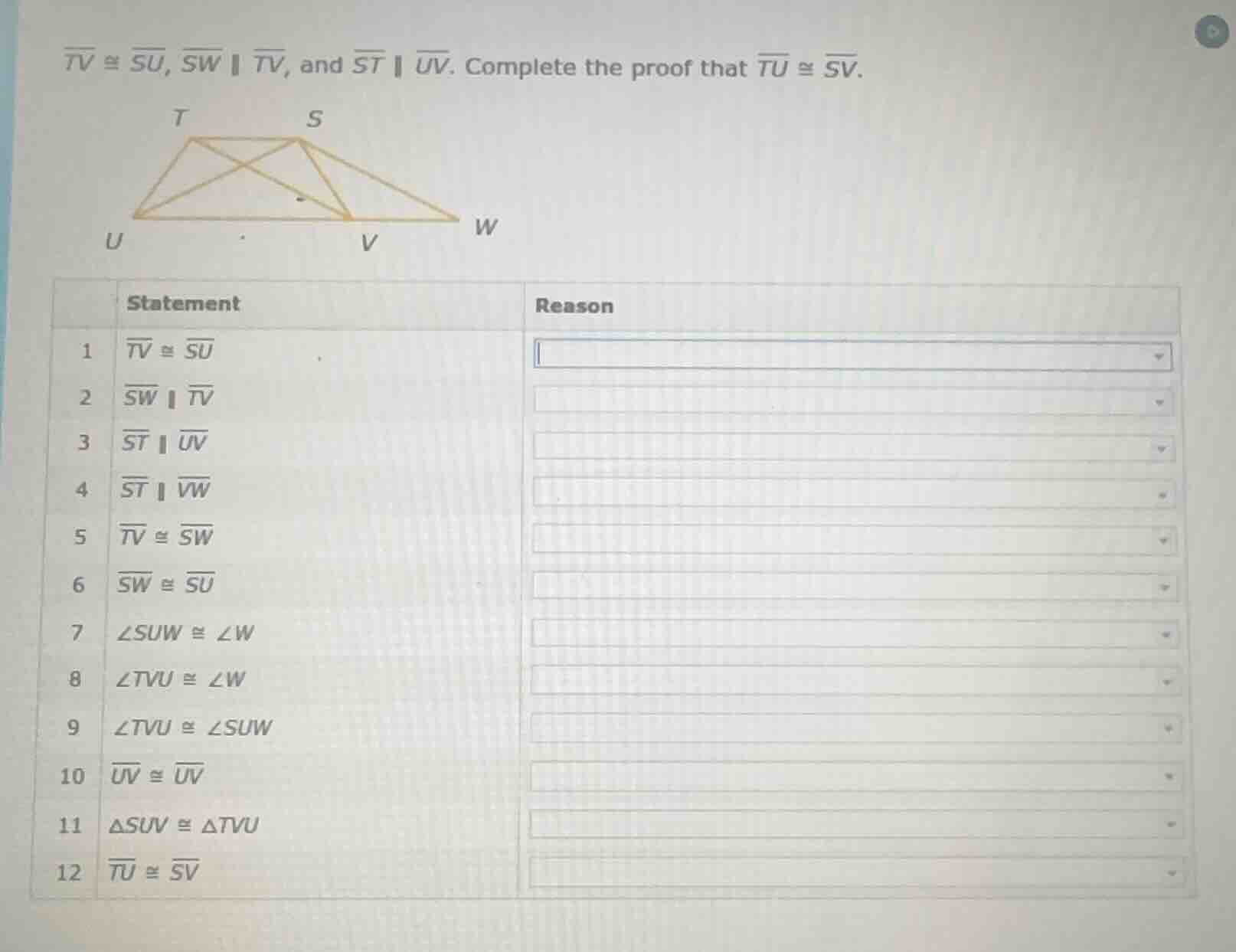
$overline{tv} cong overline{su}$, $overline{sw} parallel overline{tv}$, and $overline{st} parallel overline{uv}$. complete the proof that $overline{tu} cong overline{sv}$.
(image of a geometric figure with points t, s, u, v, w and a table with statements and reasons for a proof)
- $overline{tv} cong overline{su}$
- $overline{sw} parallel overline{tv}$
- $overline{st} parallel overline{uv}$
- $overline{st} parallel overline{vw}$
- $overline{tv} cong overline{sw}$
- $overline{sw} cong overline{su}$
- $angle suw cong angle w$
- $angle tvu cong angle w$
- $angle tvu cong angle suw$
- $overline{uv} cong overline{uv}$
- $\triangle suv cong \triangle tvu$
- $overline{tu} cong overline{sv}$
Step1: Identify Given Information
The problem states \(\overline{TV} \cong \overline{SU}\), so this is given.
Step2: Analyze Parallel Lines
- For \(\overline{SW} \parallel \overline{TV}\), this is given.
- For \(\overline{ST} \parallel \overline{UV}\), this is given.
- Since \(\overline{ST} \parallel \overline{UV}\) and \(U, V, W\) are colinear, \(\overline{ST} \parallel \overline{VW}\) (by the property of parallel lines and colinear points).
Step3: Use Parallel Line Properties for Congruence
- Since \(\overline{SW} \parallel \overline{TV}\) and \(STVW\) (implied by parallel lines), \(\overline{TV} \cong \overline{SW}\) (opposite sides of a parallelogram are congruent, as \(ST \parallel VW\) and \(SW \parallel TV\) make \(STVW\) a parallelogram).
- From \(\overline{TV} \cong \overline{SU}\) (given) and \(\overline{TV} \cong \overline{SW}\), by transitive property, \(\overline{SW} \cong \overline{SU}\).
Step4: Use Alternate Interior Angles
- \(\angle SUW \cong \angle W\) (alternate interior angles, as \(\overline{ST} \parallel \overline{VW}\) and \(\overline{SW}\) is a transversal).
- \(\angle TVU \cong \angle W\) (alternate interior angles, as \(\overline{SW} \parallel \overline{TV}\) and \(\overline{UW}\) is a transversal).
- By transitive property, \(\angle TVU \cong \angle SUW\).
Step5: Reflexive Property
\(\overline{UV} \cong \overline{UV}\) (reflexive property of congruence).
Step6: Prove Triangle Congruence
\(\triangle SUV \cong \triangle TVU\) by SAS (side - angle - side: \(\overline{SU} \cong \overline{TV}\), \(\angle SUW \cong \angle TVU\), \(\overline{UV} \cong \overline{UV}\)).
Step7: Corresponding Parts of Congruent Triangles
Since \(\triangle SUV \cong \triangle TVU\), \(\overline{TU} \cong \overline{SV}\) (corresponding parts of congruent triangles are congruent, CPCTC).
Filling the Table (Reasons):
- \(\overline{TV} \cong \overline{SU}\): Given
- \(\overline{SW} \parallel \overline{TV}\): Given
- \(\overline{ST} \parallel \overline{UV}\): Given
- \(\overline{ST} \parallel \overline{VW}\): If a line is parallel to one of two colinear lines, it is parallel to the other (or by definition of colinear and parallel lines)
- \(\overline{TV} \cong \overline{SW}\): Opposite sides of a parallelogram are congruent (since \(ST \parallel VW\) and \(SW \parallel TV\), \(STVW\) is a parallelogram)
- \(\overline{SW} \cong \overline{SU}\): Transitive property of congruence (\(\overline{TV} \cong \overline{SU}\) and \(\overline{TV} \cong \overline{SW}\))
- \(\angle SUW \cong \angle W\): Alternate interior angles ( \(\overline{ST} \parallel \overline{VW}\), \(\overline{SW}\) transversal)
- \(\angle TVU \cong \angle W\): Alternate interior angles ( \(\overline{SW} \parallel \overline{TV}\), \(\overline{UW}\) transversal)
- \(\angle TVU \cong \angle SUW\): Transitive property of congruence
- \(\overline{UV} \cong \overline{UV}\): Reflexive property
- \(\triangle SUV \cong \triangle TVU\): SAS ( \(\overline{SU} \cong \overline{TV}\), \(\angle SUW \cong \angle TVU\), \(\overline{UV} \cong \overline{UV}\))
- \(\overline{TU} \cong \overline{SV}\): CPCTC (corresponding parts of congruent triangles are congruent)

Snap & solve any problem in the app
Get step-by-step solutions on Sovi AI
Photo-based solutions with guided steps
Explore more problems and detailed explanations
The reasons for each statement are filled as above, and the final conclusion is that \(\overline{TU} \cong \overline{SV}\) is proven by CPCTC after showing \(\triangle SUV \cong \triangle TVU\) by SAS.