QUESTION IMAGE
Question
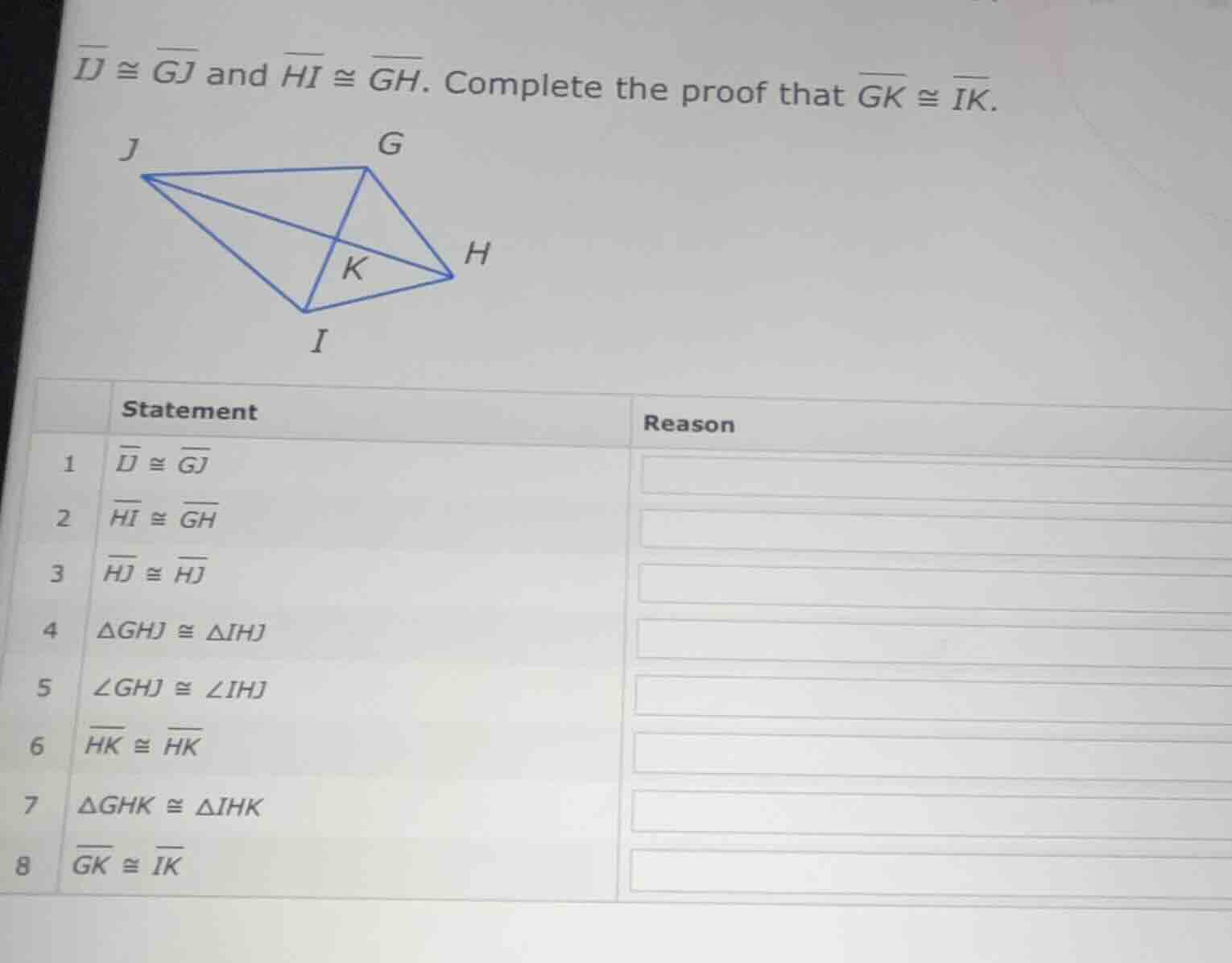
$overline{ij} cong overline{gj}$ and $overline{hi} cong overline{gh}$. complete the proof that $overline{gk} cong overline{ik}$.
(image of a quadrilateral with points j, g, h, i and intersection k)
| statement | reason | |
|---|---|---|
| 2 | $overline{hi} cong overline{gh}$ | |
| 3 | $overline{hj} cong overline{hj}$ | |
| 4 | $\triangle ghj cong \triangle ihj$ | |
| 5 | $angle ghj cong angle ihj$ | |
| 6 | $overline{hk} cong overline{hk}$ | |
| 7 | $\triangle ghk cong \triangle ihk$ | |
| 8 | $overline{gk} cong overline{ik}$ |
Step1: Identify Given Information
The problem states \(\overline{IJ} \cong \overline{GJ}\) (wait, original is \(\overline{IJ} \cong \overline{GJ}\)? Wait, original first statement: \(\overline{IJ} \cong \overline{GJ}\) (maybe typo, but given as \(\overline{IJ} \cong \overline{GJ}\)) and \(\overline{HI} \cong \overline{GH}\). Also, \(\overline{HJ}\) is common.
Step2: Reason for Statement 1
Statement 1: \(\overline{IJ} \cong \overline{GJ}\) (Given, as per problem statement)
Step3: Reason for Statement 2
Statement 2: \(\overline{HI} \cong \overline{GH}\) (Given, as per problem statement)
Step4: Reason for Statement 3
Statement 3: \(\overline{HJ} \cong \overline{HJ}\) (Reflexive Property of Congruence, a segment is congruent to itself)
Step5: Reason for Statement 4
Statement 4: \(\triangle GHJ \cong \triangle IHJ\) (SSS Congruence Postulate: since \(\overline{IJ} \cong \overline{GJ}\), \(\overline{HI} \cong \overline{GH}\), and \(\overline{HJ} \cong \overline{HJ}\), so three sides congruent)
Step6: Reason for Statement 5
Statement 5: \(\angle GHJ \cong \angle IHJ\) (Corresponding Parts of Congruent Triangles are Congruent (CPCTC), from \(\triangle GHJ \cong \triangle IHJ\))
Step7: Reason for Statement 6
Statement 6: \(\overline{HK} \cong \overline{HK}\) (Reflexive Property of Congruence, a segment is congruent to itself)
Step8: Reason for Statement 7
Statement 7: \(\triangle GHK \cong \triangle IHK\) (SAS Congruence Postulate: \(\overline{HI} \cong \overline{GH}\) (given), \(\angle GHJ \cong \angle IHJ\) (from CPCTC), \(\overline{HK} \cong \overline{HK}\) (reflexive), so two sides and included angle congruent)
Step9: Reason for Statement 8
Statement 8: \(\overline{GK} \cong \overline{IK}\) (CPCTC, from \(\triangle GHK \cong \triangle IHK\), corresponding sides are congruent)

Snap & solve any problem in the app
Get step-by-step solutions on Sovi AI
Photo-based solutions with guided steps
Explore more problems and detailed explanations
| Statement | Reason |
|---|---|
| 2. \(\overline{HI} \cong \overline{GH}\) | Given |
| 3. \(\overline{HJ} \cong \overline{HJ}\) | Reflexive Property of Congruence |
| 4. \(\triangle GHJ \cong \triangle IHJ\) | SSS Congruence Postulate |
| 5. \(\angle GHJ \cong \angle IHJ\) | CPCTC (from \(\triangle GHJ \cong \triangle IHJ\)) |
| 6. \(\overline{HK} \cong \overline{HK}\) | Reflexive Property of Congruence |
| 7. \(\triangle GHK \cong \triangle IHK\) | SAS Congruence Postulate ( \(\overline{HI} \cong \overline{GH}\), \(\angle GHJ \cong \angle IHJ\), \(\overline{HK} \cong \overline{HK}\)) |
| 8. \(\overline{GK} \cong \overline{IK}\) | CPCTC (from \(\triangle GHK \cong \triangle IHK\)) |
(Note: The first statement's segment might have a typo, but following the given, we use the provided labels. The key is to apply congruence postulates and CPCTC.)