QUESTION IMAGE
Question
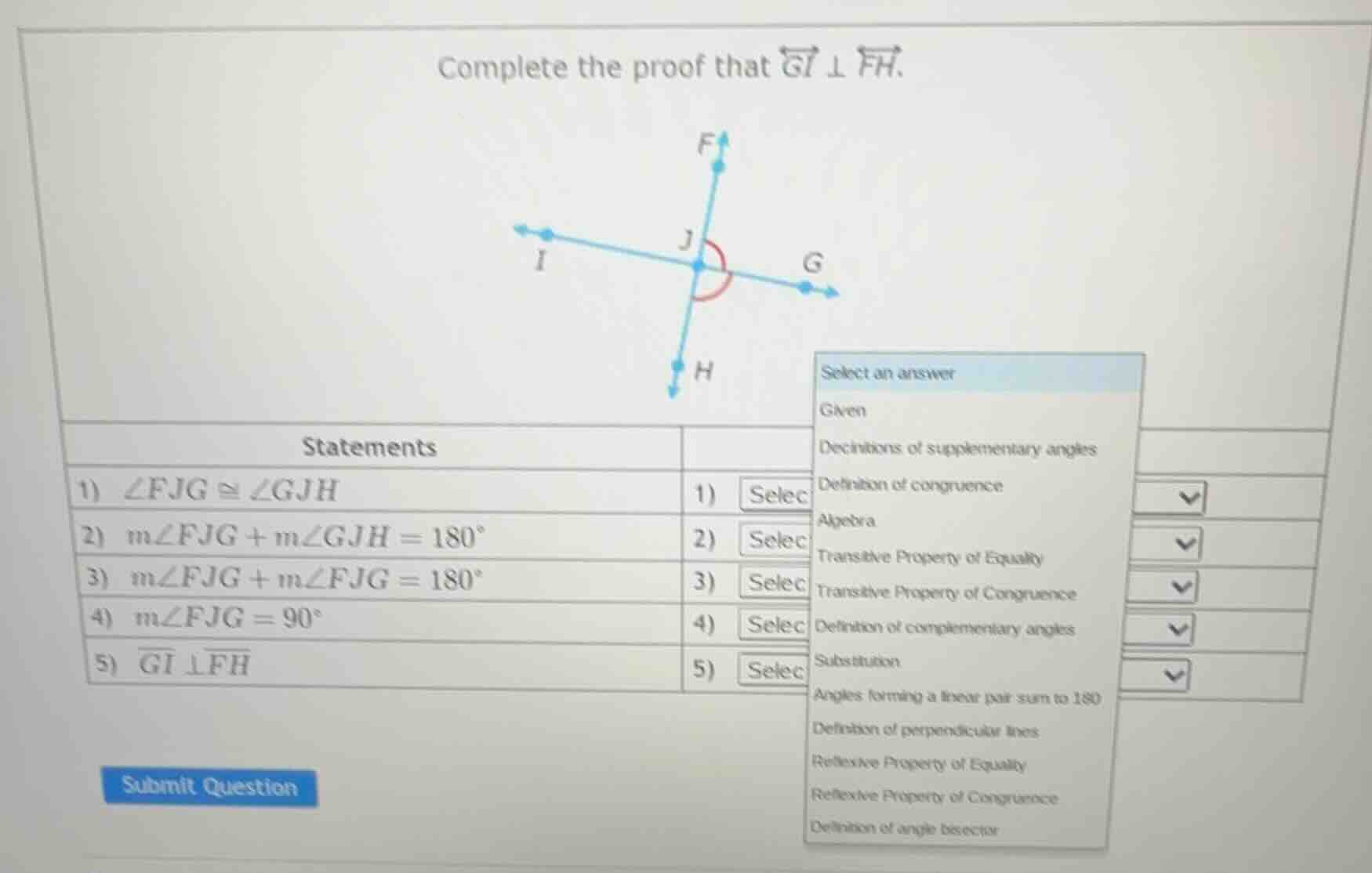
complete the proof that \\(\overleftrightarrow{gi} \perp \overleftrightarrow{fh}\\).
statements
- \\(\angle fjg \cong \angle gjh\\)
- \\(m\angle fjg + m\angle gjh = 180^\circ\\)
- \\(m\angle fjg + m\angle fjg = 180^\circ\\)
- \\(m\angle fjg = 90^\circ\\)
- \\(\overleftrightarrow{gi} \perp \overleftrightarrow{fh}\\)
select an answer
given
definitions of supplementary angles
definition of congruence
algebra
transitive property of equality
transitive property of congruence
definition of complementary angles
substitution
angles forming a linear pair sum to 180
definition of perpendicular lines
reflexive property of equality
reflexive property of congruence
definition of angle bisector
Step1: Match statement 1 to reason
$\angle FJG \cong \angle GJH$ is a given premise for the proof.
Step2: Match statement 2 to reason
$\angle FJG$ and $\angle GJH$ form a linear pair, so their measures sum to $180^\circ$.
$m\angle FJG + m\angle GJH = 180^\circ$
Step3: Match statement 3 to reason
Substitute $\angle GJH$ with $\angle FJG$ (from congruence).
$m\angle FJG + m\angle FJG = 180^\circ$
Step4: Match statement 4 to reason
Simplify the equation algebraically.
$2m\angle FJG = 180^\circ \implies m\angle FJG = 90^\circ$
Step5: Match statement 5 to reason
A right angle means the lines are perpendicular.
$\overline{GI} \perp \overline{FH}$

Snap & solve any problem in the app
Get step-by-step solutions on Sovi AI
Photo-based solutions with guided steps
Explore more problems and detailed explanations
- Given
- Angles forming a linear pair sum to 180
- Substitution
- Algebra
- Definition of perpendicular lines