QUESTION IMAGE
Question
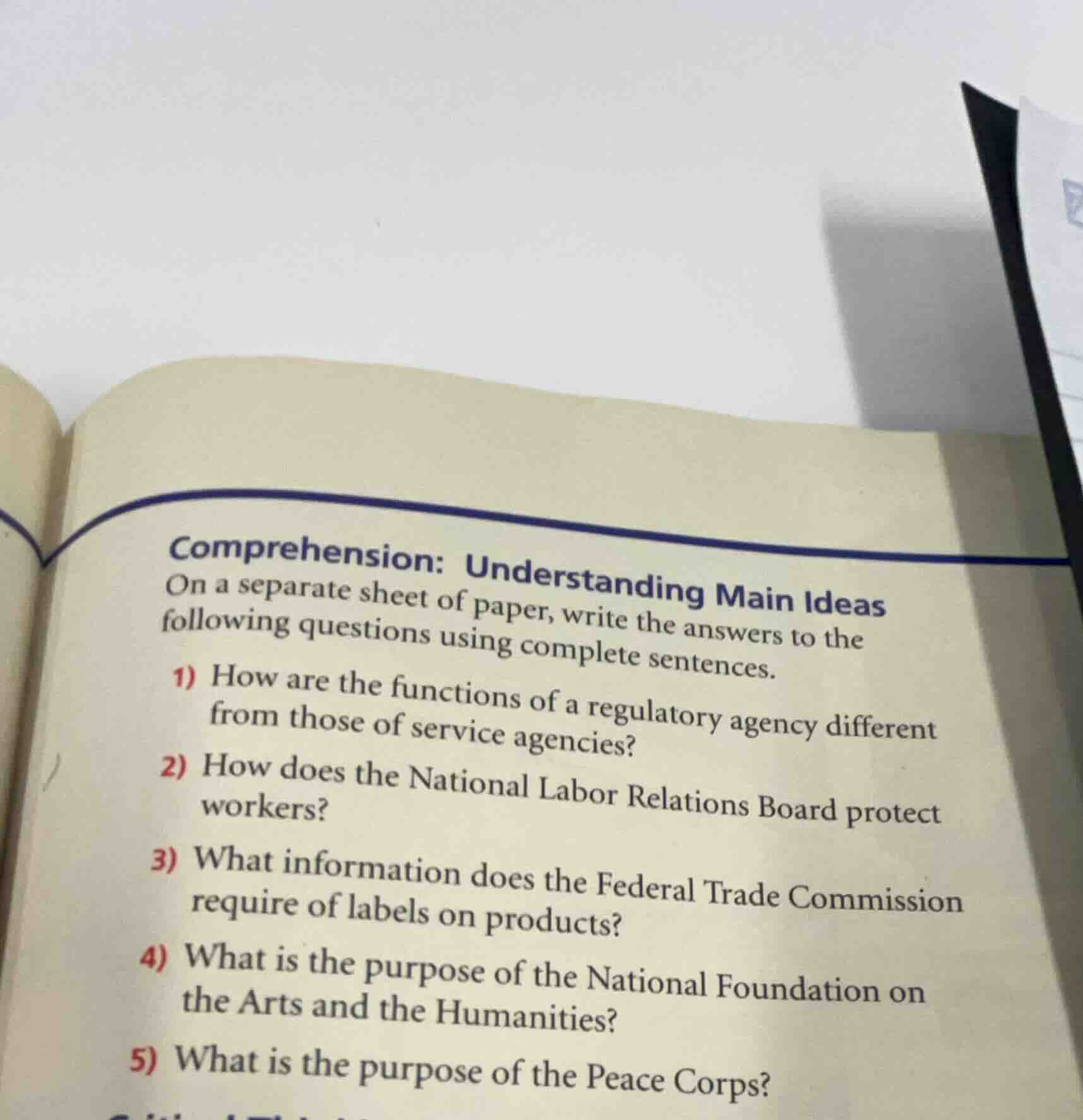
comprehension: understanding main ideas
on a separate sheet of paper, write the answers to the
following questions using complete sentences.
- how are the functions of a regulatory agency different
from those of service agencies?
- how does the national labor relations board protect
workers?
- what information does the federal trade commission
require of labels on products?
- what is the purpose of the national foundation on
the arts and the humanities?
- what is the purpose of the peace corps?
Question 1
Regulatory agencies (e.g., FCC, FDA) enforce rules/regulations to protect public interest, ensure compliance (e.g., safety, fair competition). Service agencies (e.g., Postal Service, Social Security Admin) directly provide services to the public, focusing on delivering benefits, utilities, or support. Their core functions differ: regulation vs. service delivery.
The National Labor Relations Board (NLRB) protects workers’ rights to organize, join unions, engage in collective bargaining, and protest unfair labor practices (e.g., employer interference with union activities, unfair termination for union support). It investigates complaints, holds elections for union representation, and resolves labor - management disputes.
The Federal Trade Commission (FTC) requires product labels to provide accurate, non - deceptive information. For example, labels must disclose ingredients (in food, cosmetics), safety warnings (e.g., for toys, chemicals), origin (e.g., “Made in USA”), and usage instructions to help consumers make informed, safe purchasing decisions and prevent false advertising.

Snap & solve any problem in the app
Get step-by-step solutions on Sovi AI
Photo-based solutions with guided steps
Explore more problems and detailed explanations
Regulatory agencies enforce rules and regulations to ensure compliance with laws (e.g., protecting consumers, ensuring fair competition), while service agencies directly provide services (e.g., delivering mail, administering social security) to the public.