QUESTION IMAGE
Question
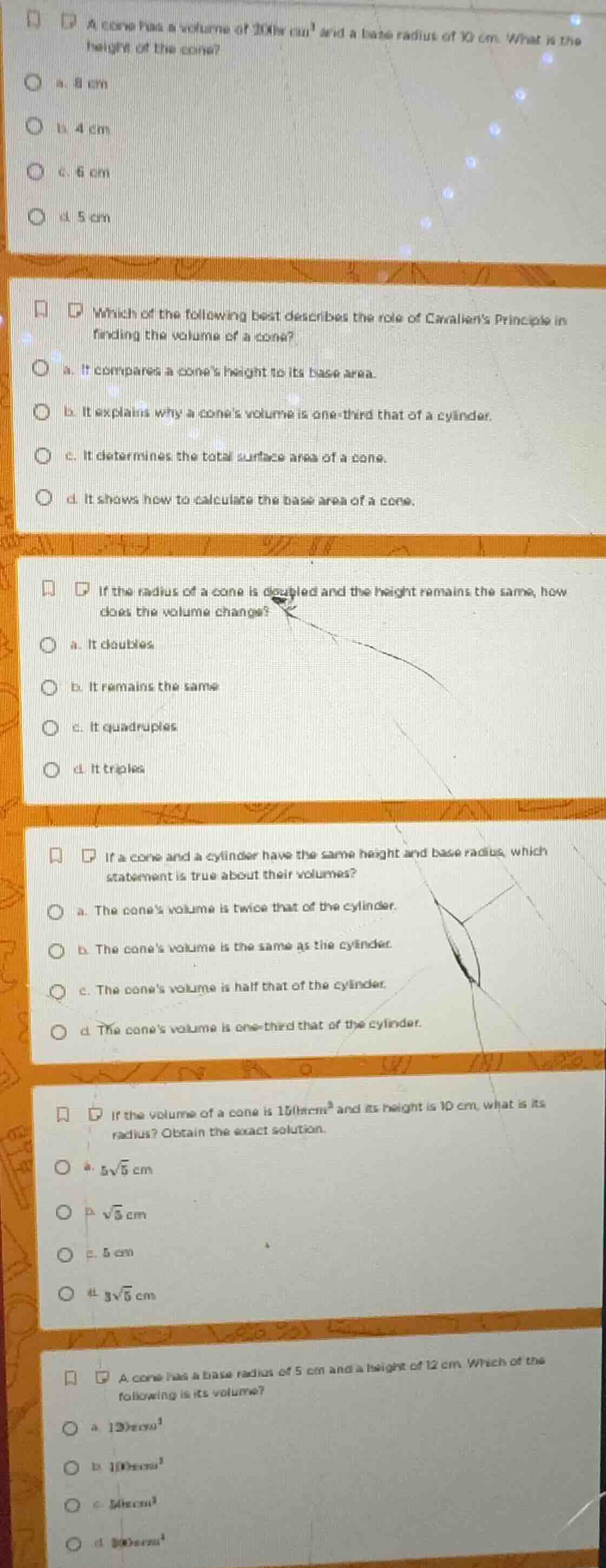
- a cone has a volume of 200π cm³ and a base radius of 10 cm. what is the height of the cone?
a. 8 cm
b. 4 cm
c. 6 cm
d. 5 cm
- which of the following best describes the role of cavalieri’s principle in finding the volume of a cone?
a. it compares a cone’s height to its base area.
b. it explains why a cone’s volume is one - third that of a cylinder.
c. it determines the total surface area of a cone.
d. it shows how to calculate the base area of a cone.
- if the radius of a cone is doubled and the height remains the same, how does the volume change?
a. it doubles
b. it remains the same
c. it quadruples
d. it triples
- if a cone and a cylinder have the same height and base radius, which statement is true about their volumes?
a. the cone’s volume is twice that of the cylinder.
b. the cone’s volume is the same as the cylinder.
c. the cone’s volume is half that of the cylinder.
d. the cone’s volume is one - third that of the cylinder.
- if the volume of a cone is 150π cm³ and its height is 10 cm, what is its radius? obtain the exact solution.
a. 5√5 cm
b. √5 cm
c. 5 cm
d. 3√5 cm
- a cone has a base radius of 5 cm and a height of 12 cm. which of the following is its volume?
a. 120π cm³
b. 100π cm³
c. 50π cm³
d. 300π cm³
Step1: Recall cone volume formula
The volume of a cone is $V = \frac{1}{3}\pi r^2 h$
---
Question 1
Step1: Rearrange for height $h$
$h = \frac{3V}{\pi r^2}$
Step2: Substitute $V=200\pi, r=10$
$h = \frac{3\times200\pi}{\pi \times 10^2} = \frac{600}{100} = 6$
---
Question 2
Step1: Recall Cavalieri's Principle role
It justifies the 1/3 cylinder volume relation for cones.
---
Question 3
Step1: Original volume formula
$V_1 = \frac{1}{3}\pi r^2 h$
Step2: New volume with $2r$
$V_2 = \frac{1}{3}\pi (2r)^2 h = 4\times\frac{1}{3}\pi r^2 h = 4V_1$
---
Question 4
Step1: Compare cone and cylinder volumes
Cylinder volume: $V_{cy} = \pi r^2 h$, Cone volume: $V_{co} = \frac{1}{3}\pi r^2 h$
---
Question 5
Step1: Rearrange volume for radius $r$
$r = \sqrt{\frac{3V}{\pi h}}$
Step2: Substitute $V=150\pi, h=10$
$r = \sqrt{\frac{3\times150\pi}{\pi \times 10}} = \sqrt{45} = 3\sqrt{5}$
---
Question 6
Step1: Substitute $r=5, h=12$ into formula
$V = \frac{1}{3}\pi \times 5^2 \times 12 = \frac{1}{3}\pi \times 25 \times 12 = 100\pi$

Snap & solve any problem in the app
Get step-by-step solutions on Sovi AI
Photo-based solutions with guided steps
Explore more problems and detailed explanations
- c. 6 cm
- b. It explains why a cone's volume is one-third that of a cylinder.
- c. It quadruples
- d. The cone's volume is one-third that of the cylinder.
- d. $3\sqrt{5}$ cm
- b. $100\pi$ cm³