QUESTION IMAGE
Question
conflict of orders: twelve tables
analysis of the social & political structures of ancient rome
name____________________________ date____________
task: read the background information about the social and political structures of ancient rome. annotate by highlighting, underlining, summarizing, & questioning.
_________________________________________________________________________
patricians: in early rome, the patricians were a highly privileged aristocratic class of roman citizens; membership in this class was hereditary and could be achieved only by birth until the end of the republic. the name probably stems from the latin word patres, \fathers,\ which was applied to the earliest members of the roman senate, from whom the patrician clans claimed descent.
plebeians: the plebeians \common people\ were all the roman citizens who were not patricians. originally, patricians were forbidden to marry plebeians, so there was no possibility of movement from one order to another.
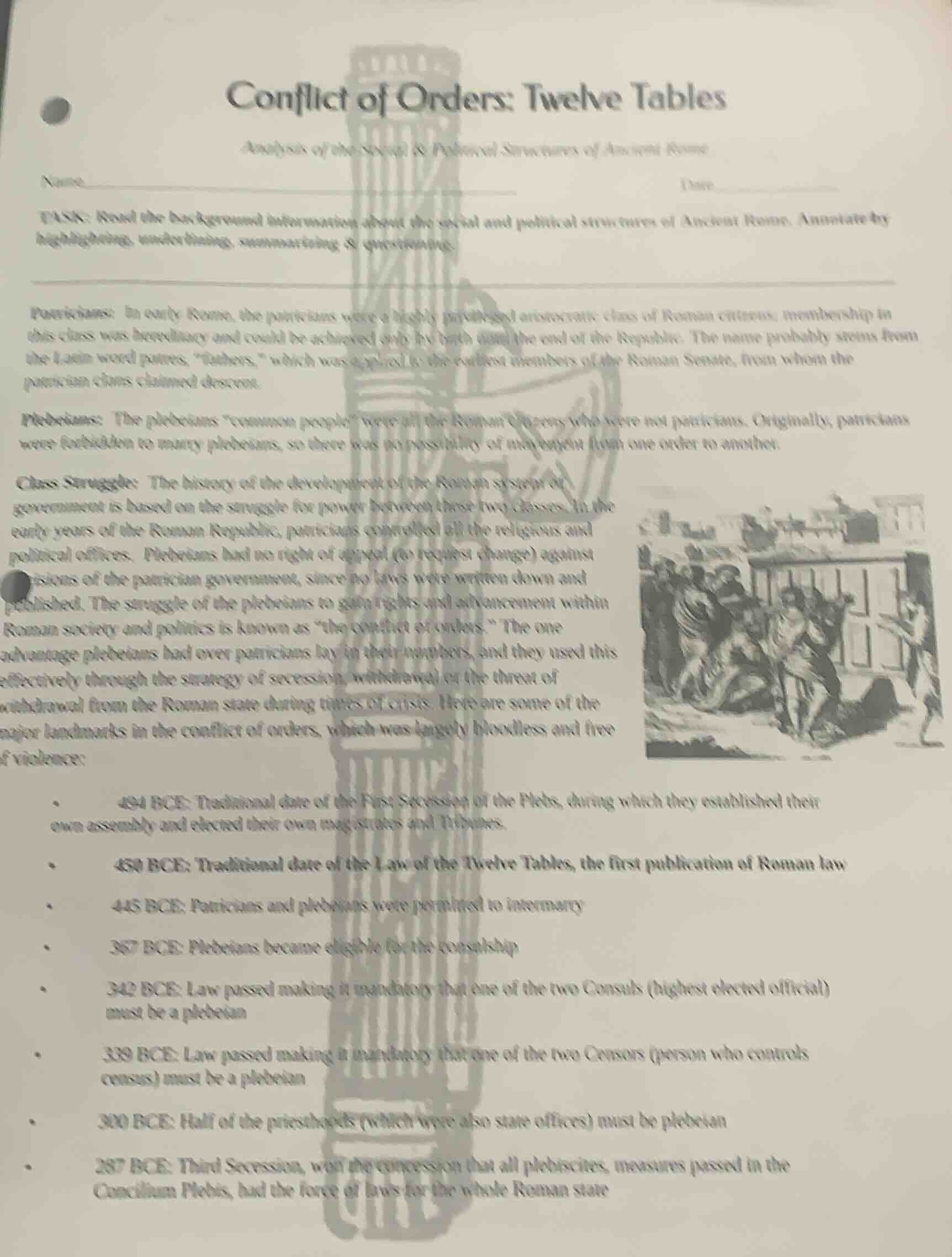
class struggle: the history of the development of the roman system of government is based on the struggle for power between these two classes. in the early years of the roman republic, patricians controlled all the religious and political offices. plebeians had no right of appeal (to request change) against decisions of the patrician government, since no laws were written down and published. the struggle of the plebeians to gain rights and advancement within roman society and politics is known as \the conflict of orders.\ the one advantage plebeians had over patricians lay in their numbers, and they used this effectively through the strategy of secession, withdrawal or the threat of withdrawal from the roman state during times of crisis. here are some of the major landmarks in the conflict of orders, which was largely bloodless and free of violence:
- 494 bce: traditional date of the first secession of the plebs, during which they established their own assembly and elected their own magistrates and tribunes.
- 450 bce: traditional date of the law of the twelve tables, the first publication of roman law
- 445 bce: patricians and plebeians were permitted to intermarry
- 367 bce: plebeians became eligible for the consulship
- 342 bce: law passed making it mandatory that one of the two consuls (highest elected official) must be a plebeian
- 339 bce: law passed making it mandatory that one of the two censors (person who controls census) must be a plebeian
- 300 bce: half of the priesthoods (which were also state offices) must be plebeian
- 287 bce: third secession, won the concession that all plebiscites, measures passed in the concilium plebis, had the force of laws for the whole roman state
Since the problem is about analyzing the social and political structures of Ancient Rome, including the conflict of orders and the Twelve Tables, the relevant subfield is History (under Social Science).
The task involves studying the social (patricians, plebeians) and political (class struggle, legal developments) structures of Ancient Rome. History as a subfield of Social Science focuses on the study of past events, societies, and their developments, which aligns with analyzing Ancient Rome's structures.

Snap & solve any problem in the app
Get step-by-step solutions on Sovi AI
Photo-based solutions with guided steps
Explore more problems and detailed explanations
History (under Social Science)