QUESTION IMAGE
Question
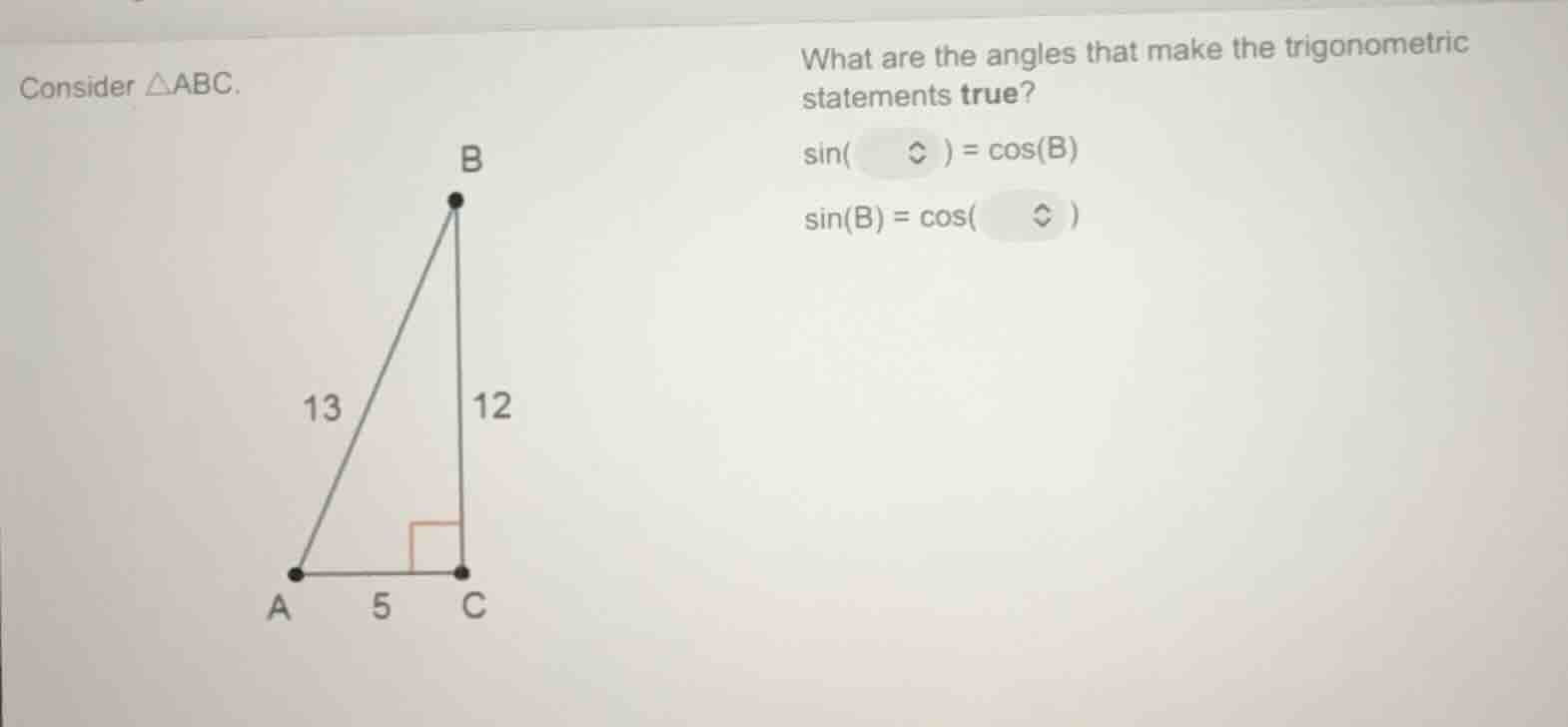
consider △abc.
what are the angles that make the trigonometric statements true?
sin( ) = cos(b)
sin(b) = cos( )
Step1: Recall co-function identity
In a right triangle, \(\sin(\theta)=\cos(90^\circ - \theta)\) (or \(\sin(A)=\cos(B)\) if \(A + B=90^\circ\) in right triangle). Here, \(\triangle ABC\) is right - angled at \(C\), so \(\angle A+\angle B = 90^\circ\) (since \(\angle C = 90^\circ\) and sum of angles in a triangle is \(180^\circ\)).
Step2: Solve \(\sin(\underline{?})=\cos(B)\)
Using the co - function identity \(\sin(x)=\cos(90^\circ - x)\) and \(\cos(B)=\sin(90^\circ - B)\). Since \(\angle A+\angle B=90^\circ\), \(90^\circ - B=\angle A\). So \(\sin(A)=\cos(B)\).
Step3: Solve \(\sin(B)=\cos(\underline{?})\)
Using the co - function identity \(\sin(B)=\cos(90^\circ - B)\). Since \(\angle A+\angle B = 90^\circ\), \(90^\circ - B=\angle A\)? Wait, no. Wait, \(\sin(B)=\cos(90^\circ - B)\), and since \(\angle A+\angle B=90^\circ\), \(90^\circ - B=\angle A\)? Wait, no, let's re - check. If \(\angle C = 90^\circ\), then \(\angle A+\angle B=90^\circ\), so \(90^\circ-\angle B=\angle A\) and \(90^\circ - \angle A=\angle B\). So \(\sin(B)=\cos(90^\circ - B)=\cos(A)\) (because \(90^\circ - B=\angle A\)). Wait, no: \(\sin(B)=\cos(90^\circ - B)\), and \(90^\circ - B=\angle A\) (since \(\angle A+\angle B = 90^\circ\)), so \(\sin(B)=\cos(A)\)? Wait, no, let's take the angles. Let's find the angles. In right triangle \(ABC\) with \(AC = 5\), \(BC = 12\), \(AB = 13\). So \(\angle C = 90^\circ\). Then \(\sin(B)=\frac{AC}{AB}=\frac{5}{13}\), and \(\cos(A)=\frac{AC}{AB}=\frac{5}{13}\). And \(\cos(A)=\sin(B)\). Also, \(\sin(A)=\frac{BC}{AB}=\frac{12}{13}\), \(\cos(B)=\frac{BC}{AB}=\frac{12}{13}\), so \(\sin(A)=\cos(B)\).
So for \(\sin(\underline{?})=\cos(B)\), the angle is \(A\). For \(\sin(B)=\cos(\underline{?})\), the angle is \(A\)? Wait, no, wait: \(\sin(B)=\cos(90^\circ - B)\), and \(90^\circ - B=\angle A\), so \(\sin(B)=\cos(A)\). Wait, let's verify with the sides. \(\sin(B)=\frac{AC}{AB}=\frac{5}{13}\), \(\cos(A)=\frac{AC}{AB}=\frac{5}{13}\), so yes, \(\sin(B)=\cos(A)\). And \(\sin(A)=\frac{BC}{AB}=\frac{12}{13}\), \(\cos(B)=\frac{BC}{AB}=\frac{12}{13}\), so \(\sin(A)=\cos(B)\).

Snap & solve any problem in the app
Get step-by-step solutions on Sovi AI
Photo-based solutions with guided steps
Explore more problems and detailed explanations
For \(\sin(\underline{?})=\cos(B)\), the angle is \(A\); for \(\sin(B)=\cos(\underline{?})\), the angle is \(A\)? Wait, no, wait the first blank: \(\sin(A)=\cos(B)\), the second blank: \(\sin(B)=\cos(A)\). Let's confirm with the co - function identity. In a right triangle, \(\sin(\theta)=\cos(90^\circ-\theta)\) where \(\theta\) and \(90^\circ - \theta\) are the two non - right angles. So if one angle is \(B\), the other non - right angle is \(A\) (since \(\angle C = 90^\circ\)). So \(\sin(A)=\cos(B)\) and \(\sin(B)=\cos(A)\).
So the first blank is \(A\) and the second blank is \(A\)? Wait, no, wait:
First equation: \(\sin(x)=\cos(B)\). Since \(\cos(B)=\sin(90^\circ - B)\) and \(90^\circ - B = A\) (because \(A + B=90^\circ\)), so \(x = A\).
Second equation: \(\sin(B)=\cos(y)\). Since \(\sin(B)=\cos(90^\circ - B)\) and \(90^\circ - B=A\), so \(y = A\)? Wait, no, \(\sin(B)=\cos(90^\circ - B)\), and \(90^\circ - B = A\), so \(\cos(A)=\sin(B)\). So the second blank is \(A\).
Wait, let's check with the sides. \(\cos(B)=\frac{BC}{AB}=\frac{12}{13}\), \(\sin(A)=\frac{BC}{AB}=\frac{12}{13}\), so \(\sin(A)=\cos(B)\). \(\sin(B)=\frac{AC}{AB}=\frac{5}{13}\), \(\cos(A)=\frac{AC}{AB}=\frac{5}{13}\), so \(\sin(B)=\cos(A)\).
So the first blank is \(A\) and the second blank is \(A\)? Wait, no, the first equation: \(\sin(\underline{A})=\cos(B)\), the second equation: \(\sin(B)=\cos(\underline{A})\).