QUESTION IMAGE
Question
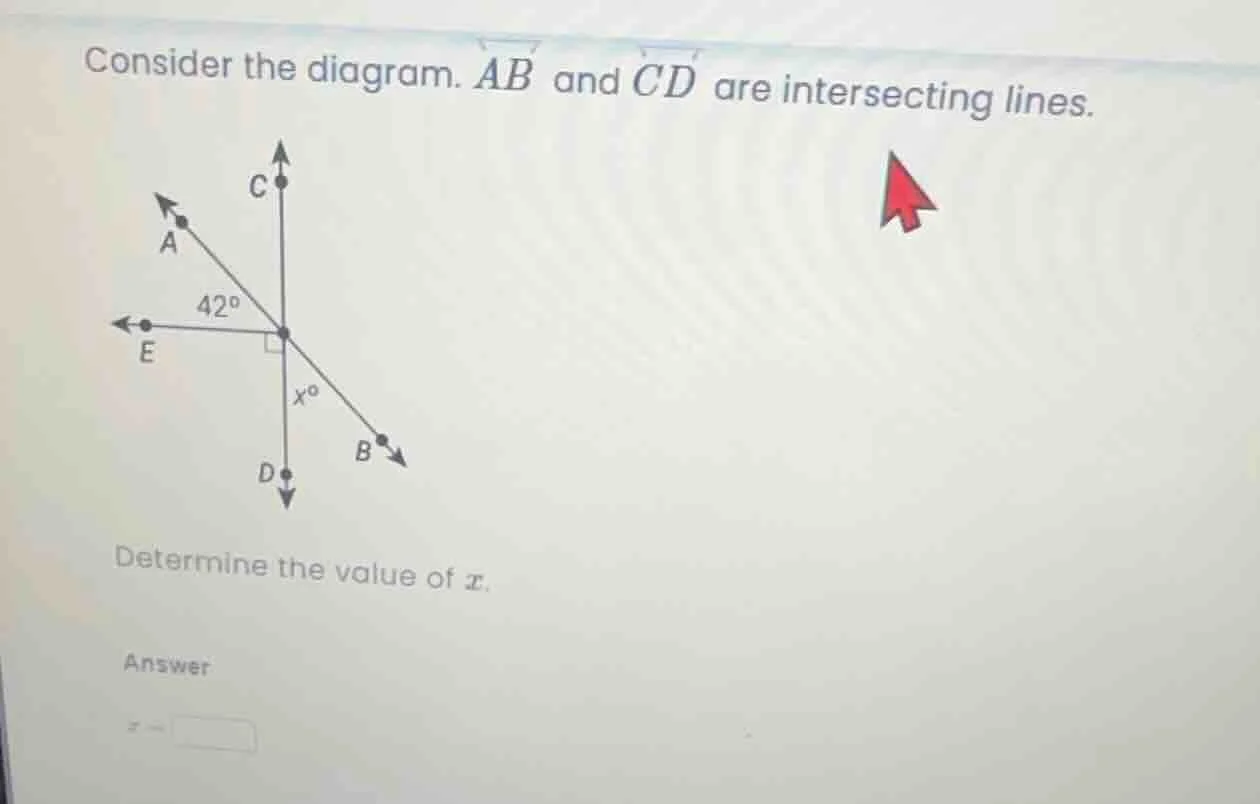
consider the diagram. $overleftrightarrow{ab}$ and $overleftrightarrow{cd}$ are intersecting lines.
determine the value of $x$.
answer
$x = \square$
Step1: Identify right angle and given angle
We see that \( \angle AOE = 42^\circ \) and \( \angle EOD = 90^\circ \) (right angle). The sum of angles on a straight line (or around the intersection) related to these should add up such that \( 42^\circ + 90^\circ + x^\circ = 180^\circ \)? Wait, no, actually, since \( AB \) and \( CD \) intersect, and \( OE \) is perpendicular to \( CD \) (right angle), so the angle between \( OE \) and \( OA \) is \( 42^\circ \), and the angle between \( OE \) and \( OD \) is \( 90^\circ \), so the angle \( x \) and \( 42^\circ \) and \( 90^\circ \) should sum to \( 180^\circ \)? Wait, no, let's think again. The line \( AB \) is a straight line, so the angles on one side of \( AB \) should sum to \( 180^\circ \). Wait, actually, \( OE \) is perpendicular to \( CD \), so \( \angle EOD = 90^\circ \). The angle between \( OA \) and \( OE \) is \( 42^\circ \), so the angle between \( OB \) and \( OD \) (which is \( x \)) can be found by \( 180^\circ - 90^\circ - 42^\circ \)? Wait, no, let's look at the right angle. Since \( OE \perp CD \), \( \angle EOC = 90^\circ \) and \( \angle EOD = 90^\circ \). The angle \( \angle AOE = 42^\circ \), so the angle \( \angle AOC = 90^\circ - 42^\circ = 48^\circ \), but maybe better: the sum of \( 42^\circ \), \( 90^\circ \), and \( x \) should be \( 180^\circ \) because they are on a straight line (AB). Wait, \( 42^\circ + 90^\circ + x = 180^\circ \). So solving for \( x \):
Step2: Solve for x
\( x = 180^\circ - 90^\circ - 42^\circ \)
\( x = 48^\circ \)
Wait, no, wait. Wait, the right angle is between \( OE \) and \( CD \), so \( OE \perp CD \), so \( \angle EOD = 90^\circ \). The angle \( \angle AOE = 42^\circ \), so the angle between \( OA \) and \( OD \) would be \( 42^\circ + 90^\circ \), but no, \( AB \) is a straight line, so the angles on \( AB \) at point \( O \) should sum to \( 180^\circ \). So \( \angle AOE + \angle EOD + \angle DOB = 180^\circ \). So \( 42^\circ + 90^\circ + x = 180^\circ \). Then \( x = 180 - 90 - 42 = 48 \). Wait, but maybe another way: since \( OE \) is perpendicular to \( CD \), the angle between \( OE \) and \( OD \) is \( 90^\circ \), and the angle between \( OE \) and \( OA \) is \( 42^\circ \), so the angle between \( OA \) and \( OD \) is \( 42 + 90 = 132^\circ \), but then \( x \) is supplementary to that? No, maybe I messed up. Wait, let's look at the diagram again. The line \( CD \) is vertical, \( OE \) is horizontal (left), so \( OE \) is perpendicular to \( CD \), so \( \angle EOD = 90^\circ \). The angle between \( OA \) and \( OE \) is \( 42^\circ \), so the angle between \( OA \) and \( OD \) is \( 42^\circ + 90^\circ = 132^\circ \). But \( AB \) is a straight line, so \( \angle AOD + \angle DOB = 180^\circ \), so \( \angle DOB = 180 - 132 = 48^\circ \). So \( x = 48 \).
Step1 (Correct approach):
We know that \( OE \perp CD \), so \( \angle EOD = 90^\circ \). The angles \( \angle AOE = 42^\circ \), \( \angle EOD = 90^\circ \), and \( \angle DOB = x^\circ \) lie on a straight line \( AB \), so their sum is \( 180^\circ \).
Step2:
So, \( 42^\circ + 90^\circ + x^\circ = 180^\circ \)
Subtract \( 42^\circ \) and \( 90^\circ \) from both sides:
\( x^\circ = 180^\circ - 42^\circ - 90^\circ \)
\( x^\circ = 48^\circ \)

Snap & solve any problem in the app
Get step-by-step solutions on Sovi AI
Photo-based solutions with guided steps
Explore more problems and detailed explanations
\( x = 48 \)