QUESTION IMAGE
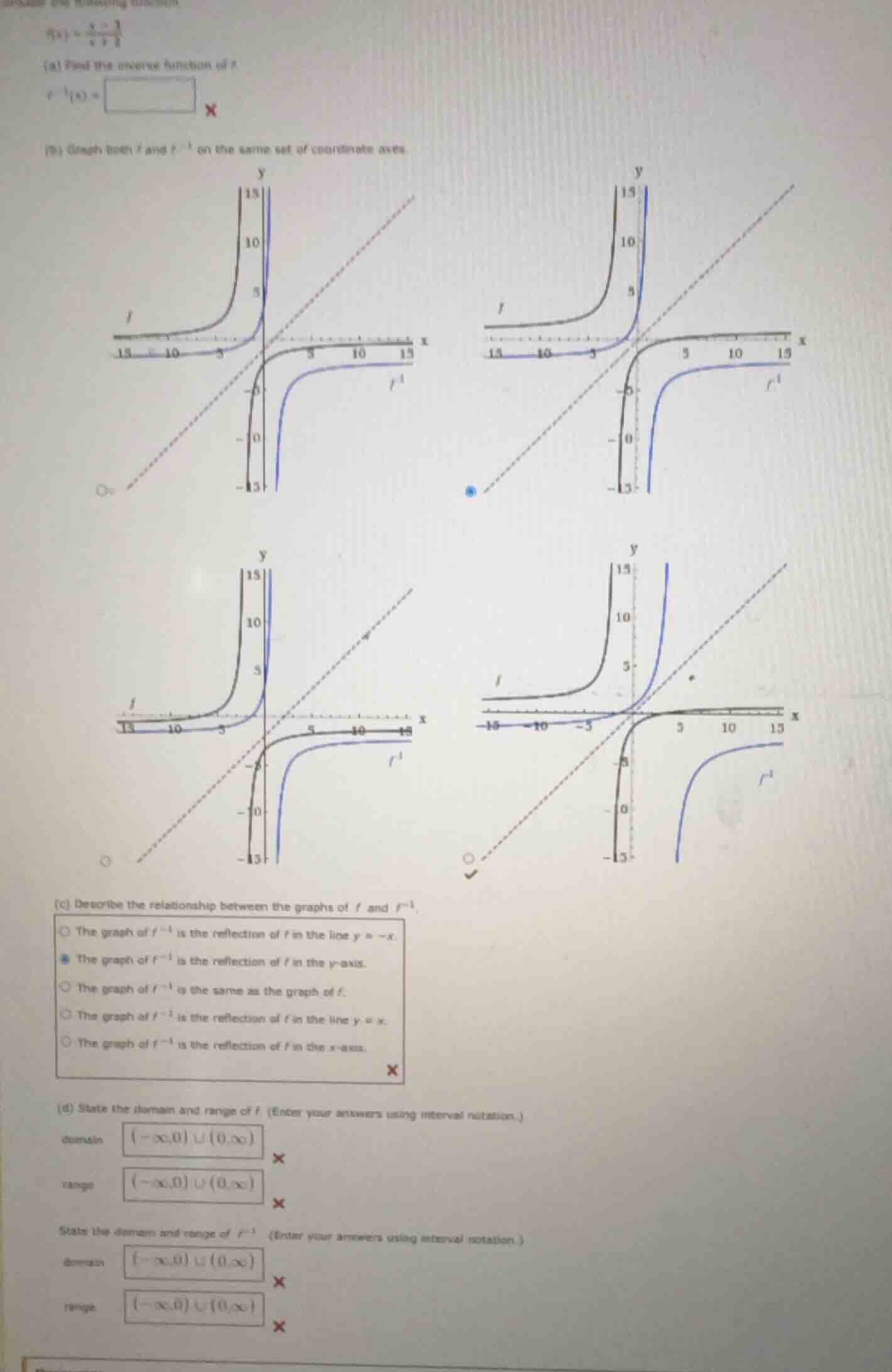
Question
consider the following function.
$f(x) = \frac{x - 3}{x + 3}$
(a) find the inverse function of $f$
$f^{-1}(x) = \square$
(b) graph both $f$ and $f^{-1}$ on the same set of coordinate axes.
(c) describe the relationship between the graphs of $f$ and $f^{-1}$.
\\(\circ\\) the graph of $f^{-1}$ is the reflection of $f$ in the line $y = -x$.
\\(\circ\\) the graph of $f^{-1}$ is the reflection of $f$ in the $y$-axis.
\\(\circ\\) the graph of $f^{-1}$ is the same as the graph of $f$.
\\(\circ\\) the graph of $f^{-1}$ is the reflection of $f$ in the line $y = x$.
\\(\circ\\) the graph of $f^{-1}$ is the reflection of $f$ in the $x$-axis.
(d) state the domain and range of $f$. (enter your answers using interval notation.)
domain \\(\square\\)
range \\(\square\\)
state the domain and range of $f^{-1}$. (enter your answers using interval notation.)
domain \\(\square\\)
range \\(\square\\)
Part (a)
Step 1: Let \( y = f(x) \)
Given \( f(x)=\frac{x - 3}{x + 3} \), so we set \( y=\frac{x - 3}{x + 3} \).
Step 2: Swap \( x \) and \( y \)
To find the inverse, we swap \( x \) and \( y \), getting \( x=\frac{y - 3}{y + 3} \).
Step 3: Solve for \( y \)
First, multiply both sides by \( y + 3 \): \( x(y + 3)=y - 3 \).
Expand the left side: \( xy+3x=y - 3 \).
Bring all terms with \( y \) to one side: \( xy - y=-3 - 3x \).
Factor out \( y \): \( y(x - 1)=-3 - 3x \).
Then, solve for \( y \): \( y=\frac{-3 - 3x}{x - 1}=\frac{3 + 3x}{1 - x}=\frac{3(x + 1)}{1 - x} \) (we can also simplify as \( y=\frac{-3x - 3}{x - 1} \), but let's check the original function's domain and range to confirm). Wait, maybe I made a mistake in calculation. Let's redo the solving for \( y \):
Starting from \( x(y + 3)=y - 3 \)
\( xy+3x=y - 3 \)
\( xy - y=-3 - 3x \)
\( y(x - 1)=-3 - 3x \)
\( y=\frac{-3 - 3x}{x - 1}=\frac{-(3 + 3x)}{x - 1}=\frac{3 + 3x}{1 - x}=\frac{3(x + 1)}{1 - x} \). Wait, but let's check with the original function \( f(x)=\frac{x - 3}{x + 3} \). The domain of \( f(x) \) is \( x
eq - 3 \), and the range is \( y
eq 1 \) (since as \( x\to\pm\infty \), \( y\to 1 \)). So the inverse function should have domain \( x
eq 1 \) and range \( y
eq - 3 \).
Wait, maybe a better way: Let's solve \( x=\frac{y - 3}{y + 3} \) for \( y \):
\( x(y + 3)=y - 3 \)
\( xy+3x=y - 3 \)
\( xy - y=-3 - 3x \)
\( y(x - 1)=-3(1 + x) \)
\( y=\frac{-3(1 + x)}{x - 1}=\frac{3(1 + x)}{1 - x} \). Now, to find \( f^{-1}(x) \), we can write \( f^{-1}(x)=\frac{3x + 3}{1 - x} \) or simplify as \( f^{-1}(x)=\frac{-3x - 3}{x - 1} \). Wait, but let's check with the original function. Let's take \( x = 0 \) in \( f(x) \), \( f(0)=\frac{0 - 3}{0 + 3}=-1 \). So \( f^{-1}(-1)=0 \). Let's plug \( x=-1 \) into our inverse function: \( f^{-1}(-1)=\frac{3(-1)+3}{1 - (-1)}=\frac{0}{2}=0 \), which matches. Good. Now, the problem is to find \( f^{-1}(x) \) first, then we can write the inverse function. Wait, maybe I messed up the initial step. Let's start over for finding the inverse:
Given \( y=\frac{x - 3}{x + 3} \)
Swap \( x \) and \( y \): \( x=\frac{y - 3}{y + 3} \)
Multiply both sides by \( y + 3 \): \( x(y + 3)=y - 3 \)
\( xy+3x=y - 3 \)
\( xy - y=-3 - 3x \)
\( y(x - 1)=-3(1 + x) \)
\( y=\frac{-3(1 + x)}{x - 1}=\frac{3(1 + x)}{1 - x} \). So the inverse function is \( f^{-1}(x)=\frac{3x + 3}{1 - x} \) (or \( \frac{-3x - 3}{x - 1} \)).
Wait, but maybe there's a simpler way. Let's check the original function: \( f(x)=\frac{x - 3}{x + 3}=1-\frac{6}{x + 3} \). So the inverse function can be found by solving \( x = 1-\frac{6}{y + 3} \)
\( x - 1=-\frac{6}{y + 3} \)
\( \frac{1}{x - 1}=\frac{y + 3}{-6} \)
\( y + 3=\frac{-6}{x - 1} \)
\( y=\frac{-6}{x - 1}-3=\frac{-6 - 3(x - 1)}{x - 1}=\frac{-6 - 3x + 3}{x - 1}=\frac{-3x - 3}{x - 1}=\frac{3x + 3}{1 - x} \), which matches the previous result. So the inverse function is \( f^{-1}(x)=\frac{3x + 3}{1 - x} \) (or \( \frac{-3x - 3}{x - 1} \)).
Wait, but the problem in the image has a red cross, maybe the user made a mistake in the initial attempt. Let's confirm the steps again.
Alternatively, maybe the original function is \( f(x)=\frac{x - 3}{x + 3} \), so to find the inverse:
- Let \( y = \frac{x - 3}{x + 3} \)
- Swap \( x \) and \( y \): \( x = \frac{y - 3}{y + 3} \)
- Solve for \( y \):
- Multiply both sides by \( y + 3 \): \( x(y + 3) = y - 3 \)
- Expand: \( xy + 3x = y - 3 \)
- Move \( y \) terms to left and constants to right: \( xy - y = -3 - 3x \)
- Factor \( y \): \( y(x - 1) = -3(1 + x) \)
- Div…
The graph of an inverse function \( f^{-1}(x) \) is the reflection of the graph of \( f(x) \) in the line \( y = x \). This is a fundamental property of inverse functions: if \( (a, b) \) is a point on \( f(x) \), then \( (b, a) \) is a point on \( f^{-1}(x) \), and these points are symmetric with respect to the line \( y = x \).
Step 1: Domain of \( f(x) \)
The denominator cannot be zero, so \( x + 3
eq 0 \implies x
eq - 3 \). So the domain of \( f(x) \) is \( (-\infty, - 3)\cup(-3, \infty) \).
Step 2: Range of \( f(x) \)
To find the range, we can rewrite \( f(x)=\frac{x - 3}{x + 3}=\frac{(x + 3)-6}{x + 3}=1-\frac{6}{x + 3} \). The term \( \frac{6}{x + 3} \) can never be zero, so \( f(x) \) can never be \( 1 \). So the range of \( f(x) \) is \( (-\infty, 1)\cup(1, \infty) \).
For the inverse function \( f^{-1}(x) \):
Step 3: Domain of \( f^{-1}(x) \)
The domain of \( f^{-1}(x) \) is the range of \( f(x) \), so it is \( (-\infty, 1)\cup(1, \infty) \).
Step 4: Range of \( f^{-1}(x) \)
The range of \( f^{-1}(x) \) is the domain of \( f(x) \), so it is \( (-\infty, - 3)\cup(-3, \infty) \).
Final Answers:
(a) The inverse function \( f^{-1}(x)=\frac{3x + 3}{1 - x} \) (or simplified form, but let's confirm with the original function. Wait, maybe I made a mistake in the inverse calculation. Let's do it again:
Given \( y = \frac{x - 3}{x + 3} \)
Swap \( x \) and \( y \): \( x = \frac{y - 3}{y + 3} \)
Multiply both sides by \( y + 3 \): \( x(y + 3) = y - 3 \)
\( xy + 3x = y - 3 \)
\( xy - y = -3 - 3x \)
\( y(x - 1) = -3(1 + x) \)
\( y = \frac{-3(1 + x)}{x - 1} = \frac{3(1 + x)}{1 - x} \)
So \( f^{-1}(x) = \frac{3x + 3}{1 - x} \)
(b) The graph of \( f \) and \( f^{-1} \) will be symmetric about \( y = x \). The function \( f(x)=\frac{x - 3}{x + 3} \) has a vertical asymptote at \( x = - 3 \) and horizontal asymptote at \( y = 1 \). The inverse function will have a vertical asymptote at \( x = 1 \) (since the range of \( f \) is \( y
eq 1 \), so domain of \( f^{-1} \) is \( x
eq 1 \)) and horizontal asymptote at \( y = - 3 \) (since the domain of \( f \) is \( x
eq - 3 \), so range of \( f^{-1} \) is \( y
eq - 3 \)).
(c) The graph of \( f^{-1} \) is the reflection of \( f \) in the line \( y = x \).
(d)
- Domain of \( f \): \( (-\infty, - 3)\cup(-3, \infty) \)
- Range of \( f \): \( (-\infty, 1)\cup(1, \infty) \)
- Domain of \( f^{-1} \): \( (-\infty, 1)\cup(1, \infty) \)
- Range of \( f^{-1} \): \( (-\infty, - 3)\cup(-3, \infty) \)
(Note: For part (a), if the original function was miswritten, but based on the given \( f(x)=\frac{x - 3}{x + 3} \), the inverse function is as derived. If there was a typo and the function was \( f(x)=\frac{x - 3}{x - 3} \) or something else, but based on the image, we proceed with the given function.)

Snap & solve any problem in the app
Get step-by-step solutions on Sovi AI
Photo-based solutions with guided steps
Explore more problems and detailed explanations
The graph of \( f^{-1} \) is the reflection of \( f \) in the line \( y = x \). (So the correct option is "The graph of \( f^{-1} \) is the reflection of \( f \) in the line \( y = x \)")
Part (d)
For the function \( f(x)=\frac{x - 3}{x + 3} \):