QUESTION IMAGE
Question
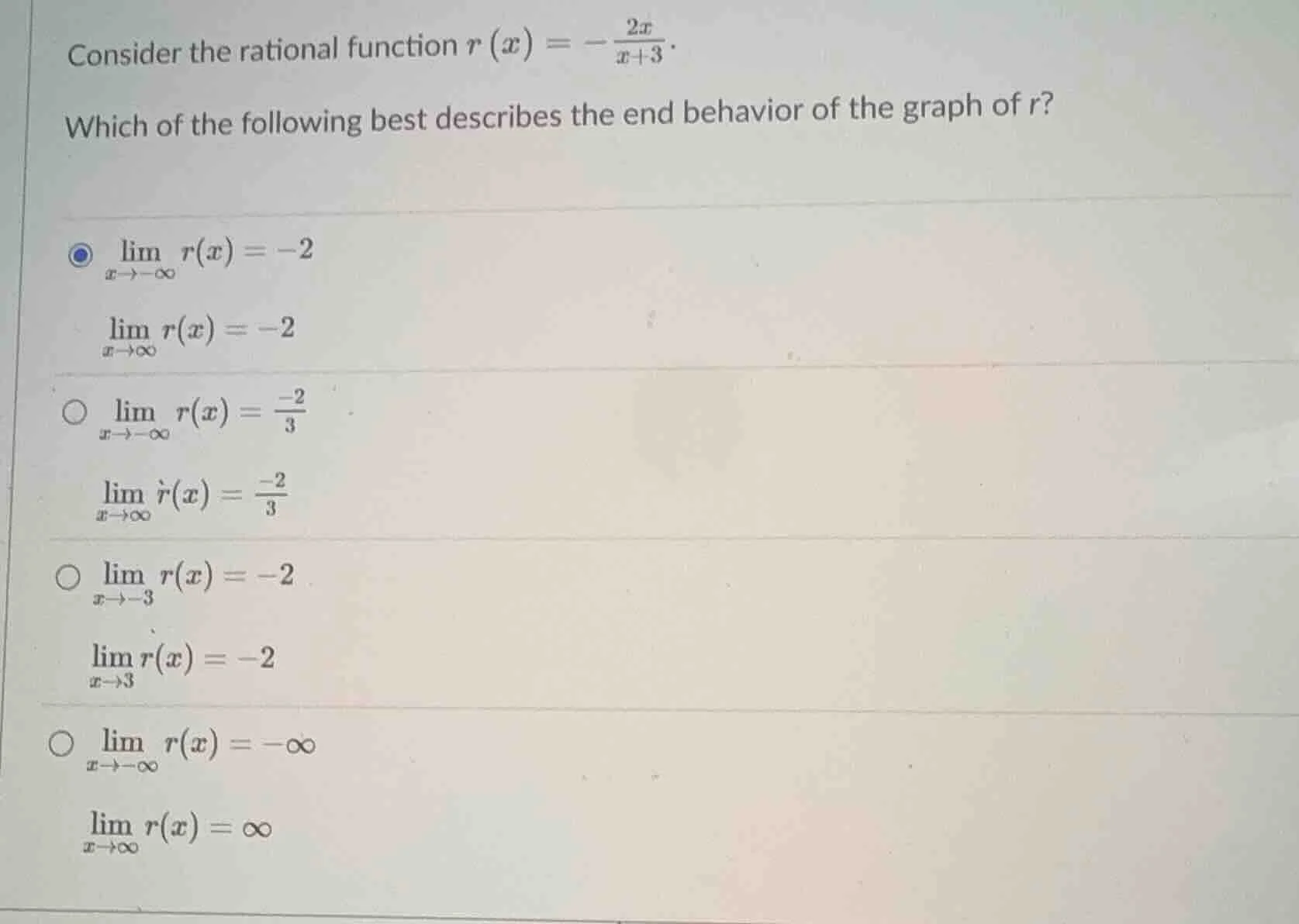
consider the rational function $r(x)=-\frac{2x}{x + 3}$. which of the following best describes the end behavior of the graph of $r$? \\(\boldsymbol{\circ\\ \lim\limits_{x\to -\infty}r(x)=-2}\\\\ \\ \\ \\ \\ \lim\limits_{x\to\infty}r(x)=-2\\\\ \circ\\ \lim\limits_{x\to -\infty}r(x)=\frac{-2}{3}\\\\ \\ \\ \\ \\ \lim\limits_{x\to\infty}\dot{r}(x)=\frac{-2}{3}\\\\ \circ\\ \lim\limits_{x\to -3}r(x)=-2\\\\ \\ \\ \\ \\ \lim\limits_{x\to 3}r(x)=-2\\\\ \circ\\ \lim\limits_{x\to -\infty}r(x)=-\infty\\\\ \\ \\ \\ \\ \lim\limits_{x\to\infty}r(x)=\infty\\)
Step1: Identify degree of numerator/denominator
Both numerator $-2x$ and denominator $x+3$ have degree 1.
Step2: Apply horizontal asymptote rule
For rational functions $\frac{ax^n+...}{bx^n+...}$, $\lim_{x\to\pm\infty} r(x)=\frac{a}{b}$. Here $a=-2$, $b=1$.
$\lim_{x\to-\infty} r(x)=\frac{-2}{1}=-2$
$\lim_{x\to\infty} r(x)=\frac{-2}{1}=-2$
Step3: Eliminate incorrect options
Options 2 uses wrong ratio, 3 focuses on vertical asymptote, 4 has incorrect infinite limits.

Snap & solve any problem in the app
Get step-by-step solutions on Sovi AI
Photo-based solutions with guided steps
Explore more problems and detailed explanations
$\boldsymbol{\lim_{x\to-\infty} r(x) = -2}$
$\boldsymbol{\lim_{x\to\infty} r(x) = -2}$