QUESTION IMAGE
Question
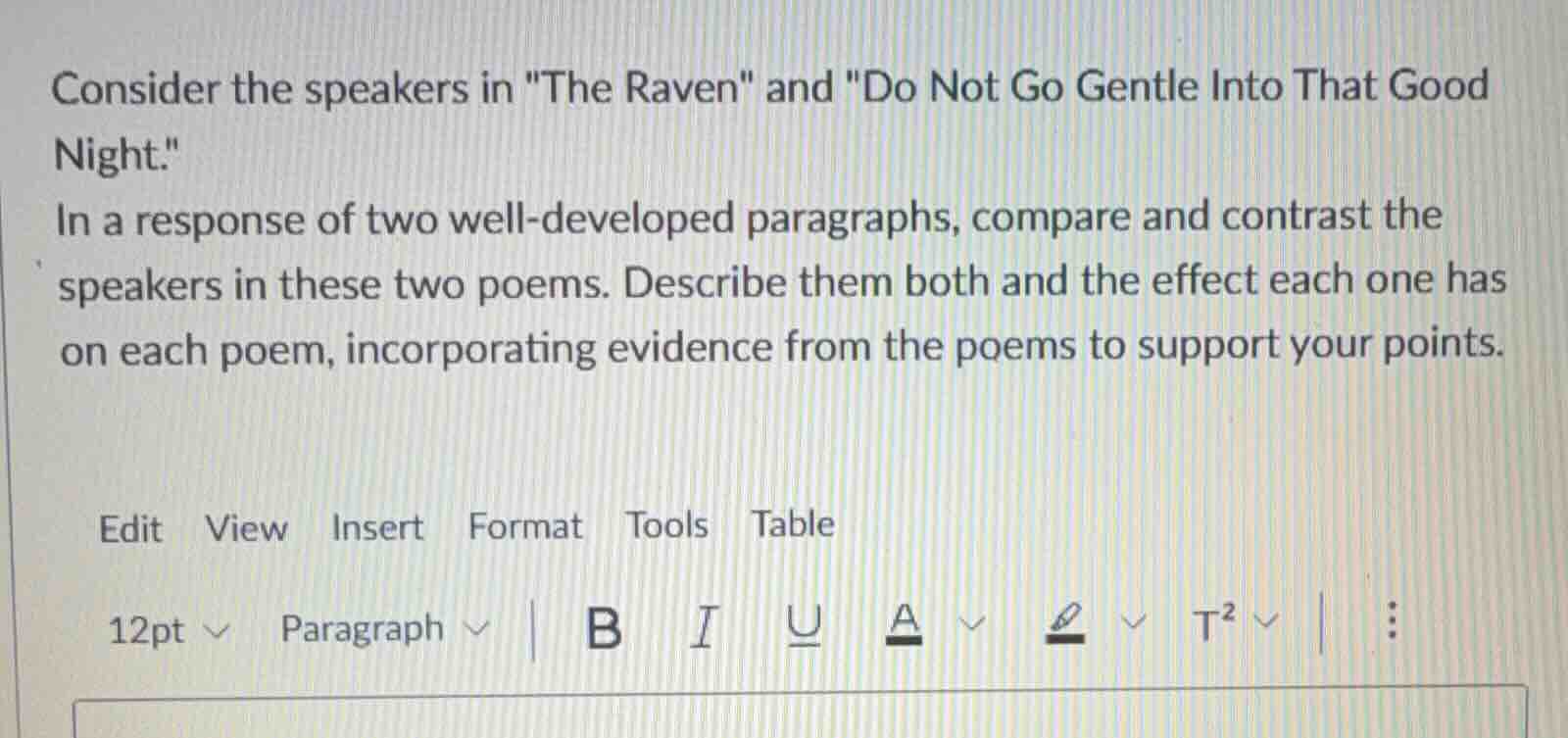
consider the speakers in \the raven\ and \do not go gentle into that good night.\
in a response of two well-developed paragraphs, compare and contrast the speakers in these two poems. describe them both and the effect each one has on each poem, incorporating evidence from the poems to support your points.
The speaker in Edgar Allan Poe’s The Raven is a grieving scholar, isolated in his study as he mourns the loss of Lenore. His descent into obsessive despair is driven by the raven’s repetitive "Nevermore," which amplifies the poem’s atmosphere of existential hopelessness; when he begs, "Tell this soul with sorrow laden if, within the distant Aidenn, / It shall clasp a sainted maiden whom the angels name Lenore?" the raven’s unyielding reply traps him in permanent grief, framing the poem as a study in unrelenting psychological torment. In contrast, the speaker in Dylan Thomas’s Do Not Go Gentle Into That Good Night is a passionate, urgent son addressing his dying father, urging resistance against death. His fiery, repetitive pleas—"Do not go gentle into that good night / Rage, rage against the dying of the light"—infuse the poem with fierce, defiant energy, and he draws on examples of "wise men," "good men," and "wild men" who all fight against death, positioning the poem as a rallying cry for clinging to life’s spark.
While both speakers grapple with loss and mortality, their tones and effects on their poems are starkly different. The Raven speaker is passive and unraveling, his vulnerability turning the poem into a claustrophobic exploration of unresolvable grief; his willingness to engage with the raven, even as it crushes his last hope, emphasizes the inescapability of his pain. The speaker in Do Not Go Gentle Into That Good Night is active and combative, his urgency transforming the poem into a visceral celebration of life’s tenacity; his direct address to his father creates an intimate, emotional call to action, making the poem’s message about resisting despair feel personal and universal.

Snap & solve any problem in the app
Get step-by-step solutions on Sovi AI
Photo-based solutions with guided steps
Explore more problems and detailed explanations
The speaker in The Raven is a grief-stricken, isolated scholar trapped in unrelenting despair, whose passive unraveling amplifies the poem’s atmosphere of claustrophobic, hopeless grief. For example, his desperate question about reuniting with Lenore, met with the raven’s cold "Nevermore," cements his permanent entrapment in sorrow, framing the poem as a study in psychological torment. In contrast, the speaker in Do Not Go Gentle Into That Good Night is a fiery, urgent son addressing his dying father, whose active defiance infuses the poem with a visceral, rallying energy. His repetitive cries to "rage against the dying of the light," paired with his references to wise, good, and wild men fighting death, turn the poem into an intimate, universal call to cling to life’s spark.
Though both speakers confront mortality, their tones and impacts diverge sharply. The Raven speaker’s vulnerability and passivity make the poem a meditation on inescapable grief; his willingness to engage with the raven, even as it destroys his last hope, underscores the futility of his struggle. The speaker in Thomas’s poem, by contrast, is combative and purpose-driven, his direct address creating an emotional, personal plea that transforms the work from a meditation on death to a celebration of life’s tenacity. Where the Raven speaker succumbs to despair, the other demands resistance, resulting in two poems that explore loss through opposing lenses of surrender and defiance.