QUESTION IMAGE
Question
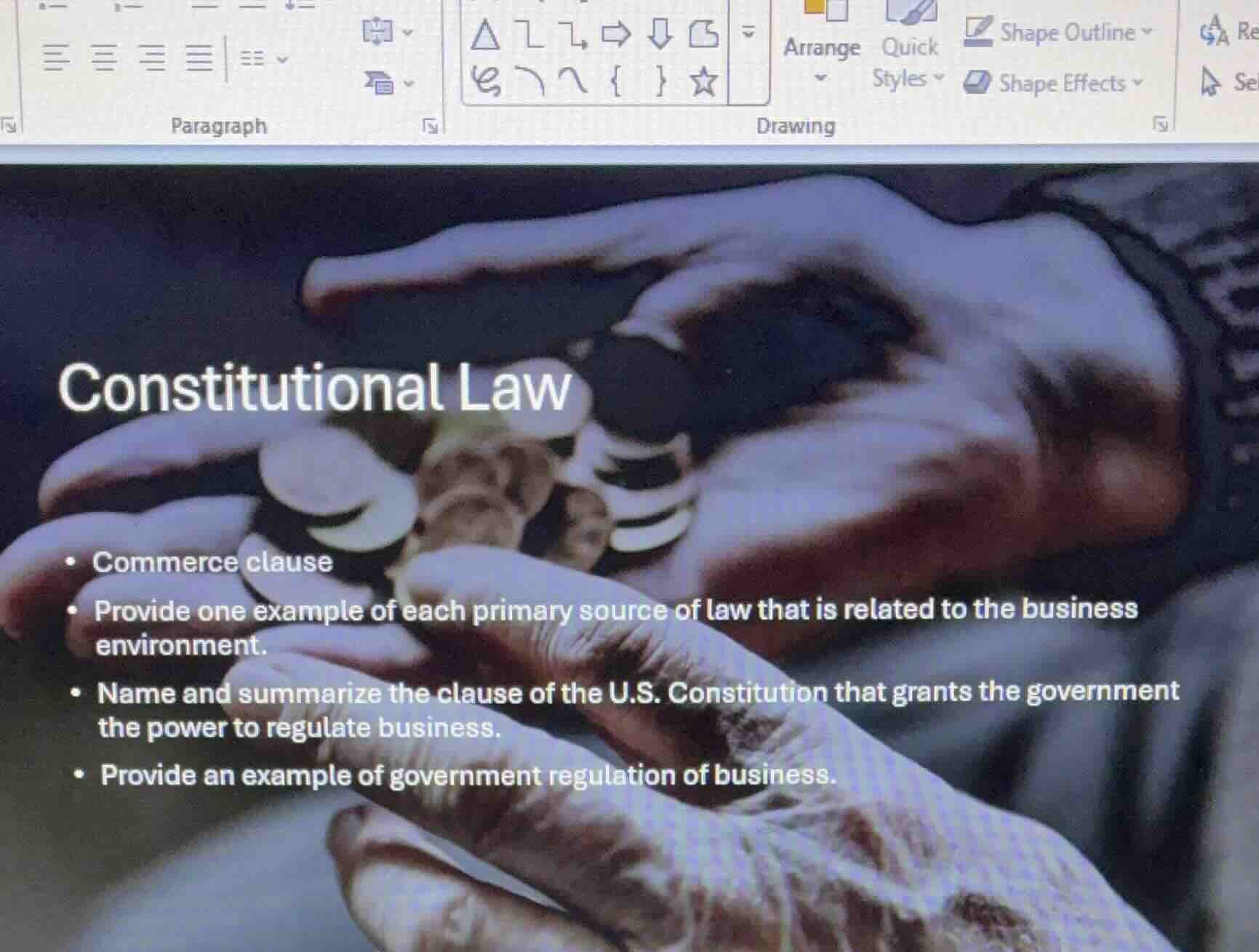
constitutional law
- commerce clause
- provide one example of each primary source of law that is related to the business environment.
- name and summarize the clause of the u.s. constitution that grants the government the power to regulate business.
- provide an example of government regulation of business.
Response
1. Primary Sources of Law in Business Environment (Examples)
- Constitutional Law: The Commerce Clause (Article I, Section 8, Clause 3 of the U.S. Constitution) is a primary source. It gives Congress the power to regulate interstate and foreign commerce, which impacts business activities across state lines (e.g., regulating the transportation of goods between states).
- Statutory Law: The Sherman Antitrust Act (1890) is a federal statute. It prohibits monopolistic business practices and agreements that restrain trade, like price - fixing cartels, to promote fair competition in the business environment.
- Administrative Law: Regulations from the Federal Trade Commission (FTC) are administrative laws. For example, the FTC's regulations on truth - in - advertising require businesses to be honest in their marketing communications, such as not making false claims about a product's effectiveness.
- Case Law (Common Law): Dred Scott v. Sandford (1857) is a historic case, but a more business - relevant example is United States v. Microsoft Corporation (2001). In this case, the court ruled on issues of monopolistic behavior in the software market, and such case law helps shape how businesses operate in terms of competition.
2. Clause Granting Government Power to Regulate Business (Commerce Clause)
- Name: Commerce Clause (Article I, Section 8, Clause 3 of the U.S. Constitution)
- Summary: The Commerce Clause gives the United States Congress the authority “To regulate Commerce with foreign Nations, and among the several States, and with the Indian Tribes.” This power allows the government to regulate business activities that involve interstate or international trade. For instance, it can set rules for the transportation of goods across state borders, regulate international trade agreements, and oversee industries that operate in multiple states (like the airline industry, which operates across state lines and is subject to federal regulation under the Commerce Clause).
3. Example of Government Regulation of Business
- One example is environmental regulation, such as the Clean Air Act. The Clean Air Act is administered by the Environmental Protection Agency (EPA). It sets standards for air quality and regulates emissions from businesses. For example, manufacturing plants that emit pollutants like sulfur dioxide or particulate matter must install pollution - control equipment and meet specific emission limits. This regulation affects how businesses operate, as they need to invest in technology to comply with the air quality standards, and it also influences production costs and business strategies related to environmental sustainability. Another example is the regulation of the financial industry by the Securities and Exchange Commission (SEC). The SEC requires publicly - traded companies to disclose financial information in a timely and accurate manner, such as filing quarterly and annual reports. This helps protect investors and ensures the integrity of the financial markets, but it also imposes compliance costs on businesses, as they need to maintain proper accounting systems and hire professionals to prepare and audit these reports.

Snap & solve any problem in the app
Get step-by-step solutions on Sovi AI
Photo-based solutions with guided steps
Explore more problems and detailed explanations
1. Primary Sources of Law in Business Environment (Examples)
- Constitutional Law: The Commerce Clause (Article I, Section 8, Clause 3 of the U.S. Constitution) is a primary source. It gives Congress the power to regulate interstate and foreign commerce, which impacts business activities across state lines (e.g., regulating the transportation of goods between states).
- Statutory Law: The Sherman Antitrust Act (1890) is a federal statute. It prohibits monopolistic business practices and agreements that restrain trade, like price - fixing cartels, to promote fair competition in the business environment.
- Administrative Law: Regulations from the Federal Trade Commission (FTC) are administrative laws. For example, the FTC's regulations on truth - in - advertising require businesses to be honest in their marketing communications, such as not making false claims about a product's effectiveness.
- Case Law (Common Law): Dred Scott v. Sandford (1857) is a historic case, but a more business - relevant example is United States v. Microsoft Corporation (2001). In this case, the court ruled on issues of monopolistic behavior in the software market, and such case law helps shape how businesses operate in terms of competition.
2. Clause Granting Government Power to Regulate Business (Commerce Clause)
- Name: Commerce Clause (Article I, Section 8, Clause 3 of the U.S. Constitution)
- Summary: The Commerce Clause gives the United States Congress the authority “To regulate Commerce with foreign Nations, and among the several States, and with the Indian Tribes.” This power allows the government to regulate business activities that involve interstate or international trade. For instance, it can set rules for the transportation of goods across state borders, regulate international trade agreements, and oversee industries that operate in multiple states (like the airline industry, which operates across state lines and is subject to federal regulation under the Commerce Clause).
3. Example of Government Regulation of Business
- One example is environmental regulation, such as the Clean Air Act. The Clean Air Act is administered by the Environmental Protection Agency (EPA). It sets standards for air quality and regulates emissions from businesses. For example, manufacturing plants that emit pollutants like sulfur dioxide or particulate matter must install pollution - control equipment and meet specific emission limits. This regulation affects how businesses operate, as they need to invest in technology to comply with the air quality standards, and it also influences production costs and business strategies related to environmental sustainability. Another example is the regulation of the financial industry by the Securities and Exchange Commission (SEC). The SEC requires publicly - traded companies to disclose financial information in a timely and accurate manner, such as filing quarterly and annual reports. This helps protect investors and ensures the integrity of the financial markets, but it also imposes compliance costs on businesses, as they need to maintain proper accounting systems and hire professionals to prepare and audit these reports.