QUESTION IMAGE
Question
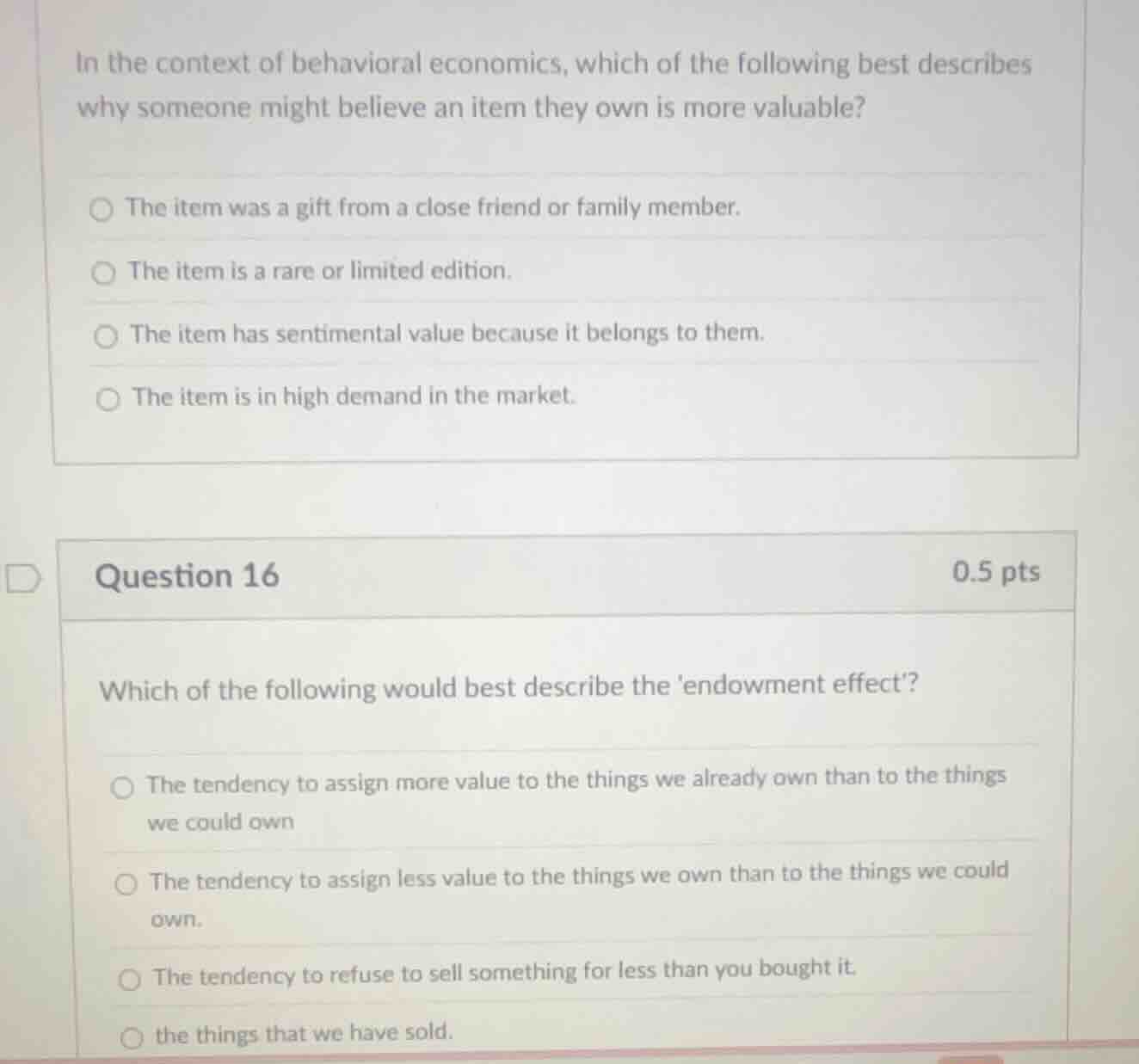
in the context of behavioral economics, which of the following best describes why someone might believe an item they own is more valuable?
the item was a gift from a close friend or family member.
the item is a rare or limited edition.
the item has sentimental value because it belongs to them.
the item is in high demand in the market.
question 16 0.5 pts
which of the following would best describe the endowment effect?
the tendency to assign more value to the things we already own than to the things we could own
the tendency to assign less value to the things we own than to the things we could own.
the tendency to refuse to sell something for less than you bought it.
the things that we have sold.
First Question (Behavioral Economics - Why own item is more valuable)
In behavioral economics, the endowment effect (related to this) or sentimental value from ownership is key. The option "The item has sentimental value because it belongs to them" ties to how ownership creates perceived value (endowment effect - assigning more value to owned items). Other options: gift source (not about ownership - value from gifting, not ownership), rare/limited (market rarity, not ownership -driven), high demand (market demand, not ownership). So the correct option is about ownership -driven sentimental/value assignment.
The endowment effect is defined as the tendency to value owned items more than non - owned (potential) items. The first option "The tendency to assign more value to the things we already own than to the things we could own" matches this definition. The second option is the opposite. The third option is about loss aversion/price anchoring (not endowment effect). The last option is unclear and incorrect.

Snap & solve any problem in the app
Get step-by-step solutions on Sovi AI
Photo-based solutions with guided steps
Explore more problems and detailed explanations
The item has sentimental value because it belongs to them.