QUESTION IMAGE
Question
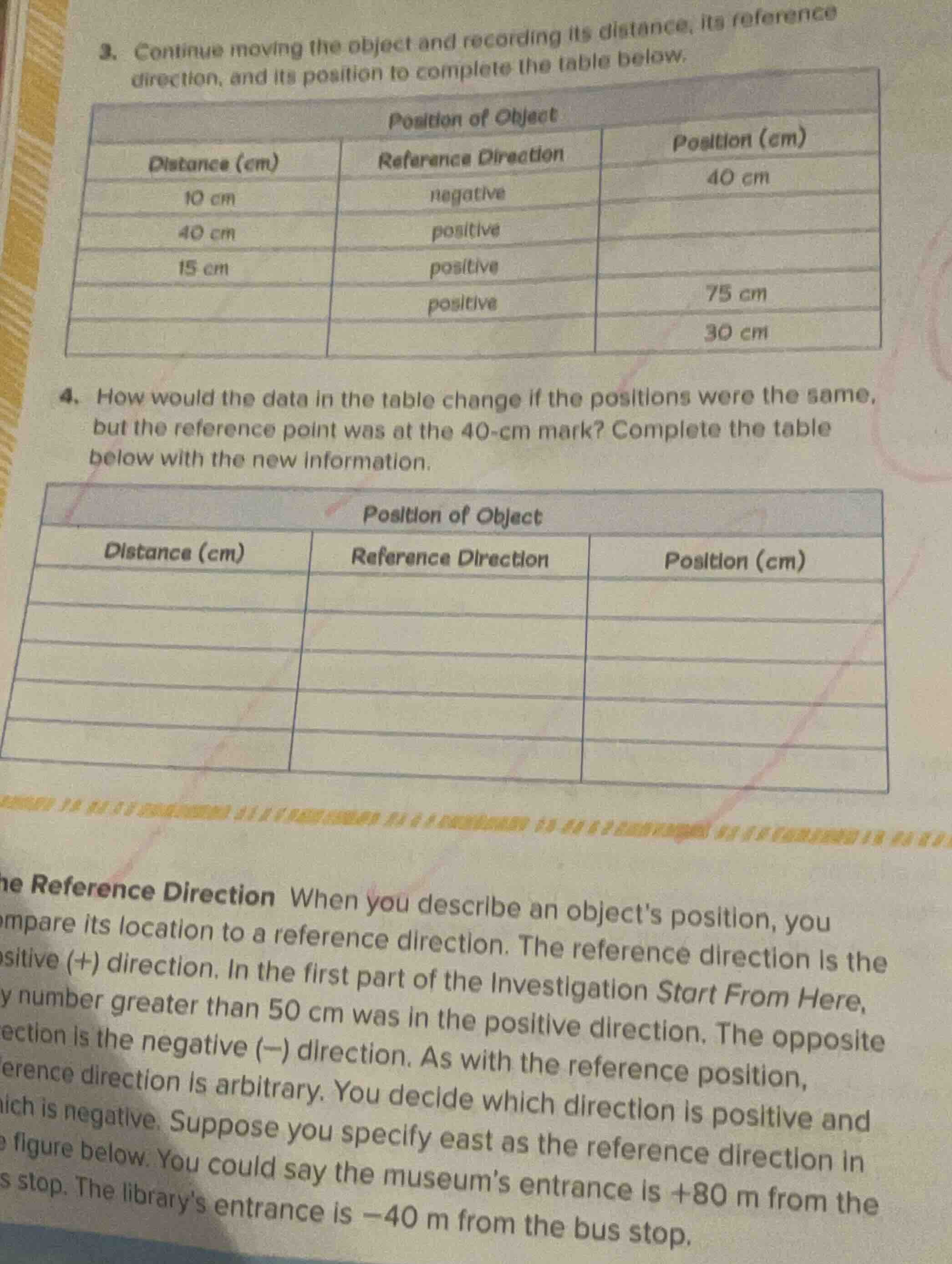
- continue moving the object and recording its distance, its reference direction, and its position to complete the table below.
position of object
| distance (cm) | reference direction | position (cm) |
|---|---|---|
| 40 cm | positive | |
| 15 cm | positive | |
| positive | 75 cm | |
| 30 cm |
- how would the data in the table change if the positions were the same, but the reference point was at the 40 - cm mark? complete the table below with the new information.
position of object
| distance (cm) | reference direction | position (cm) |
|---|---|---|
the reference direction when you describe an objects position, you compare its location to a reference direction. the reference direction is the positive (+) direction. in the first part of the investigation start from here, any number greater than 50 cm was in the positive direction. the opposite direction is the negative (–) direction. as with the reference position, the reference direction is arbitrary. you decide which direction is positive and which is negative. suppose you specify east as the reference direction in the figure below. you could say the museums entrance is +80 m from the bus stop. the librarys entrance is –40 m from the bus stop.
Step1: Find initial reference point
First, use the first row of the first table: moving 10 cm negative from the initial reference point gives position 40 cm. Let initial reference point be $x_0$.
$x_0 - 10 = 40$
Solve for $x_0$: $x_0 = 40 + 10 = 50$ cm
Step2: Complete first table
Row2: 40 cm positive from 50 cm
$50 + 40 = 90$ cm
Row3:15 cm positive from 50 cm
$50 + 15 = 65$ cm
Row4: Position 75 cm, find distance
$75 - 50 = 25$ cm
Row5: Position 30 cm, find distance/direction
$30 - 50 = -20$ cm, so distance 20 cm, negative direction
Step3: Calculate new positions (ref at 40 cm)
New position = original position - 40 cm. Distance is absolute value of (new position), direction is positive if new position >0, negative if <0.
Row1: Original pos 40 cm
New position: $40 - 40 = 0$ cm; distance 0 cm, no direction
Row2: Original pos 90 cm
New position: $90 - 40 = 50$ cm; distance 50 cm, positive
Row3: Original pos 65 cm
New position: $65 - 40 = 25$ cm; distance 25 cm, positive
Row4: Original pos75 cm
New position: $75 - 40 = 35$ cm; distance35 cm, positive
Row5: Original pos30 cm
New position: $30 - 40 = -10$ cm; distance10 cm, negative

Snap & solve any problem in the app
Get step-by-step solutions on Sovi AI
Photo-based solutions with guided steps
Explore more problems and detailed explanations
Completed Table 3:
| Distance (cm) | Reference Direction | Position (cm) |
|---|---|---|
| 40 cm | positive | 90 cm |
| 15 cm | positive | 65 cm |
| 25 cm | positive | 75 cm |
| 20 cm | negative | 30 cm |
Completed Table 4:
| Distance (cm) | Reference Direction | Position (cm) |
|---|---|---|
| 50 cm | positive | 50 cm |
| 25 cm | positive | 25 cm |
| 35 cm | positive | 35 cm |
| 10 cm | negative | -10 cm |