QUESTION IMAGE
Question
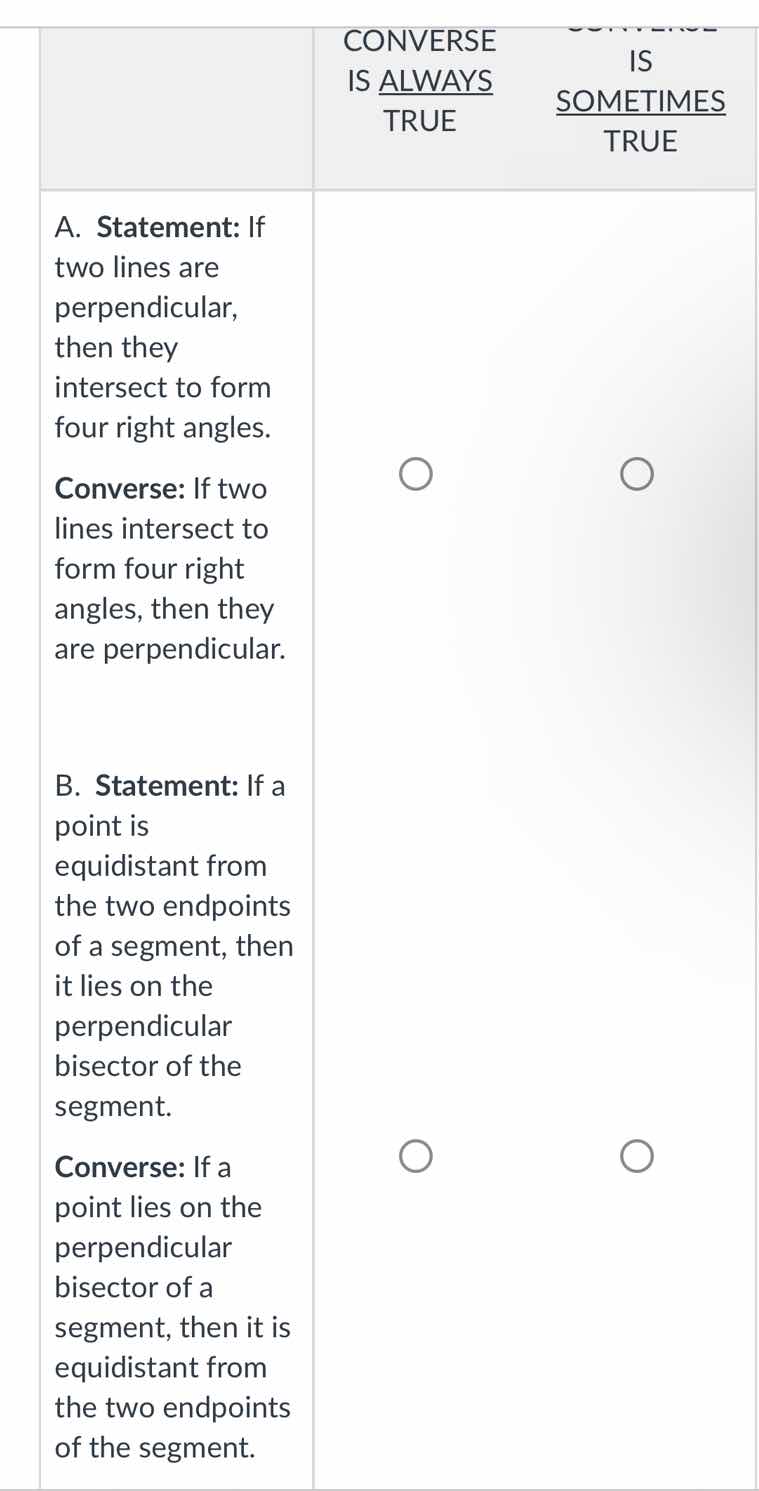
converse is always true converse is sometimes true a. statement: if two lines are perpendicular, then they intersect to form four right angles. converse: if two lines intersect to form four right angles, then they are perpendicular. b. statement: if a point is equidistant from the two endpoints of a segment, then it lies on the perpendicular bisector of the segment. converse: if a point lies on the perpendicular bisector of a segment, then it is equidistant from the two endpoints of the segment.
For Option A:
The original statement defines perpendicular lines as those forming four right angles when intersecting. The converse states that if two lines form four right angles upon intersection, they are perpendicular. By the definition of perpendicular lines (lines that intersect at 90° angles, and four right angles mean each angle is 90°), this converse is always true because forming four right angles is the defining characteristic of perpendicular intersection.
For Option B:
The original statement is about a point equidistant from segment endpoints lying on the perpendicular bisector. The converse says a point on the perpendicular bisector is equidistant from the endpoints. By the theorem of perpendicular bisectors (any point on the perpendicular bisector of a segment is equidistant from the segment’s endpoints), this converse is a proven theorem, so it is always true.

Snap & solve any problem in the app
Get step-by-step solutions on Sovi AI
Photo-based solutions with guided steps
Explore more problems and detailed explanations
For both A and B, the "CONVERSE IS ALWAYS TRUE" option is correct. So:
A. CONVERSE IS ALWAYS TRUE
B. CONVERSE IS ALWAYS TRUE