QUESTION IMAGE
Question
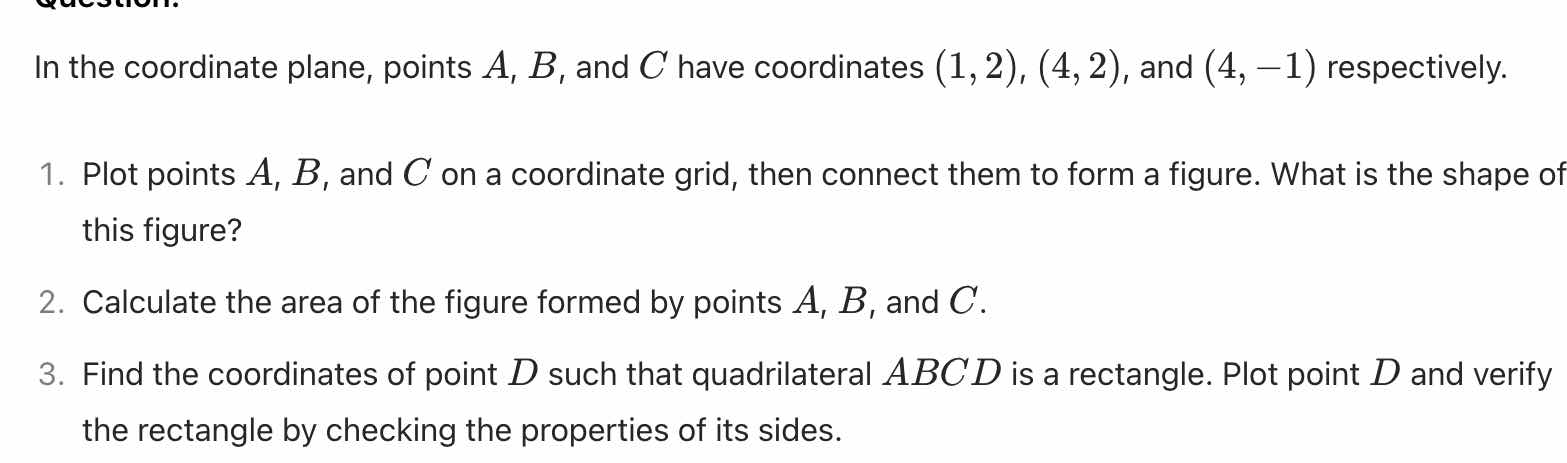
in the coordinate plane, points a, b, and c have coordinates (1,2), (4,2), and (4, -1) respectively.
- plot points a, b, and c on a coordinate grid, then connect them to form a figure. what is the shape of this figure?
- calculate the area of the figure formed by points a, b, and c.
- find the coordinates of point d such that quadrilateral abcd is a rectangle. plot point d and verify the rectangle by checking the properties of its sides.
Sub - question 1
To determine the shape, we analyze the coordinates. For points \(A(1,2)\), \(B(4,2)\), and \(C(4, - 1)\):
- The distance between \(A\) and \(B\): Since the \(y\) - coordinates are the same (\(y = 2\)), the distance \(AB=\vert4 - 1\vert=3\) (horizontal line segment).
- The distance between \(B\) and \(C\): Since the \(x\) - coordinates are the same (\(x = 4\)), the distance \(BC=\vert-1 - 2\vert = 3\) (vertical line segment).
- The angle at \(B\): The horizontal line \(AB\) and vertical line \(BC\) are perpendicular (slope of \(AB\) is \(0\) as \(y\) is constant, slope of \(BC\) is undefined as \(x\) is constant), so \(\angle ABC = 90^{\circ}\). A triangle with two equal - length perpendicular sides is a right triangle.
Step 1: Identify the base and height of the right triangle
For a right triangle, the two legs can be used as the base and height. From part 1, we know that \(AB = 3\) (base) and \(BC=3\) (height) (or vice - versa).
Step 2: Use the formula for the area of a right triangle
The formula for the area of a right triangle is \(A=\frac{1}{2}\times\text{base}\times\text{height}\). Substituting the values of base \( = 3\) and height \( = 3\) into the formula, we get \(A=\frac{1}{2}\times3\times3\).
Step 3: Calculate the area
\(\frac{1}{2}\times3\times3=\frac{9}{2}=4.5\)
Step 1: Recall the properties of a rectangle
In a rectangle \(ABCD\), opposite sides are equal and parallel, and adjacent sides are perpendicular. We know that \(A(1,2)\), \(B(4,2)\), \(C(4,-1)\).
- The vector \(\overrightarrow{AB}=(4 - 1,2 - 2)=(3,0)\) and \(\overrightarrow{BC}=(4 - 4,-1 - 2)=(0,-3)\).
- For \(ABCD\) to be a rectangle, \(\overrightarrow{AD}=\overrightarrow{BC}\) and \(\overrightarrow{DC}=\overrightarrow{AB}\).
- Let \(D=(x,y)\). Since \(\overrightarrow{AD}=(x - 1,y - 2)\) and \(\overrightarrow{BC}=(0,-3)\), we have \(x-1 = 0\) and \(y - 2=-3\).
- Solving \(x - 1=0\) gives \(x = 1\). Solving \(y-2=-3\) gives \(y=2 - 3=-1\).
Step 2: Verify the rectangle
- The coordinates of \(D\) are \((1,-1)\).
- Check the sides:
- \(AB\): distance between \(A(1,2)\) and \(B(4,2)\) is \(3\). \(DC\): distance between \(D(1,-1)\) and \(C(4,-1)\) is \(\vert4 - 1\vert = 3\), so \(AB = DC\) and both are horizontal.
- \(BC\): distance between \(B(4,2)\) and \(C(4,-1)\) is \(3\). \(AD\): distance between \(A(1,2)\) and \(D(1,-1)\) is \(\vert-1 - 2\vert = 3\), so \(BC = AD\) and both are vertical.
- The angles: Since \(AB\) is horizontal and \(BC\) is vertical, \(\angle ABC = 90^{\circ}\); similarly, all angles are \(90^{\circ}\) as the sides are horizontal and vertical.

Snap & solve any problem in the app
Get step-by-step solutions on Sovi AI
Photo-based solutions with guided steps
Explore more problems and detailed explanations
The figure is a right triangle.