QUESTION IMAGE
Question
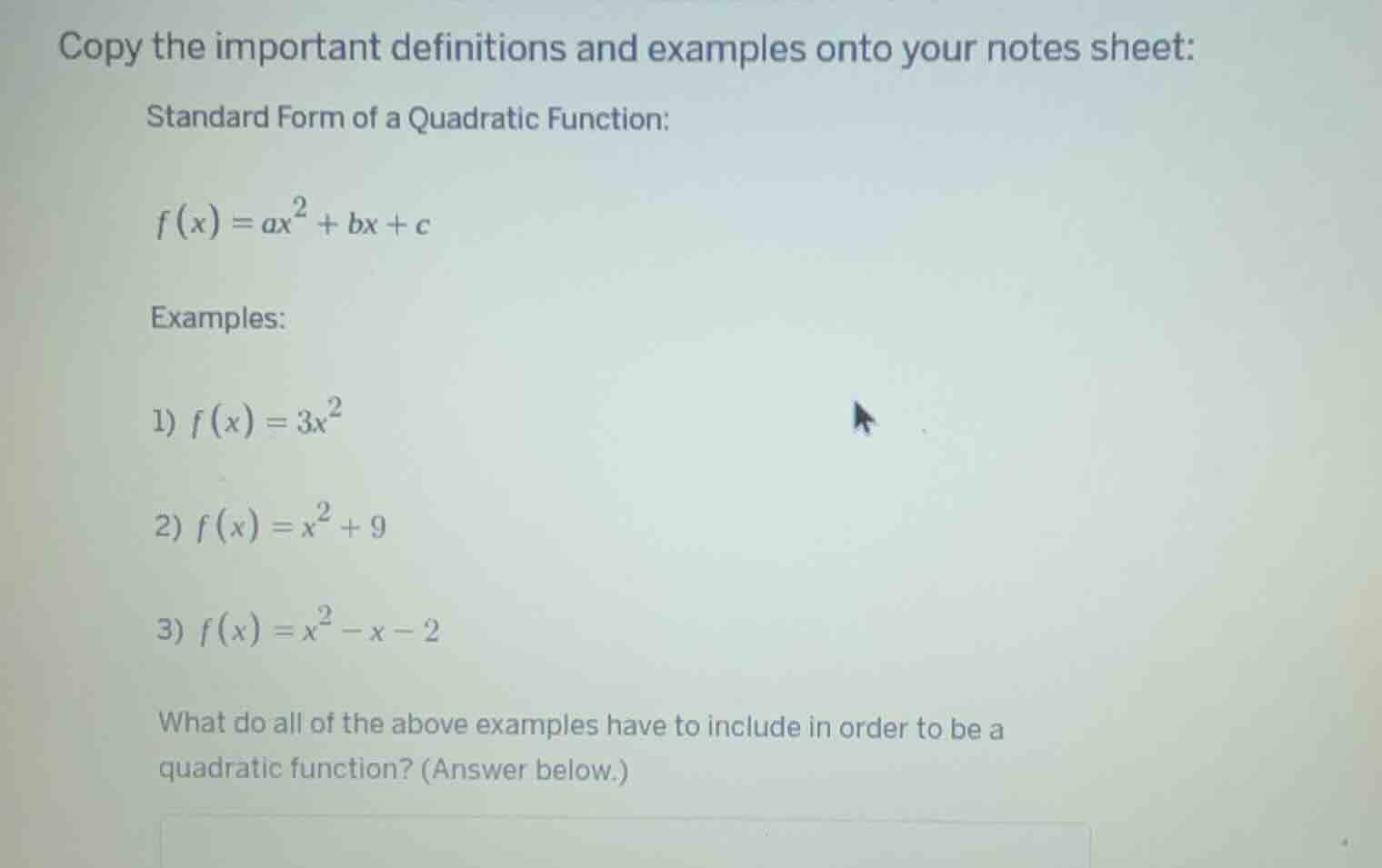
copy the important definitions and examples onto your notes sheet:
standard form of a quadratic function:
$f(x)=ax^2 + bx + c$
examples:
- $f(x)=3x^2$
- $f(x)=x^2 + 9$
- $f(x)=x^2 - x - 2$
what do all of the above examples have to include in order to be a quadratic function? (answer below.)
To determine what all quadratic function examples must include, we analyze the standard form \( f(x)=ax^{2}+bx + c \) and the given examples:
- Example 1: \( f(x) = 3x^{2} \) has \( a = 3 \), \( b = 0 \), \( c = 0 \). The \( x^{2} \) term (with non - zero \( a \) for the quadratic nature) is present.
- Example 2: \( f(x)=x^{2}+9 \) has \( a = 1 \), \( b = 0 \), \( c = 9 \). The \( x^{2} \) term is present.
- Example 3: \( f(x)=x^{2}-x - 2 \) has \( a = 1 \), \( b=- 1 \), \( c = - 2 \). The \( x^{2} \) term is present.
A quadratic function is a polynomial function of degree 2. The degree of a polynomial is determined by the highest power of the variable. In the standard form \( f(x)=ax^{2}+bx + c \), the term with \( x^{2} \) (where \( a
eq0 \)) gives the function its quadratic (degree 2) nature. So, all quadratic functions must include a squared term (i.e., a term with \( x^{2} \), where the coefficient of \( x^{2} \) ( \( a \)) is not equal to zero).

Snap & solve any problem in the app
Get step-by-step solutions on Sovi AI
Photo-based solutions with guided steps
Explore more problems and detailed explanations
All of the above examples must include a squared term (a term with \( x^{2} \), where the coefficient of \( x^{2} \) is non - zero) to be a quadratic function.