QUESTION IMAGE
Question
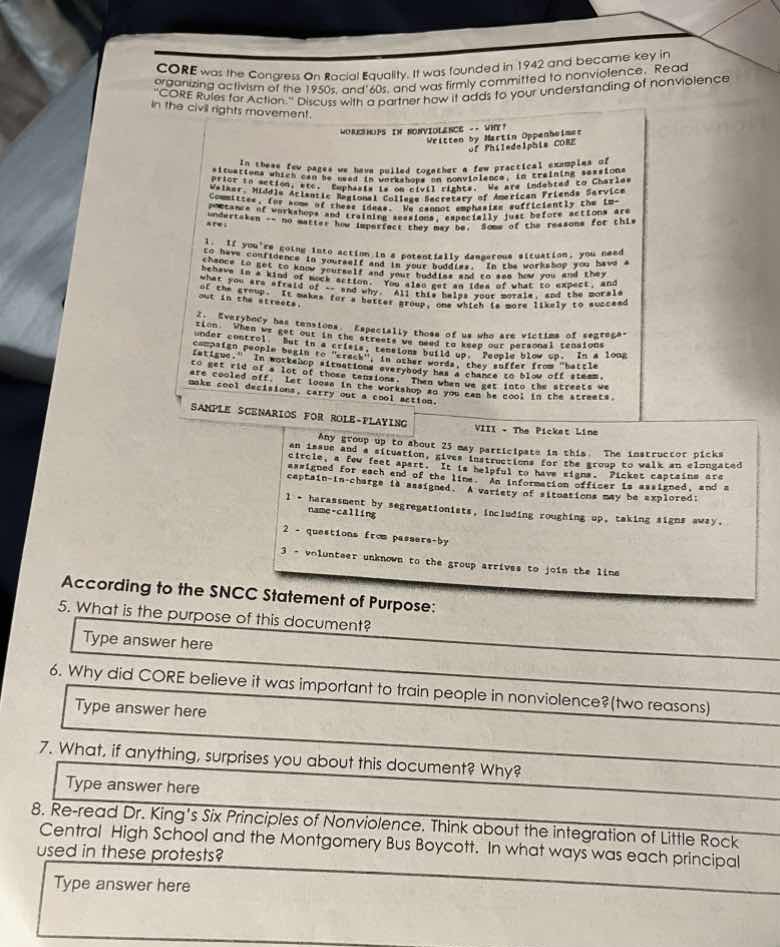
core was the congress on racial equality. it was founded in 1942 and became key in organizing activism for the 1950s, and 60s, and was firmly committed to nonviolence. read \core rules of action.\ discuss with a partner how it adds to your understanding of nonviolence in the civil rights movement.
workshop in nonviolence - why?
written by philadelphia core
in these few pages we have pulled together a few practical examples of situations which can be used as a basis for role - playing in training sessions with schools, clubs, etc. emphasis is on civil rights. we are indebted to walter nudelman, of the national college secretary of america, and to the national catholic federation for work and training sessions, especially just before actions are undertaken, for some of the materials. some of the reasons for this are:
- if youre going into action in a potentially dangerous situation, you need to have confidence in yourself and your buddies. in the workshop and in role - playing you make a decision, and practice what you are going to do. you also get an idea of what to expect, and of how you are likely to act. at best, one which is more likely to be carried out in the streets.
- everybody gets tensions. especially those of us who are victims of segregation. tensions build up. people blow up. in a long campaign, people begin to crack, they suffer from battle fatigue. a lot of situations everybody needs to let loose. then we get into the streets we are able to control ourselves, carry out a cool action, and you can be cool in the streets, make cool decisions, for role - playing
sample scenarios for role - playing
viii - the picket line
any group up to about 25 may participate in this. the instructor picks an issue and a situation, gives help to the group to walk an elongated circle for feet apart. it is helpful for the picket captains are assigned for each end of the line. an information officer may be assigned and a captain - in - charge is assigned. a variety of situations may be explored:
1 - harassment by segregationists, including: roughing up, taking signs away, name - calling
2 - questions from passers - by
3 - volunteer unknown to the group arrives to join the line
according to the sncc statement of purpose:
- what is the purpose of this document?
type answer here
- why did core believe it was important to train people in nonviolence?(two reasons)
type answer here
- what, if anything, surprises you about this document? why?
type answer here
- re - read dr. kings six principles of nonviolence. think about the integration of little rock central high school and the montgomery bus boycott. in what ways was each principal used in these protests?
type answer here
Question 5
The document (from CORE, Congress On Racial Equality) includes materials on nonviolence training (like workshops, role - playing scenarios) and connects to civil rights activism. Its purpose is to provide practical guidance and training for civil rights activists in nonviolent action, to prepare them for situations during the civil rights movement (e.g., picket lines, dealing with opposition) and enhance their understanding and ability to practice nonviolence.
- From the “Workshops in Nonviolence” section: When in a potentially dangerous situation, training in nonviolence helps activists “behave in confidence in yourself and your buddies” and “know what to expect and how to act”. It gives them a sense of the “moral and practical issues” and helps with decision - making (e.g., “make cool decisions” in the streets). So one reason is to help activists act confidently and make good decisions in dangerous or tense civil rights action situations.
- Also, the text mentions that “everybody gets tensions... especially those of us who are victims of segregation... tensions build up... People blow up”. Training in nonviolence helps manage these tensions. It helps activists “keep your personal tensions under control” so they don't “blow up” and can “carry out a cool action” in the streets. So another reason is to help activists manage personal tensions that arise from segregation and the stress of civil rights actions, so they can act calmly and effectively.

Snap & solve any problem in the app
Get step-by-step solutions on Sovi AI
Photo-based solutions with guided steps
Explore more problems and detailed explanations
The purpose of this document is to provide practical examples, training materials (like workshops and role - playing scenarios), and guidance on nonviolent action for civil rights activists, to prepare them for situations in the civil rights movement and help them understand and practice nonviolence effectively.