QUESTION IMAGE
Question
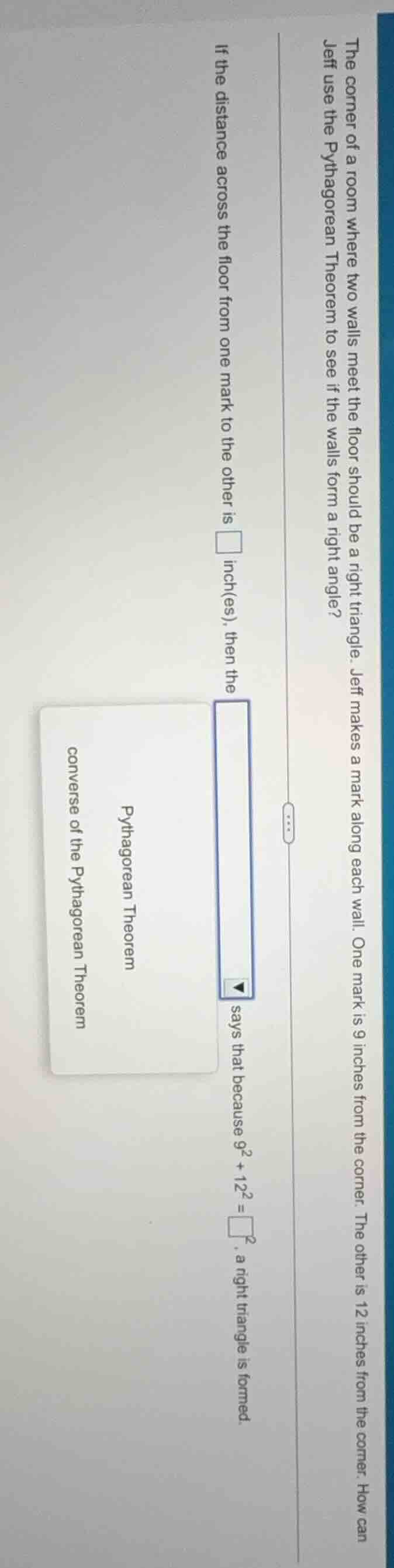
the corner of a room where two walls meet the floor should be a right triangle. jeff makes a mark along each wall. one mark is 9 inches from the corner. the other is 12 inches from the corner. how can jeff use the pythagorean theorem to see if the walls form a right angle? if the distance across the floor from one mark to the other is \\(\square\\) inch(es), then the \\(\boldsymbol{\text{says that because } 9^2 + 12^2 = \square^2\\), a right triangle is formed. \\(\text{pythagorean theorem}\\) \\(\text{converse of the pythagorean theorem}\\)
Step1: Calculate sum of squared sides
$9^2 + 12^2 = 81 + 144 = 225$
Step2: Find square root of the sum
$\sqrt{225} = 15$
Step3: Identify the theorem
We use the converse of the Pythagorean Theorem to verify if the triangle (and thus the wall angle) is right, by checking if the side lengths satisfy the Pythagorean relationship.

Snap & solve any problem in the app
Get step-by-step solutions on Sovi AI
Photo-based solutions with guided steps
Explore more problems and detailed explanations
If the distance across the floor from one mark to the other is $\boldsymbol{15}$ inch(es), then the converse of the Pythagorean Theorem says that because $9^2 + 12^2 = \boldsymbol{15}^2$, a right triangle is formed.