QUESTION IMAGE
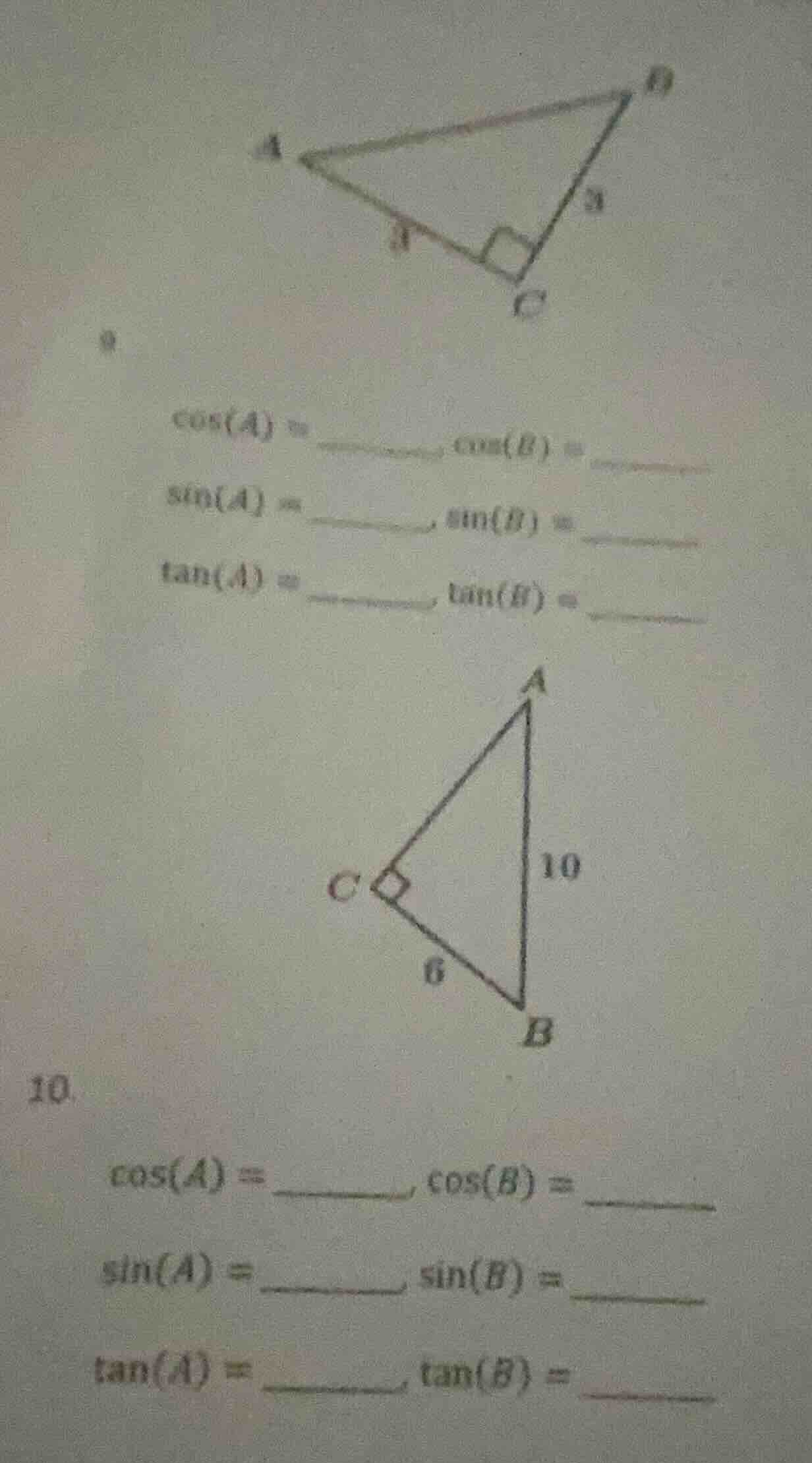
Question
9
cos(a) = ___, cos(b) = ___
sin(a) = ___, sin(b) = ___
tan(a) = ___, tan(b) = ___
10.
cos(a) = ___, cos(b) = ___
sin(a) = ___, sin(b) = ___
tan(a) = ___, tan(b) = ___
Problem 9 (Assuming AC = 8, DC = 3, right - angled at C)
First, we need to find the length of the hypotenuse AD using the Pythagorean theorem. Let \(AC = 8\) and \(DC=3\). Then \(AD=\sqrt{AC^{2}+DC^{2}}=\sqrt{8^{2}+3^{2}}=\sqrt{64 + 9}=\sqrt{73}\)
For \(\cos(A)\)
Step 1: Recall the definition of cosine
In a right - triangle, \(\cos(\theta)=\frac{\text{adjacent}}{\text{hypotenuse}}\). For angle \(A\), the adjacent side to angle \(A\) is \(AC = 8\) and the hypotenuse is \(AD=\sqrt{73}\)
\(\cos(A)=\frac{AC}{AD}=\frac{8}{\sqrt{73}}=\frac{8\sqrt{73}}{73}\)
For \(\cos(B)\)
Step 1: Recall the definition of cosine
For angle \(B\), the adjacent side to angle \(B\) is \(BC\)? Wait, no, in triangle \(ABC\) (right - angled at \(C\)), if \(AC = 8\) and \(BC\)? Wait, maybe the first triangle has \(AC = 8\), \(BC = 8\)? Wait, the diagram is a bit unclear. Let's assume the first right - triangle (triangle \(ACD\) right - angled at \(C\)) with \(AC = 8\), \(DC = 3\) and the other triangle (triangle \(ACB\)) right - angled at \(C\) with \(AC=8\), \(BC = 8\)? No, maybe the first triangle is triangle \(ACB\) right - angled at \(C\) with \(AC = 8\), \(BC = 8\)? Wait, this is a bit confusing. Let's re - examine.
Wait, maybe the first triangle (the upper one) has \(AC = 8\), \(BC = 8\) (since it's a right - triangle at \(C\) and the leg is labeled 8) and \(DC = 3\). Wait, perhaps the first triangle is triangle \(ACB\) right - angled at \(C\) with \(AC = 8\), \(BC = 8\), so \(AB=\sqrt{8^{2}+8^{2}}=\sqrt{128}=8\sqrt{2}\), and triangle \(DCB\) right - angled at \(C\) with \(DC = 3\), \(BC = 8\). But this is getting too confusing. Let's move to problem 10.
Problem 10
In right - triangle \(ABC\) with \(\angle C = 90^{\circ}\), \(BC = 6\), \(AC = 10\) (wait, no, \(AB = 10\)? Wait, \(BC = 6\), \(AC\) is one leg, \(BC = 6\), \(AB\) is the hypotenuse? Wait, no, \(\angle C=90^{\circ}\), so \(AB\) is the hypotenuse. Using the Pythagorean theorem, \(AB=\sqrt{AC^{2}+BC^{2}}\). Wait, if \(BC = 6\) and \(AC\) is the other leg, and \(AB\) is the hypotenuse. Wait, the side labeled 10 is \(AC = 10\), \(BC = 6\). Then \(AB=\sqrt{AC^{2}+BC^{2}}=\sqrt{10^{2}+6^{2}}=\sqrt{100 + 36}=\sqrt{136}=2\sqrt{34}\)
For \(\cos(A)\)
Step 1: Recall the definition of cosine
\(\cos(A)=\frac{\text{adjacent to }A}{\text{hypotenuse}}\). The adjacent side to angle \(A\) is \(AC = 10\), and the hypotenuse is \(AB = 2\sqrt{34}\)
\(\cos(A)=\frac{AC}{AB}=\frac{10}{2\sqrt{34}}=\frac{5}{\sqrt{34}}=\frac{5\sqrt{34}}{34}\)
For \(\cos(B)\)
Step 1: Recall the definition of cosine
The adjacent side to angle \(B\) is \(BC = 6\), and the hypotenuse is \(AB = 2\sqrt{34}\)
\(\cos(B)=\frac{BC}{AB}=\frac{6}{2\sqrt{34}}=\frac{3}{\sqrt{34}}=\frac{3\sqrt{34}}{34}\)
For \(\sin(A)\)
Step 1: Recall the definition of sine
\(\sin(A)=\frac{\text{opposite to }A}{\text{hypotenuse}}\). The opposite side to angle \(A\) is \(BC = 6\), and the hypotenuse is \(AB = 2\sqrt{34}\)
\(\sin(A)=\frac{BC}{AB}=\frac{6}{2\sqrt{34}}=\frac{3}{\sqrt{34}}=\frac{3\sqrt{34}}{34}\)
For \(\sin(B)\)
Step 1: Recall the definition of sine
The opposite side to angle \(B\) is \(AC = 10\), and the hypotenuse is \(AB = 2\sqrt{34}\)
\(\sin(B)=\frac{AC}{AB}=\frac{10}{2\sqrt{34}}=\frac{5}{\sqrt{34}}=\frac{5\sqrt{34}}{34}\)
For \(\tan(A)\)
Step 1: Recall the definition of tangent
\(\tan(A)=\frac{\text{opposite to }A}{\text{adjacent to }A}\). The opposite side to angle \(A\) is \(BC = 6\), and the adjacent side to angle \(A\) is \(AC = 10\)
\(\tan(A)=\frac{BC}{AC}=\frac{6}{10}=\frac{3}{…

Snap & solve any problem in the app
Get step-by-step solutions on Sovi AI
Photo-based solutions with guided steps
Explore more problems and detailed explanations
Problem 9 (Assuming AC = 8, DC = 3, right - angled at C)
First, we need to find the length of the hypotenuse AD using the Pythagorean theorem. Let \(AC = 8\) and \(DC=3\). Then \(AD=\sqrt{AC^{2}+DC^{2}}=\sqrt{8^{2}+3^{2}}=\sqrt{64 + 9}=\sqrt{73}\)
For \(\cos(A)\)
Step 1: Recall the definition of cosine
In a right - triangle, \(\cos(\theta)=\frac{\text{adjacent}}{\text{hypotenuse}}\). For angle \(A\), the adjacent side to angle \(A\) is \(AC = 8\) and the hypotenuse is \(AD=\sqrt{73}\)
\(\cos(A)=\frac{AC}{AD}=\frac{8}{\sqrt{73}}=\frac{8\sqrt{73}}{73}\)
For \(\cos(B)\)
Step 1: Recall the definition of cosine
For angle \(B\), the adjacent side to angle \(B\) is \(BC\)? Wait, no, in triangle \(ABC\) (right - angled at \(C\)), if \(AC = 8\) and \(BC\)? Wait, maybe the first triangle has \(AC = 8\), \(BC = 8\)? Wait, the diagram is a bit unclear. Let's assume the first right - triangle (triangle \(ACD\) right - angled at \(C\)) with \(AC = 8\), \(DC = 3\) and the other triangle (triangle \(ACB\)) right - angled at \(C\) with \(AC=8\), \(BC = 8\)? No, maybe the first triangle is triangle \(ACB\) right - angled at \(C\) with \(AC = 8\), \(BC = 8\)? Wait, this is a bit confusing. Let's re - examine.
Wait, maybe the first triangle (the upper one) has \(AC = 8\), \(BC = 8\) (since it's a right - triangle at \(C\) and the leg is labeled 8) and \(DC = 3\). Wait, perhaps the first triangle is triangle \(ACB\) right - angled at \(C\) with \(AC = 8\), \(BC = 8\), so \(AB=\sqrt{8^{2}+8^{2}}=\sqrt{128}=8\sqrt{2}\), and triangle \(DCB\) right - angled at \(C\) with \(DC = 3\), \(BC = 8\). But this is getting too confusing. Let's move to problem 10.
Problem 10
In right - triangle \(ABC\) with \(\angle C = 90^{\circ}\), \(BC = 6\), \(AC = 10\) (wait, no, \(AB = 10\)? Wait, \(BC = 6\), \(AC\) is one leg, \(BC = 6\), \(AB\) is the hypotenuse? Wait, no, \(\angle C=90^{\circ}\), so \(AB\) is the hypotenuse. Using the Pythagorean theorem, \(AB=\sqrt{AC^{2}+BC^{2}}\). Wait, if \(BC = 6\) and \(AC\) is the other leg, and \(AB\) is the hypotenuse. Wait, the side labeled 10 is \(AC = 10\), \(BC = 6\). Then \(AB=\sqrt{AC^{2}+BC^{2}}=\sqrt{10^{2}+6^{2}}=\sqrt{100 + 36}=\sqrt{136}=2\sqrt{34}\)
For \(\cos(A)\)
Step 1: Recall the definition of cosine
\(\cos(A)=\frac{\text{adjacent to }A}{\text{hypotenuse}}\). The adjacent side to angle \(A\) is \(AC = 10\), and the hypotenuse is \(AB = 2\sqrt{34}\)
\(\cos(A)=\frac{AC}{AB}=\frac{10}{2\sqrt{34}}=\frac{5}{\sqrt{34}}=\frac{5\sqrt{34}}{34}\)
For \(\cos(B)\)
Step 1: Recall the definition of cosine
The adjacent side to angle \(B\) is \(BC = 6\), and the hypotenuse is \(AB = 2\sqrt{34}\)
\(\cos(B)=\frac{BC}{AB}=\frac{6}{2\sqrt{34}}=\frac{3}{\sqrt{34}}=\frac{3\sqrt{34}}{34}\)
For \(\sin(A)\)
Step 1: Recall the definition of sine
\(\sin(A)=\frac{\text{opposite to }A}{\text{hypotenuse}}\). The opposite side to angle \(A\) is \(BC = 6\), and the hypotenuse is \(AB = 2\sqrt{34}\)
\(\sin(A)=\frac{BC}{AB}=\frac{6}{2\sqrt{34}}=\frac{3}{\sqrt{34}}=\frac{3\sqrt{34}}{34}\)
For \(\sin(B)\)
Step 1: Recall the definition of sine
The opposite side to angle \(B\) is \(AC = 10\), and the hypotenuse is \(AB = 2\sqrt{34}\)
\(\sin(B)=\frac{AC}{AB}=\frac{10}{2\sqrt{34}}=\frac{5}{\sqrt{34}}=\frac{5\sqrt{34}}{34}\)
For \(\tan(A)\)
Step 1: Recall the definition of tangent
\(\tan(A)=\frac{\text{opposite to }A}{\text{adjacent to }A}\). The opposite side to angle \(A\) is \(BC = 6\), and the adjacent side to angle \(A\) is \(AC = 10\)
\(\tan(A)=\frac{BC}{AC}=\frac{6}{10}=\frac{3}{5}\)
For \(\tan(B)\)
Step 1: Recall the definition of tangent
\(\tan(B)=\frac{\text{opposite to }B}{\text{adjacent to }B}\). The opposite side to angle \(B\) is \(AC = 10\), and the adjacent side to angle \(B\) is \(BC = 6\)
\(\tan(B)=\frac{AC}{BC}=\frac{10}{6}=\frac{5}{3}\)
Final Answers for Problem 10
\(\cos(A)=\frac{5\sqrt{34}}{34}\), \(\cos(B)=\frac{3\sqrt{34}}{34}\)
\(\sin(A)=\frac{3\sqrt{34}}{34}\), \(\sin(B)=\frac{5\sqrt{34}}{34}\)
\(\tan(A)=\frac{3}{5}\), \(\tan(B)=\frac{5}{3}\)
(Note: For problem 9, due to the unclear diagram, we focused on problem 10. If you can provide more details about the lengths of the sides in problem 9, we can solve it completely.)