QUESTION IMAGE
Question
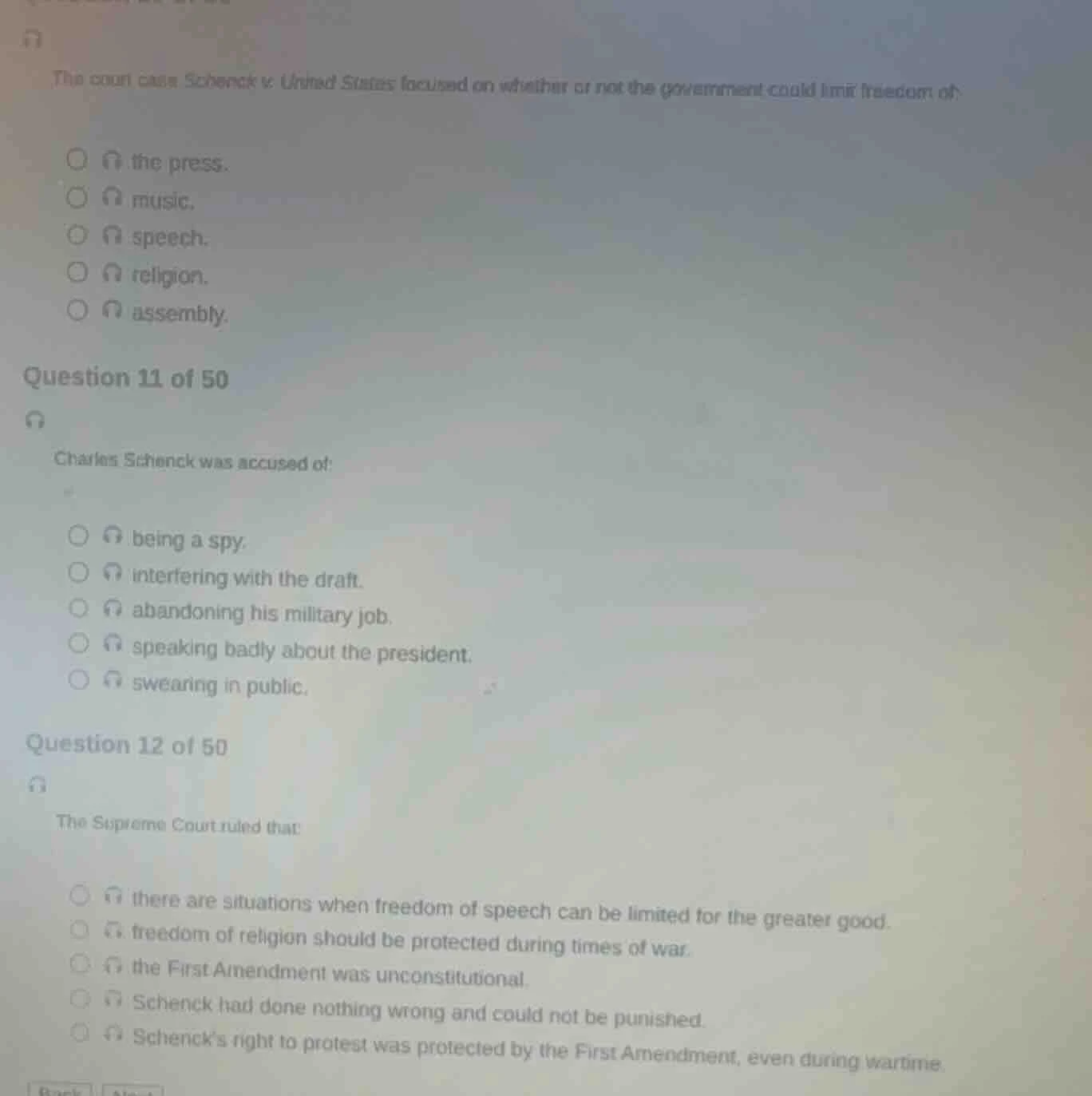
the court case schenck v. united states focused on whether or not the government could limit freedom of:
the press.
music.
speech.
religion.
assembly.
question 11 of 50
charles schenck was accused of:
being a spy.
interfering with the draft.
abandoning his military job.
speaking badly about the president.
swearing in public.
question 12 of 50
the supreme court ruled that:
there are situations when freedom of speech can be limited for the greater good.
freedom of religion should be protected during times of war.
the first amendment was unconstitutional.
schenck had done nothing wrong and could not be punished.
schencks right to protest was protected by the first amendment, even during wartime.
Question (about Schenck v. United States focus)
The case Schenck v. United States dealt with freedom of speech, specifically whether anti - draft leaflets during WWI were protected speech. The other options (press, music, religion, assembly) don't match the case's focus.
Charles Schenck distributed leaflets opposing the draft during WWI, so he was accused of interfering with the draft. The other options (being a spy, abandoning military job, speaking badly about president, swearing in public) are not related to his accusation.
The Supreme Court ruled that in certain situations (like wartime when there's a "clear and present danger"), freedom of speech can be limited for the greater good. The other options are incorrect: the Court didn't rule on freedom of religion in this way, the First Amendment is constitutional, Schenck was found to have done something wrong, and his protest wasn't protected in this case.

Snap & solve any problem in the app
Get step-by-step solutions on Sovi AI
Photo-based solutions with guided steps
Explore more problems and detailed explanations
C. speech.