QUESTION IMAGE
Question
cphs : advanced algebra: concepts and connections - block (27.0831030)
adding and subtracting rational expressions
adding and subtracting rational expressions with unlike denominators
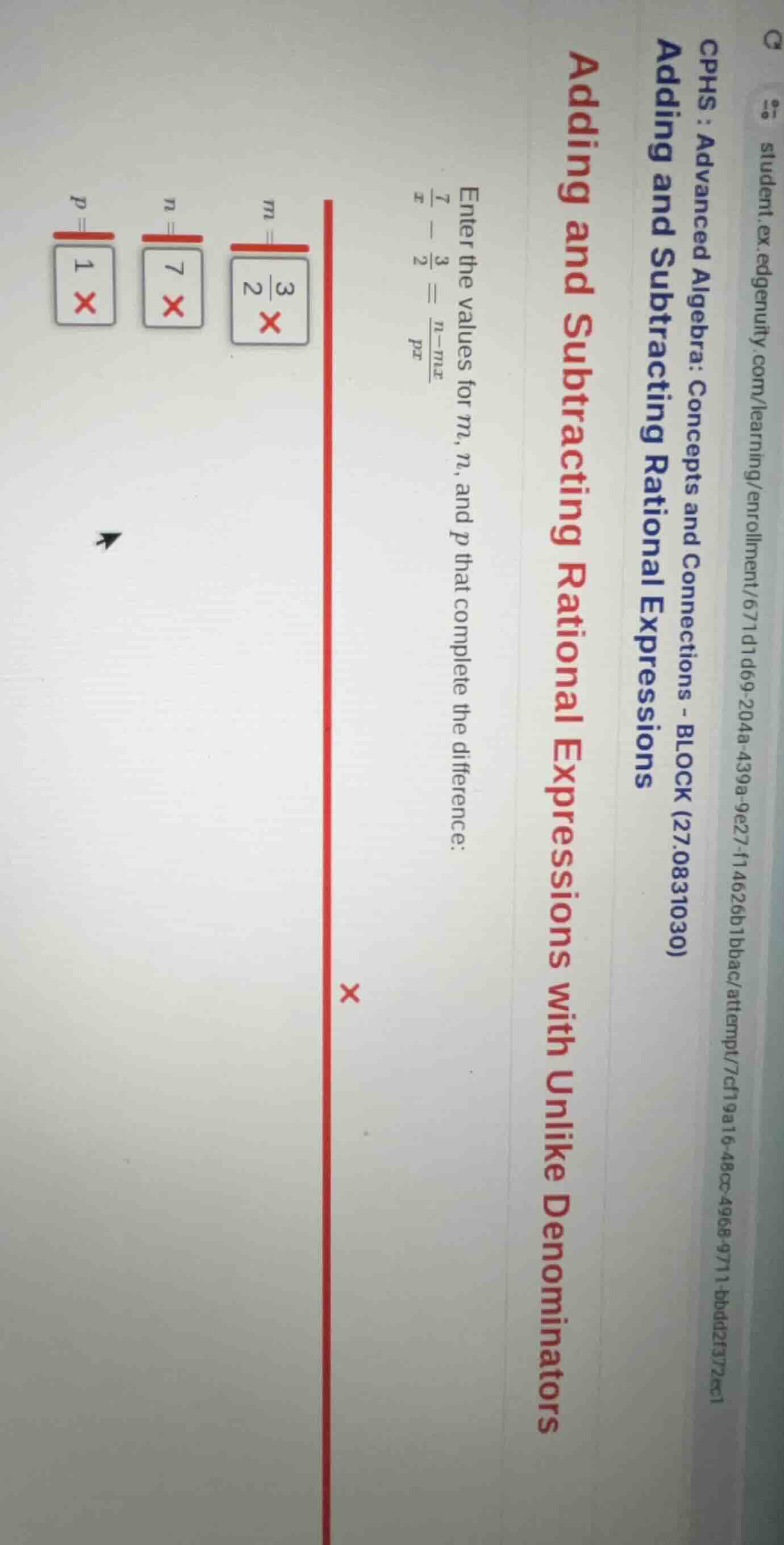
enter the values for m, n, and p that complete the difference:
$\frac{7}{x} - \frac{3}{2} = \frac{n - mx}{px}$
$m = \frac{3}{2} \times$
$n = 7 \times$
$p = 1 \times$
Step1: Recall subtraction of fractions
To subtract \(\frac{7}{x}-\frac{3}{2}\), we need a common denominator. The common denominator of \(x\) and \(2\) is \(2x\).
Step2: Rewrite fractions with common denominator
\(\frac{7}{x}=\frac{7\times2}{x\times2}=\frac{14}{2x}\) and \(\frac{3}{2}=\frac{3\times x}{2\times x}=\frac{3x}{2x}\)
Step3: Subtract the fractions
\(\frac{7}{x}-\frac{3}{2}=\frac{14 - 3x}{2x}\)
Now, compare with \(\frac{n - mx}{px}\). So, \(n = 14\)? Wait, no, wait the given \(n = 7\)? Wait, maybe I misread. Wait the problem says "Enter the values for \(m\), \(n\), and \(p\) that complete the difference: \(\frac{7}{x}-\frac{3}{2}=\frac{n - mx}{px}\)". Wait, let's do it again.
Wait, \(\frac{7}{x}-\frac{3}{2}=\frac{7\times2 - 3\times x}{2x}=\frac{14 - 3x}{2x}\). But the given \(n = 7\)? Wait, maybe the problem has a typo or I misread the given \(n\). Wait the image shows \(n = 7\), \(m=\frac{3}{2}\)? Wait no, the image has \(m=\frac{3}{2}\), \(n = 7\), \(p = 1\)? Wait let's check:
If we write \(\frac{7}{x}-\frac{3}{2}=\frac{7\times2 - 3\times x}{2\times x}=\frac{14 - 3x}{2x}\), but the given \(n = 7\), so maybe the common denominator is \(px\) where \(p = 2\)? Wait no, the image shows \(p = 1\times\)? Wait the image has \(m=\frac{3}{2}\), \(n = 7\), \(p = 1\)? Wait let's re - express \(\frac{7}{x}-\frac{3}{2}=\frac{7\times p - 3\times x}{p\times x}\)? No, wait the right - hand side is \(\frac{n - mx}{px}\). So we have \(\frac{7}{x}-\frac{3}{2}=\frac{n}{px}-\frac{mx}{px}=\frac{n - mx}{px}\). So \(\frac{7}{x}=\frac{n}{px}\) and \(\frac{3}{2}=\frac{mx}{px}\). From \(\frac{7}{x}=\frac{n}{px}\), cross - multiplying gives \(7p=n\). From \(\frac{3}{2}=\frac{mx}{px}=\frac{m}{p}\), cross - multiplying gives \(3p = 2m\). Also, the denominator of the left - hand side after getting a common denominator should be \(px\), and the common denominator of \(x\) and \(2\) is \(2x\), so \(px = 2x\), which implies \(p = 2\) (assuming \(x
eq0\)). If \(p = 2\), then from \(7p=n\), \(n=14\), and from \(3p = 2m\), \(3\times2=2m\), so \(m = 3\). But the image shows \(m=\frac{3}{2}\), \(n = 7\), \(p = 1\). Wait maybe the problem is written as \(\frac{7}{x}-\frac{3}{2}=\frac{7 - \frac{3}{2}x}{1\times x}\)? Let's check: \(\frac{7}{x}-\frac{3}{2}=\frac{14 - 3x}{2x}=\frac{7-\frac{3}{2}x}{x}\) (dividing numerator and denominator by 2). Yes! \(\frac{14 - 3x}{2x}=\frac{7-\frac{3}{2}x}{x}\). So here, \(n = 7\), \(m=\frac{3}{2}\), \(p = 1\). Let's verify:
\(\frac{n - mx}{px}=\frac{7-\frac{3}{2}x}{1\times x}=\frac{7}{x}-\frac{3}{2}\), which matches the left - hand side.

Snap & solve any problem in the app
Get step-by-step solutions on Sovi AI
Photo-based solutions with guided steps
Explore more problems and detailed explanations
\(m=\frac{3}{2}\), \(n = 7\), \(p = 1\) (So the values are \(m=\frac{3}{2}\), \(n = 7\), \(p = 1\))