QUESTION IMAGE
Question
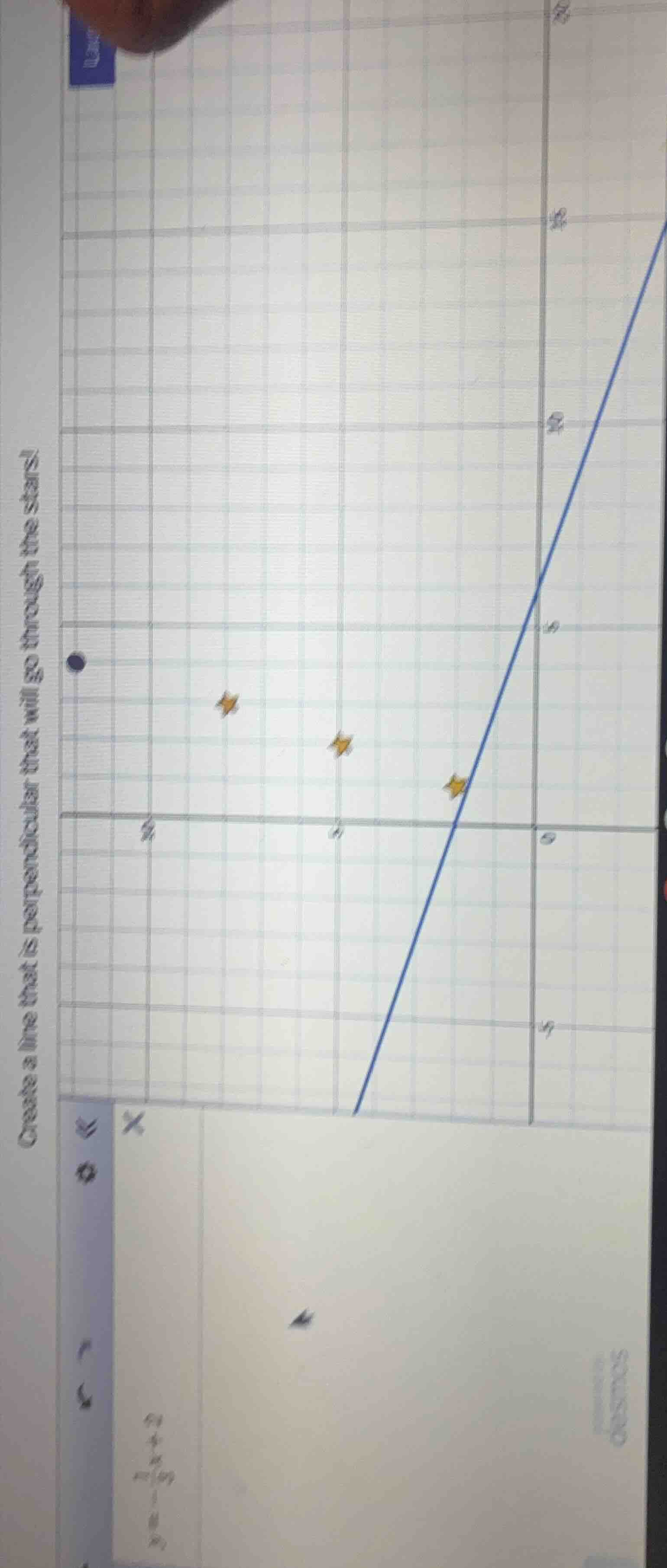
create a line that is perpendicular that will go through the stars!
Step1: Find slope of given line
First, identify two points on the blue line. Let's assume the line passes through points (let's say) \((x_1,y_1)\) and \((x_2,y_2)\). From the graph, if we take two points, say when \(x = -2\), \(y = 0\) and when \(x = 0\), \(y = 2\) (estimating from the grid). The slope \(m\) of the blue line is \(m=\frac{y_2 - y_1}{x_2 - x_1}=\frac{2 - 0}{0 - (-2)}=\frac{2}{2}=1\).
Step2: Determine slope of perpendicular line
The slope of a line perpendicular to a line with slope \(m\) is the negative reciprocal, so \(m_{\perp}=-\frac{1}{m}\). Since \(m = 1\), \(m_{\perp}=- 1\).
Step3: Find the point through which perpendicular line passes
The black dot (let's find its coordinates). From the grid, if the black dot is at \((-6,2)\) (estimating from the grid: x - coordinate -6, y - coordinate 2).
Step4: Use point - slope form to find equation
Point - slope form is \(y - y_0=m_{\perp}(x - x_0)\), where \((x_0,y_0)=(-6,2)\) and \(m_{\perp}=-1\). So \(y - 2=-1(x + 6)\), which simplifies to \(y=-x - 6 + 2=-x - 4\). Now, to draw the line, we can use the slope \(-1\) (rise -1, run 1) from the point \((-6,2)\). So from \((-6,2)\), moving right 1 unit and down 1 unit gives \((-5,1)\), right 1 and down 1 gives \((-4,0)\), etc. We can see that the middle star (at \(x=-4,y = 0\)? Wait, no, let's re - check. Wait, the stars: let's assume the black dot is at \((-6,2)\). The perpendicular line with slope \(-1\) will pass through the left - most star? Wait, maybe better to check the coordinates. Wait, the problem says "go through the stars". Wait, perhaps the black dot is the point from which we draw the perpendicular, and we need to see which star it passes through. Wait, maybe the given line has a slope of 2? Wait, maybe my initial point selection was wrong. Let's re - estimate. Suppose the blue line passes through \((-2,0)\) and \((0,4)\), then slope \(m=\frac{4 - 0}{0 - (-2)} = 2\). Then the perpendicular slope is \(-\frac{1}{2}\). Wait, maybe the grid is such that each square is 1 unit. Let's look at the stars: the three stars. Let's say the blue line goes through (let's see the blue line: when x is, say, -2, y is 0; when x is 0, y is 4? No, the blue line is steeper. Wait, maybe the slope of the blue line is 2. Let's take two points on the blue line: let's say ( - 3, - 2) and ( - 1,2). Then slope \(m=\frac{2-(-2)}{-1-(-3)}=\frac{4}{2}=2\). Then the perpendicular slope is \(-\frac{1}{2}\). The black dot: let's say its coordinates are ( - 6,2). Then using point - slope form: \(y - 2=-\frac{1}{2}(x + 6)\), \(y=-\frac{1}{2}x-3 + 2=-\frac{1}{2}x - 1\). Now, let's check the stars. Suppose the stars are at ( - 4,1), ( - 2,0), (0, - 1)? No, this is getting confusing. Alternatively, since the problem is to draw the perpendicular line through the black dot (the point) that passes through the stars, and the key is that the perpendicular line will have a slope that is the negative reciprocal of the blue line's slope. But maybe the blue line has a slope of 2, so perpendicular slope is \(-\frac{1}{2}\). But perhaps a better way: the blue line is a line, and we need to draw a line perpendicular to it, passing through the black dot, and see which star it goes through. The middle star (the one in the center) – when we draw the perpendicular line with the correct slope, it should pass through the middle star. But since this is a drawing problem, the main steps are: 1. Find the slope of the given line. 2. Find the negative reciprocal slope for the perpendicular line. 3. Use the point (black dot) to draw the line with the perpendicul…

Snap & solve any problem in the app
Get step-by-step solutions on Sovi AI
Photo-based solutions with guided steps
Explore more problems and detailed explanations
To draw the perpendicular line:
- Calculate the slope of the given blue line (e.g., if blue line has slope \(m\), perpendicular slope is \(-\frac{1}{m}\)).
- Use the coordinates of the black dot (the starting point) and the perpendicular slope to draw the line, which will pass through one of the yellow stars (usually the middle - positioned star when calculated correctly). The line should have a slope that is the negative reciprocal of the blue line's slope and pass through the black dot and the appropriate star. (Note: The actual drawing involves using the slope - intercept or point - slope form to plot points and draw the line through the correct star, with the slope being the negative reciprocal of the original line's slope.)