QUESTION IMAGE
Question
creating the new logo
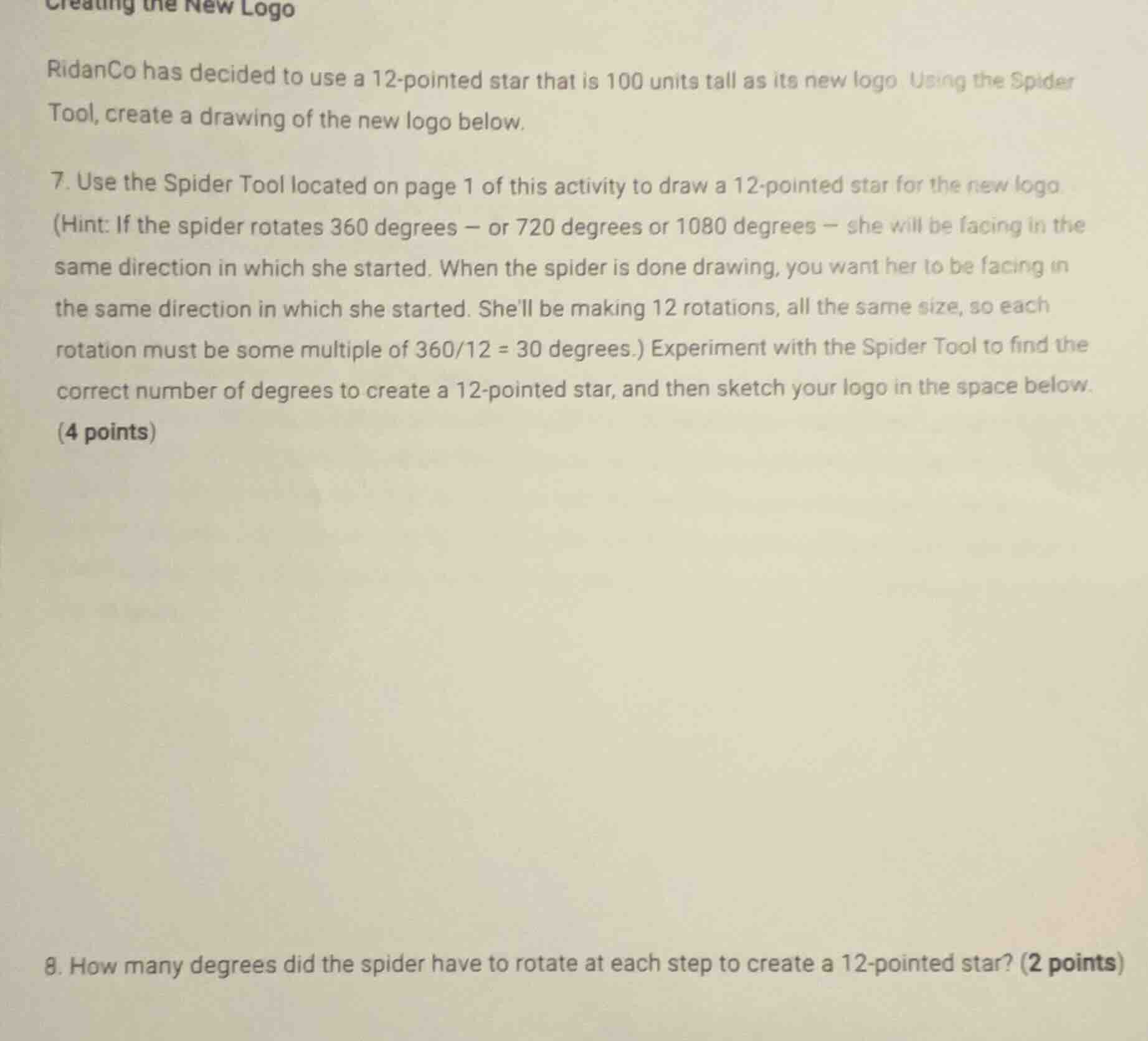
ridanco has decided to use a 12 - pointed star that is 100 units tall as its new logo. using the spider tool, create a drawing of the new logo below.
- use the spider tool located on page 1 of this activity to draw a 12 - pointed star for the new logo. (hint: if the spider rotates 360 degrees — or 720 degrees or 1080 degrees — she will be facing in the same direction in which she started. when the spider is done drawing, you want her to be facing in the same direction in which she started. shell be making 12 rotations, all the same size, so each rotation must be some multiple of 360/12 = 30 degrees.) experiment with the spider tool to find the correct number of degrees to create a 12 - pointed star, and then sketch your logo in the space below. (4 points)
- how many degrees did the spider have to rotate at each step to create a 12 - pointed star? (2 points)
For Question 8:
Step1: Understand the problem
We need to find the rotation angle per step for a 12 - pointed star. The total rotation around a point is 360 degrees, and for a regular \(n\) - pointed star (in the context of equal rotations), if we make \(n\) rotations, the angle per rotation can be found by considering the symmetry. But for a star, we also need to consider the fact that the rotation angle should be a multiple of \(\frac{360}{n}\) and also such that the star is formed. For a 12 - pointed star, we know that the basic angle for each rotation (when considering the symmetry of dividing the circle into 12 equal parts) is \(\frac{360}{12}\times k\), where \(k\) is an integer. But to form a 12 - pointed star, we can also think about the fact that if we want the spider to end up facing the same direction, the total rotation after 12 steps should be a multiple of 360 degrees. Let the rotation angle per step be \(\theta\). After 12 steps, the total rotation is \(12\theta=360m\), where \(m\) is an integer. But also, for a star, we can use the hint which says each rotation must be a multiple of \(\frac{360}{12} = 30\) degrees. To form a 12 - pointed star, we can use the formula for the rotation angle in a star - like figure. For a regular \(n\) - pointed star, the rotation angle \(\theta\) (in degrees) can be calculated as \(\theta=\frac{360\times k}{n}\), where \(k\) is an integer and \(\gcd(k,n)=1\) for a simple star, but for a 12 - pointed star, if we take \(k = 5\) (a common value for forming a 12 - pointed star, since \(\gcd(5,12) = 1\)), but wait, no, actually in the hint it is said that each rotation must be a multiple of \(30\) degrees. Wait, the hint says "each rotation must be some multiple of \(360/12=30\) degrees". But also, when we want to form a 12 - pointed star, if we consider that the spider makes 12 rotations, and to form the star, the rotation angle should be such that after 12 rotations, the spider is back to the original direction. But also, for a star, the angle between each point (in terms of rotation) can be found by considering that the star has 12 points, so the central angle between each "arm" of the star. But actually, the key here is that for a regular division of the circle into 12 equal parts, the angle between each part is \(30\) degrees. But to form a star, we can also use the fact that if we rotate by \(30\times5 = 150\) degrees? No, wait, no. Wait, the hint says "each rotation must be some multiple of \(360/12 = 30\) degrees". But let's think again. The total circle is 360 degrees. For a 12 - pointed star, when we draw it with the spider tool, each time we rotate the spider, we are creating a new point. So, if we want 12 points, and the spider rotates by \(\theta\) degrees each time, after 12 rotations, the total rotation is \(12\theta\). Since the spider must end up facing the same direction, \(12\theta\) must be a multiple of 360 degrees, so \(\theta=\frac{360m}{12}=30m\) degrees, where \(m\) is an integer. Now, to form a 12 - pointed star, we need to choose \(m\) such that the star is formed. If \(m = 1\), we would just get a regular 12 - gon (a dodecagon), not a star. If \(m = 5\), \(\theta=30\times5 = 150\) degrees? No, wait, no. Wait, the formula for the angle of rotation in a star polygon (denoted by \(\{n/k\}\)) is \(\theta=\frac{360k}{n}\) degrees, where \(n\) is the number of points, \(k\) is an integer such that \(1 < k<\frac{n}{2}\) and \(\gcd(k,n)=1\). For \(n = 12\), if we take \(k = 5\) (since \(\gcd(5,12)=1\) and \(5<6\)), then \(\theta=\frac{360\times5}{12}=150\) degrees? No, that can't be. W…

Snap & solve any problem in the app
Get step-by-step solutions on Sovi AI
Photo-based solutions with guided steps
Explore more problems and detailed explanations
The spider had to rotate 30 degrees at each step to create a 12 - pointed star.