QUESTION IMAGE
Question
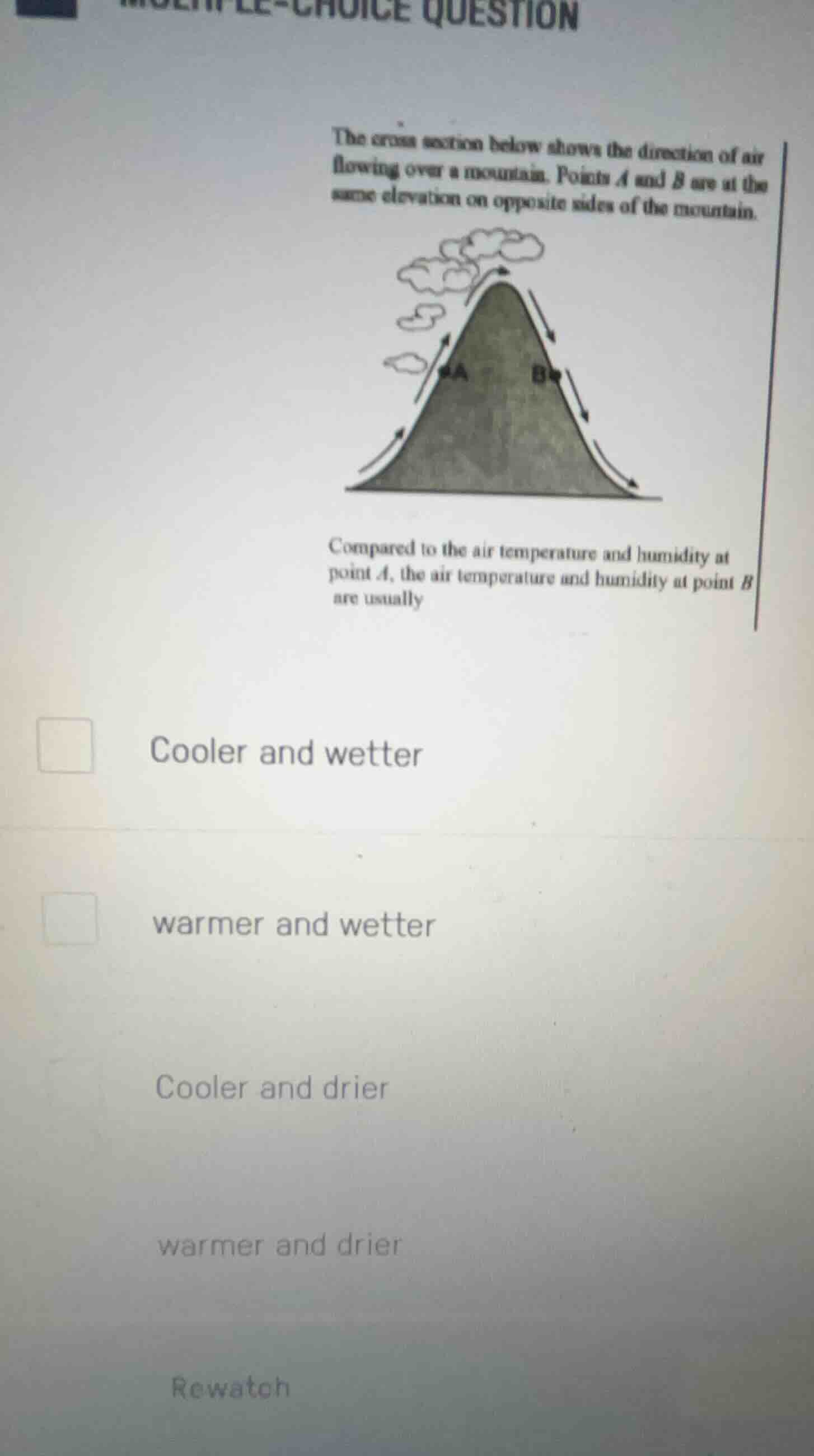
the cross section below shows the direction of air flowing over a mountain. points a and b are at the same elevation on opposite sides of the mountain. compared to the air temperature and humidity at point a, the air temperature and humidity at point b are usually cooler and wetter warmer and wetter cooler and drier warmer and drier rewatch
When air moves up the windward side (point A side) of a mountain, it cools and condenses, causing precipitation (so air at A is cooling and losing moisture? Wait, no—wait, air rising at A cools, condenses, forms clouds, and loses moisture (precipitates). Then, when the air descends on the leeward side (point B side), it compresses and warms (adiabatic heating). Also, since the air already lost moisture on the windward side, the descending air at B is drier. So compared to A: at B, air is warmer (because descending air warms) and drier (because it lost moisture on the windward side). Let's check the options:
- "Cooler and wetter": No, B is descending, so warms, not cools. And drier, not wetter.
- "Warmer and wetter": No, it lost moisture, so not wetter.
- "Cooler and drier": No, descending air warms, so not cooler.
- "Warmer and drier": Yes, because descending air (at B) warms (adiabatic heating) and is drier (since moisture was lost on the windward side as precipitation).

Snap & solve any problem in the app
Get step-by-step solutions on Sovi AI
Photo-based solutions with guided steps
Explore more problems and detailed explanations
warmer and drier (the option with "warmer and drier")