QUESTION IMAGE
Question
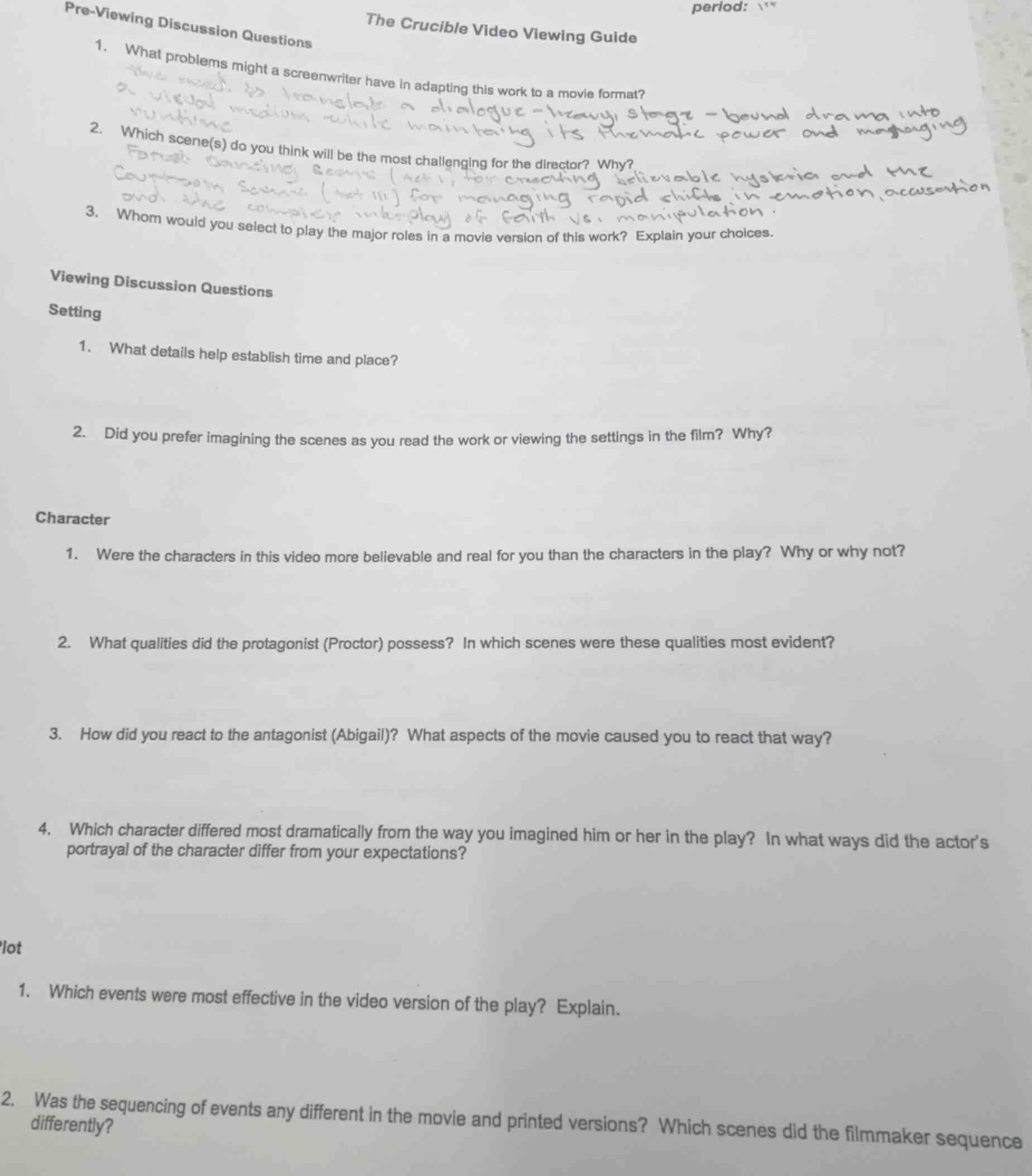
the crucible video viewing guide period: pre-viewing discussion questions 1. what problems might a screenwriter have in adapting this work to a movie format? 2. which scene(s) do you think will be the most challenging for the director? why? 3. whom would you select to play the major roles in a movie version of this work? explain your choices. viewing discussion questions setting 1. what details help establish time and place? 2. did you prefer imagining the scenes as you read the work or viewing the settings in the film? why? character 1. were the characters in this video more believable and real for you than the characters in the play? why or why not? 2. what qualities did the protagonist (proctor) possess? in which scenes were these qualities most evident? 3. how did you react to the antagonist (abigail)? what aspects of the movie caused you to react that way? 4. which character differed most dramatically from the way you imagined him or her in the play? in what ways did the actor’s portrayal of the character differ from your expectations? plot 1. which events were most effective in the video version of the play? explain. 2. was the sequencing of events any different in the movie and printed versions? which scenes did the filmmaker sequence differently?
Since the provided text is a set of discussion questions related to viewing "The Crucible" (a literary work adapted to film) and there is no specific question asked here (just the list of questions), I'll assume you might want help answering one of them. Let's pick the first Pre - Viewing Discussion Question: "What problems might a screenwriter have in adapting this work to a movie format?"
A screenwriter adapting "The Crucible" (a play) to a movie faces challenges. Plays are dialogue - heavy and stage - bound, while movies are a visual medium with different pacing. The screenwriter needs to translate the thematic depth (like the exploration of mass hysteria, faith vs. manipulation) and the intense dialogue into a visual narrative. They also have to manage the transition from the limited stage settings to the more expansive (or appropriately constrained for historical accuracy) movie settings, and ensure that the characters' motivations and the dramatic tension are maintained without the live - performance context of the play. Also, condensing or expanding scenes to fit the movie's runtime while preserving the story's integrity is a problem. For example, the courtroom scenes in the play rely on the tension of the stage's confined space and the rapid exchange of dialogue; in a movie, the screenwriter has to use camera angles, editing, and perhaps additional visual cues to recreate that tension, which is a different challenge than writing for the stage.

Snap & solve any problem in the app
Get step-by-step solutions on Sovi AI
Photo-based solutions with guided steps
Explore more problems and detailed explanations
A screenwriter adapting "The Crucible" to a movie may face problems like translating a dialogue - heavy, stage - bound drama into a visual medium while maintaining thematic power, managing scene transitions between stage - like settings and movie - appropriate settings, preserving character depth and dramatic tension without the live - performance context, and adjusting scene length/runtime while keeping the story's integrity (e.g., recreating courtroom scene tension via visual techniques instead of just stage - based dialogue tension).