QUESTION IMAGE
Question
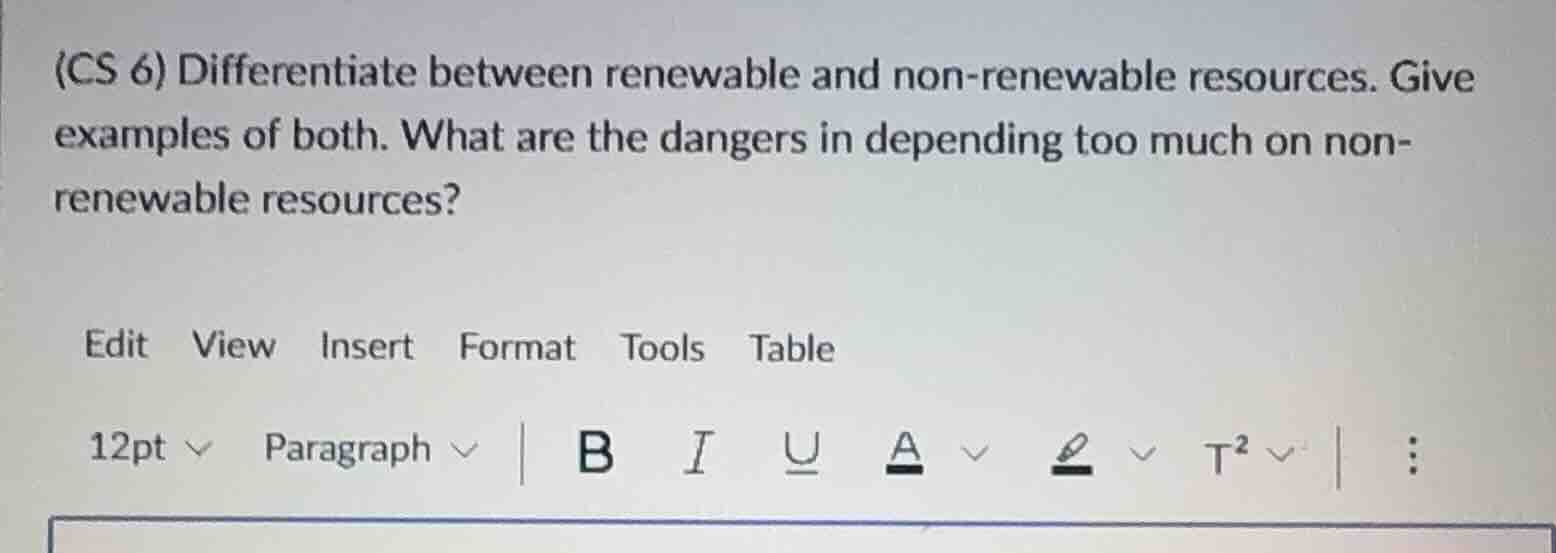
(cs 6) differentiate between renewable and non - renewable resources. give examples of both. what are the dangers in depending too much on non - renewable resources?
Brief Explanations
- Differentiation:
- Renewable Resources: These are resources that can be replenished naturally over time, either through biological or physical processes. Their supply is essentially inexhaustible on a human timescale. For example, solar energy (from the sun's radiation, which is continuously available), wind energy (generated by atmospheric pressure differences, a natural and ongoing process), hydroelectric power (from flowing water, which is part of the water cycle), and biomass (organic matter like plants and animal waste that can be regrown or recycled).
- Non - renewable Resources: These are resources that are formed over millions of years through geological processes and exist in finite quantities. Once used up, they cannot be replaced within a human - relevant time frame. Examples include fossil fuels such as coal (formed from plant matter over millions of years in swamps), oil (formed from marine organisms in sedimentary basins), and natural gas (often associated with oil deposits or formed from organic matter), as well as minerals like iron ore (formed through geological processes over long periods) and uranium (used in nuclear power, with a limited supply on Earth).
- Dangers of Over - Dependence on Non - renewable Resources:
- Depletion: Since non - renewable resources are finite, continued large - scale use will eventually lead to their exhaustion. For instance, if current rates of oil consumption continue, known oil reserves will be depleted, leading to a global energy crisis as oil is a major energy source for transportation, industry, and many other sectors.
- Environmental Degradation: The extraction of non - renewable resources often causes significant environmental harm. Mining for coal can lead to deforestation, soil erosion, and water pollution from mining waste. The burning of fossil fuels releases large amounts of greenhouse gases (like carbon dioxide) into the atmosphere, contributing to global climate change (global warming, rising sea levels, more extreme weather events). It also releases pollutants such as sulfur dioxide and nitrogen oxides, which cause acid rain, damaging forests, lakes, and buildings.
- Economic Volatility: The prices of non - renewable resources, especially fossil fuels, are subject to significant fluctuations. This is due to factors like geopolitical tensions (e.g., conflicts in oil - producing regions can disrupt supply and drive up prices), changes in global demand (e.g., economic booms or recessions), and limited reserves. These price fluctuations can have a major impact on economies, especially those that are heavily dependent on imported non - renewable resources. For example, a sudden increase in oil prices can lead to higher transportation costs, which in turn increase the prices of goods and services across the board, leading to inflation.
- Geopolitical Tensions: Control over non - renewable resources, especially oil, has been a major source of geopolitical conflict. Countries with large reserves of non - renewable resources may have significant political power, and access to these resources can be a cause of international disputes. For example, the Middle East, which has large oil reserves, has been a region of ongoing political and military conflict partly due to the strategic importance of oil.

Snap & solve any problem in the app
Get step-by-step solutions on Sovi AI
Photo-based solutions with guided steps
Explore more problems and detailed explanations
1. Differentiation between Renewable and Non - renewable Resources
- Renewable Resources: Can be naturally replenished over time (e.g., solar energy, wind energy, hydroelectric power, biomass).
- Non - renewable Resources: Exist in finite quantities and are formed over millions of years (e.g., coal, oil, natural gas, iron ore, uranium).
2. Dangers of Over - Dependence on Non - renewable Resources
- Depletion: Finite supply will be exhausted, leading to resource shortages (e.g., potential oil depletion affecting energy - dependent sectors).
- Environmental Degradation: Extraction causes deforestation, soil erosion, water pollution; burning releases greenhouse gases (causing climate change) and pollutants (causing acid rain).
- Economic Volatility: Prices are volatile due to supply - demand, geopolitics, leading to inflation and economic instability (e.g., oil price spikes increasing production costs).
- Geopolitical Tensions: Control over resources causes international conflicts (e.g., Middle East oil - related disputes).