QUESTION IMAGE
Question
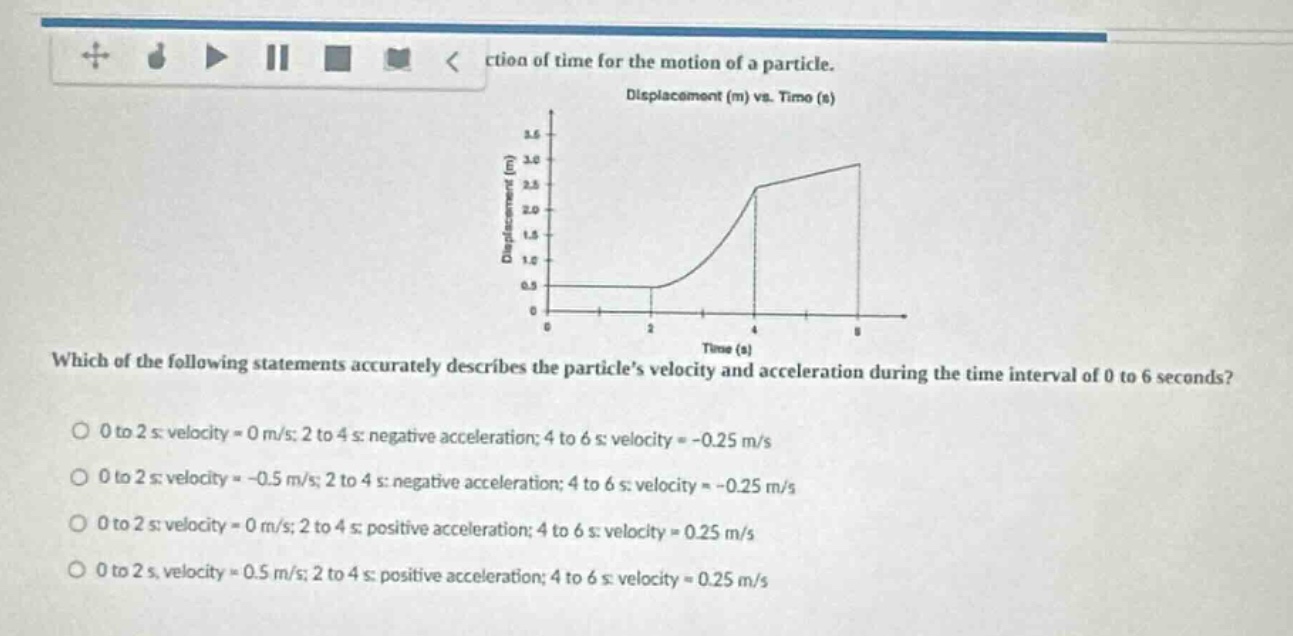
ction of time for the motion of a particle.
displacement (m) vs. time (s)
which of the following statements accurately describes the particles velocity and acceleration during the time interval of 0 to 6 seconds?
0 to 2 s: velocity = 0 m/s; 2 to 4 s: negative acceleration; 4 to 6 s: velocity = -0.25 m/s
0 to 2 s: velocity = -0.5 m/s; 2 to 4 s: negative acceleration; 4 to 6 s: velocity = -0.25 m/s
0 to 2 s: velocity = 0 m/s; 2 to 4 s: positive acceleration; 4 to 6 s: velocity = 0.25 m/s
0 to 2 s: velocity = 0.5 m/s; 2 to 4 s: positive acceleration; 4 to 6 s: velocity = 0.25 m/s
Step1: Analyze 0 to 2 s interval
Velocity is slope of displacement-time graph: $\text{Velocity} = \frac{\Delta x}{\Delta t} = \frac{0.5 - 0.5}{2 - 0} = 0$ m/s.
Step2: Analyze 2 to 4 s interval
Slope of the graph increases, so velocity increases. Positive change in velocity means $\text{Acceleration} > 0$ (positive acceleration).
Step3: Analyze 4 to 6 s interval
Calculate constant velocity: $\text{Velocity} = \frac{\Delta x}{\Delta t} = \frac{3.0 - 2.5}{6 - 4} = 0.25$ m/s.
Step4: Match with options
The calculated values match the third option.

Snap & solve any problem in the app
Get step-by-step solutions on Sovi AI
Photo-based solutions with guided steps
Explore more problems and detailed explanations
O 0 to 2 s: velocity = 0 m/s; 2 to 4 s: positive acceleration; 4 to 6 s: velocity = 0.25 m/s