QUESTION IMAGE
Question
cubic and cube root functions and equations
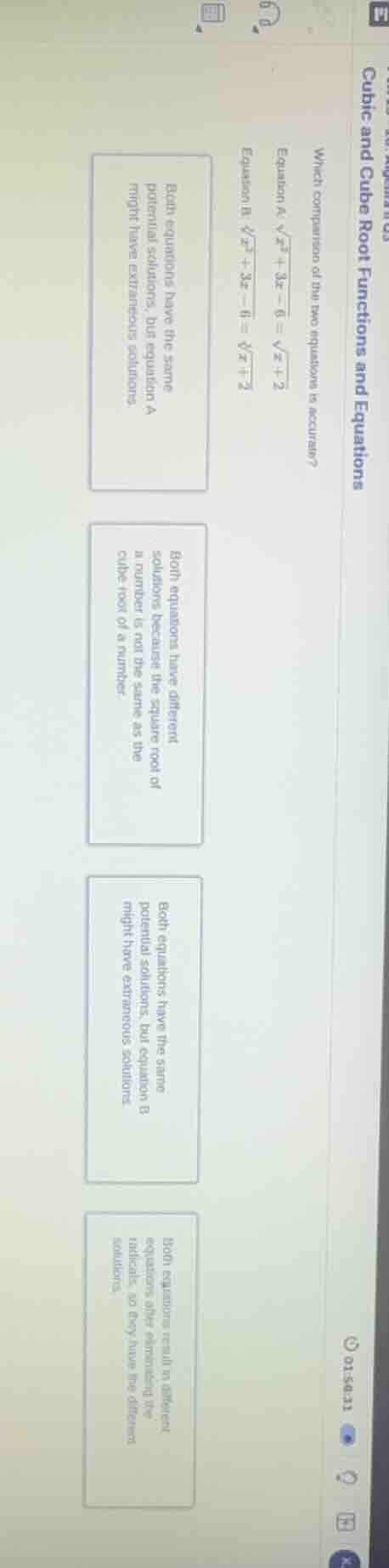
which comparison of the two equations is accurate?
equation a: $sqrt{x^2 + 3x - 6} = sqrt{x + 2}$
equation b: $sqrt3{x^2 + 3x - 6} = sqrt3{x + 2}$
- both equations have the same potential solutions, but equation a might have extraneous solutions.
- both equations have different solutions because the square root of a number is not the same as the cube root of a number.
- both equations have the same potential solutions, but equation b might have extraneous solutions.
- both equations result in different equations after eliminating the radicals, so they have different solutions.
Brief Explanations
- When solving both equations, you start by eliminating the root (square root for A, cube root for B) by raising both sides to the power of 2 (for A) or 3 (for B), which leads to the same polynomial equation $x^2 + 3x - 6 = x + 2$, so they share potential solutions.
- Square roots (Equation A) have a non-negative domain and range, so any solution that makes the original square root expression invalid (e.g., negative value under the root or a result that doesn't match the non-negative root) is extraneous.
- Cube roots (Equation B) are defined for all real numbers and can output negative values, so solutions to the polynomial equation will always be valid in the original cube root equation, with no extraneous solutions.

Snap & solve any problem in the app
Get step-by-step solutions on Sovi AI
Photo-based solutions with guided steps
Explore more problems and detailed explanations
Both equations have the same potential solutions, but equation A might have extraneous solutions.