QUESTION IMAGE
Question
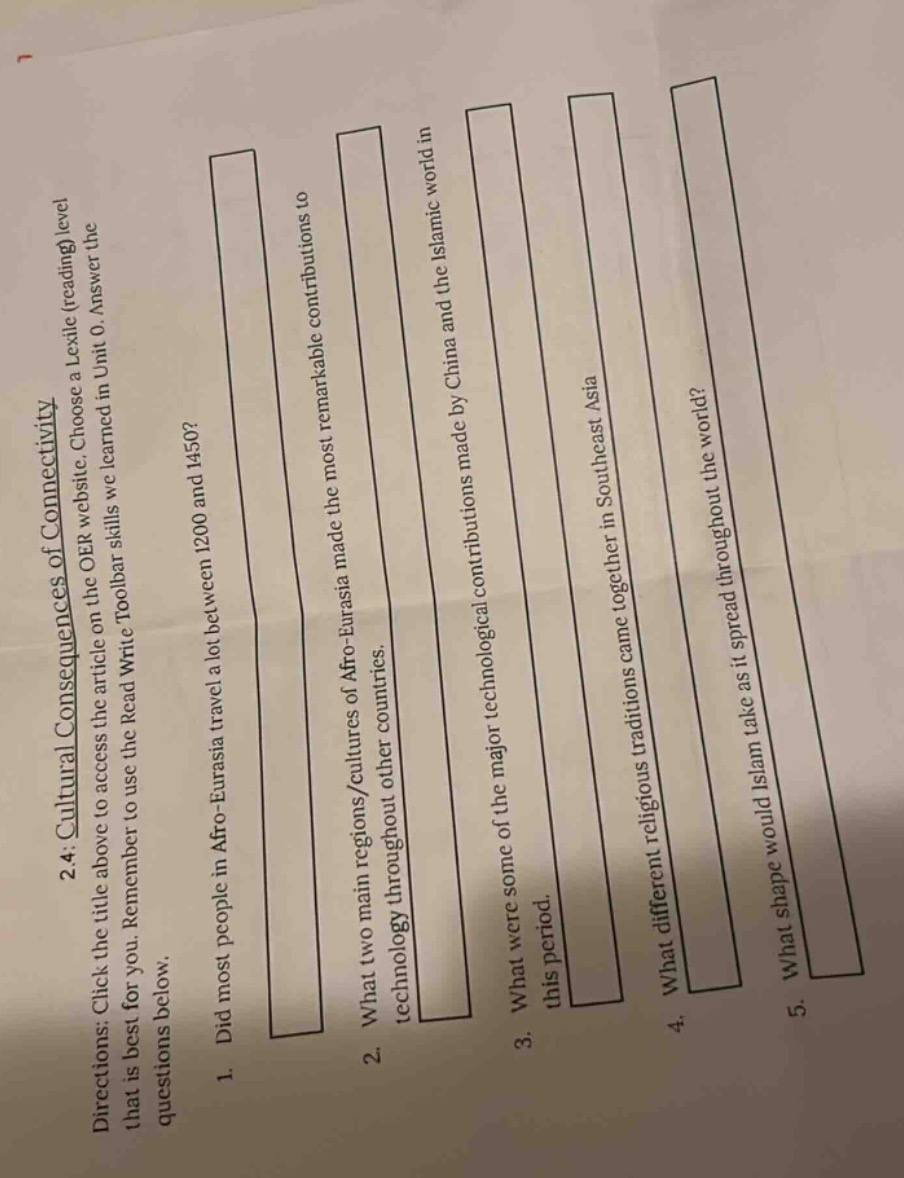
2.4: cultural consequences of connectivitydirections: click the title above to access the article on the oer website. choose a lexile (reading) level that is best for you. remember to use the read write toolbar skills we learned in unit 0. answer the questions below.1. did most people in afro-eurasia travel a lot between 1200 and 1450?2. what two main regions/cultures of afro-eurasia made the most remarkable contributions to technology throughout other countries.3. what were some of the major technological contributions made by china and the islamic world in this period.4. what different religious traditions came together in southeast asia5. what shape would islam take as it spread throughout the world?
- Most people in Afro-Eurasia did not travel far between 1200 and 1450. The vast majority were rural agriculturalists tied to their local lands, only traveling short distances for local trade, festivals, or family needs. Long-distance travel was limited to merchants, pilgrims, and officials, not the general population.
- The two most impactful regions/cultures for technological diffusion were the Islamic world (spanning across the Middle East, North Africa, and parts of South Asia) and China. The Islamic world acted as a hub for translating and sharing knowledge across Afro-Eurasia, while China developed many foundational technologies that spread outward.
- China contributed innovations like gunpowder, the magnetic compass, movable type printing, and advanced shipbuilding techniques (such as junk ships). The Islamic world contributed advancements in algebra and trigonometry, improved astronomical instruments (like astrolabes), and refined irrigation technologies (like qanats).
- In Southeast Asia, Hinduism, Buddhism, and Islam came together with local animist traditions. Hindu and Buddhist ideas shaped early kingdoms (like Srivijaya and Majapahit), while Islam spread later, blending with existing local spiritual practices.
- Islam took diverse regional shapes as it spread. In West Africa, it blended with local animist traditions and often coexisted with traditional rulers. in South Asia, it merged with Hindu devotional practices, giving rise to movements like Sufism that emphasized personal spiritual experience. in Southeast Asia, it incorporated local customs related to ancestor worship and nature spirits.

Snap & solve any problem in the app
Get step-by-step solutions on Sovi AI
Photo-based solutions with guided steps
Explore more problems and detailed explanations
- No, most people in Afro-Eurasia did not travel a lot between 1200 and 1450; most were settled agriculturalists who only traveled locally.
- The Islamic world and China.
- China: Gunpowder, magnetic compass, movable type printing, advanced shipbuilding. Islamic world: Advanced mathematical systems, refined astronomical instruments, improved irrigation technologies.
- Hinduism, Buddhism, Islam, and local animist traditions came together in Southeast Asia.
- Islam adapted to local cultures: in West Africa, it coexisted with animist practices and traditional rule; in South Asia, it merged with Hindu devotionalism (via Sufism); in Southeast Asia, it incorporated ancestor and nature worship.