QUESTION IMAGE
Question
current attempt in progress
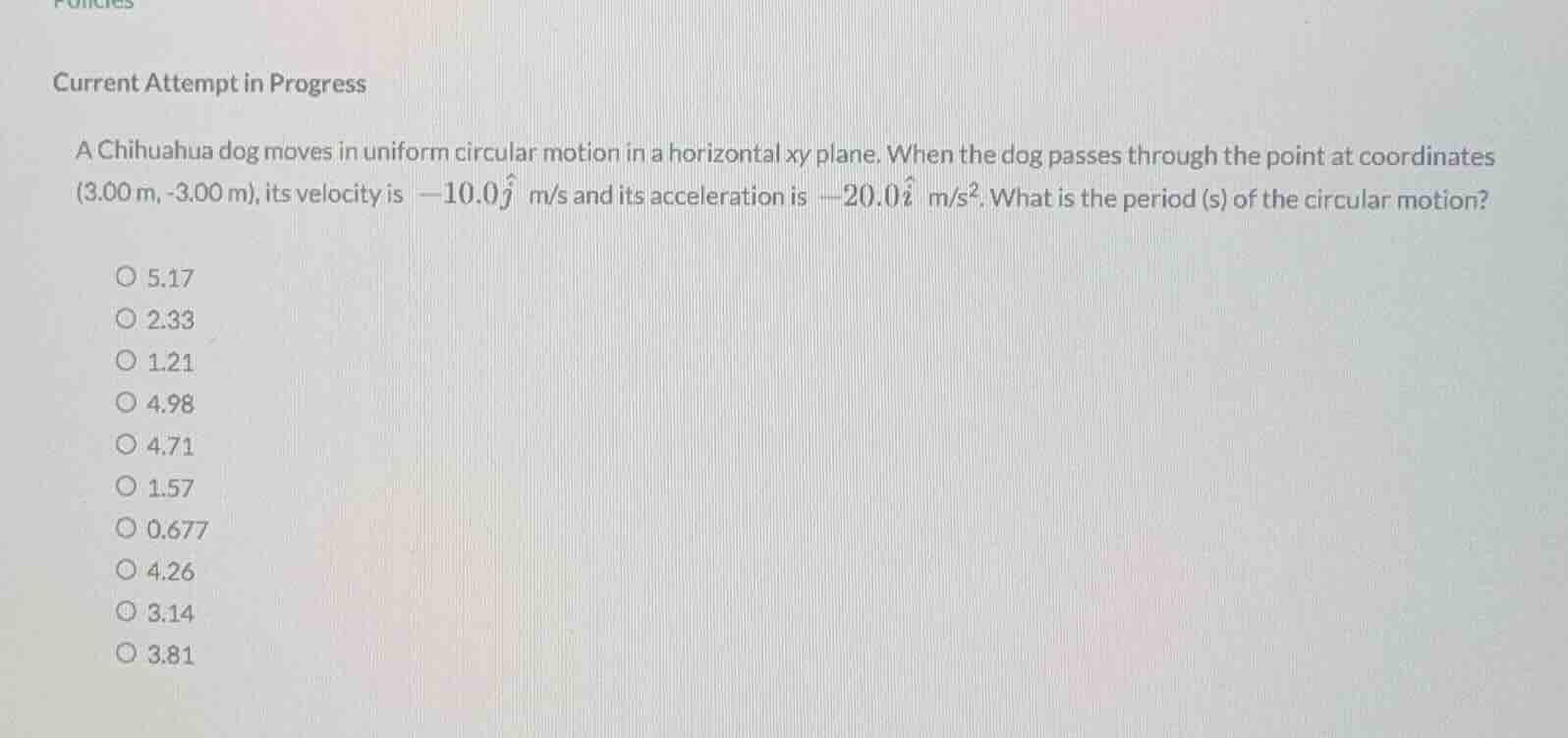
a chihuahua dog moves in uniform circular motion in a horizontal xy plane. when the dog passes through the point at coordinates (3.00 m, -3.00 m), its velocity is $-10.0\hat{j}$ m/s and its acceleration is $-20.0\hat{i}$ m/s². what is the period (s) of the circular motion?
○ 5.17
○ 2.33
○ 1.21
○ 4.98
○ 4.71
○ 1.57
○ 0.677
○ 4.26
○ 3.14
○ 3.81
Step1: Extract speed from velocity
The velocity is $\vec{v} = -10.0\hat{j}$ m/s, so speed $v = |\vec{v}| = 10.0$ m/s.
Step2: Extract acceleration magnitude
The acceleration is $\vec{a} = -20.0\hat{i}$ m/s², so centripetal acceleration $a_c = |\vec{a}| = 20.0$ m/s².
Step3: Relate $a_c$, $v$, and radius $r$
Centripetal acceleration formula: $a_c = \frac{v^2}{r}$. Solve for $r$:
$r = \frac{v^2}{a_c} = \frac{(10.0)^2}{20.0} = 5.00$ m
Step4: Relate period $T$, $v$, and $r$
Circumference is $2\pi r$, so $v = \frac{2\pi r}{T}$. Solve for $T$:
$T = \frac{2\pi r}{v} = \frac{2\pi \times 5.00}{10.0}$

Snap & solve any problem in the app
Get step-by-step solutions on Sovi AI
Photo-based solutions with guided steps
Explore more problems and detailed explanations
3.14