QUESTION IMAGE
Question
current skill $\\$\
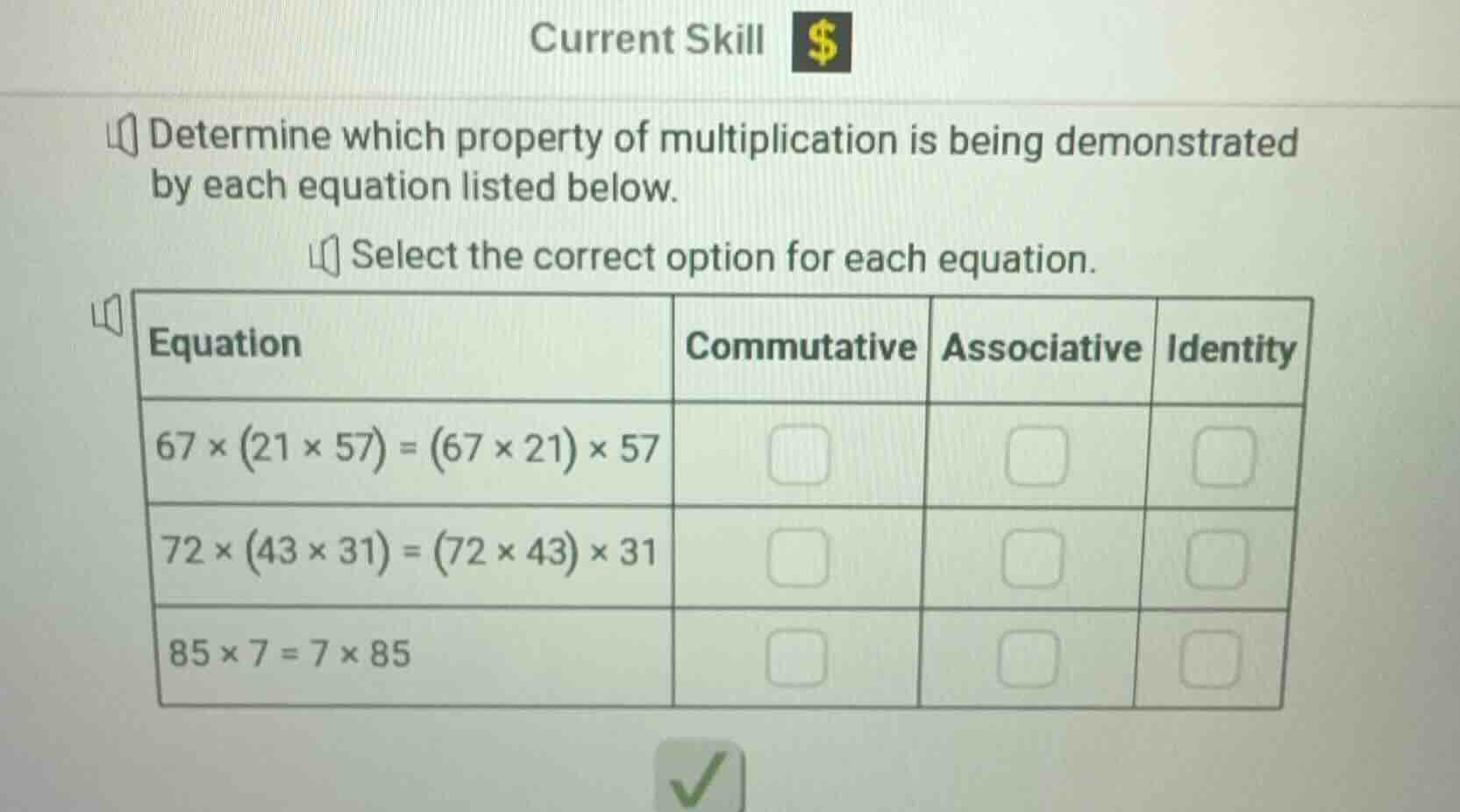
determine which property of multiplication is being demonstrated by each equation listed below.\
select the correct option for each equation.\
| equation | commutative | associative | identity | \ |
| --- | --- | --- | --- | \ |
| $67 \times (21 \times 57) = (67 \times 21) \times 57$ | $\square$ | $\square$ | $\square$ | \ |
| $72 \times (43 \times 31) = (72 \times 43) \times 31$ | $\square$ | $\square$ | $\square$ | \ |
| $85 \times 7 = 7 \times 85$ | $\square$ | $\square$ | $\square$ |
Response
To solve this, we recall the properties of multiplication:
1. For \( 67 \times (21 \times 57) = (67 \times 21) \times 57 \)
- Associative Property: \( (a \times b) \times c = a \times (b \times c) \) (grouping of factors changes, product remains same).
- Here, the grouping of \( 67, 21, 57 \) changes (from \( 21 \times 57 \) grouped first to \( 67 \times 21 \) grouped first), so this is the Associative Property.
2. For \( 72 \times (43 \times 31) = (72 \times 43) \times 31 \)
- Using the same logic as above, the grouping of \( 72, 43, 31 \) changes. This matches the Associative Property (\( (a \times b) \times c = a \times (b \times c) \)).
3. For \( 85 \times 7 = 7 \times 85 \)
- Commutative Property: \( a \times b = b \times a \) (order of factors changes, product remains same).
- Here, \( 85 \) and \( 7 \) swap places, so this is the Commutative Property.
Final Selections:
- \( 67 \times (21 \times 57) = (67 \times 21) \times 57 \): Check the “Associative” column.
- \( 72 \times (43 \times 31) = (72 \times 43) \times 31 \): Check the “Associative” column.
- \( 85 \times 7 = 7 \times 85 \): Check the “Commutative” column.

Snap & solve any problem in the app
Get step-by-step solutions on Sovi AI
Photo-based solutions with guided steps
Explore more problems and detailed explanations
To solve this, we recall the properties of multiplication:
1. For \( 67 \times (21 \times 57) = (67 \times 21) \times 57 \)
- Associative Property: \( (a \times b) \times c = a \times (b \times c) \) (grouping of factors changes, product remains same).
- Here, the grouping of \( 67, 21, 57 \) changes (from \( 21 \times 57 \) grouped first to \( 67 \times 21 \) grouped first), so this is the Associative Property.
2. For \( 72 \times (43 \times 31) = (72 \times 43) \times 31 \)
- Using the same logic as above, the grouping of \( 72, 43, 31 \) changes. This matches the Associative Property (\( (a \times b) \times c = a \times (b \times c) \)).
3. For \( 85 \times 7 = 7 \times 85 \)
- Commutative Property: \( a \times b = b \times a \) (order of factors changes, product remains same).
- Here, \( 85 \) and \( 7 \) swap places, so this is the Commutative Property.
Final Selections:
- \( 67 \times (21 \times 57) = (67 \times 21) \times 57 \): Check the “Associative” column.
- \( 72 \times (43 \times 31) = (72 \times 43) \times 31 \): Check the “Associative” column.
- \( 85 \times 7 = 7 \times 85 \): Check the “Commutative” column.