QUESTION IMAGE
Question
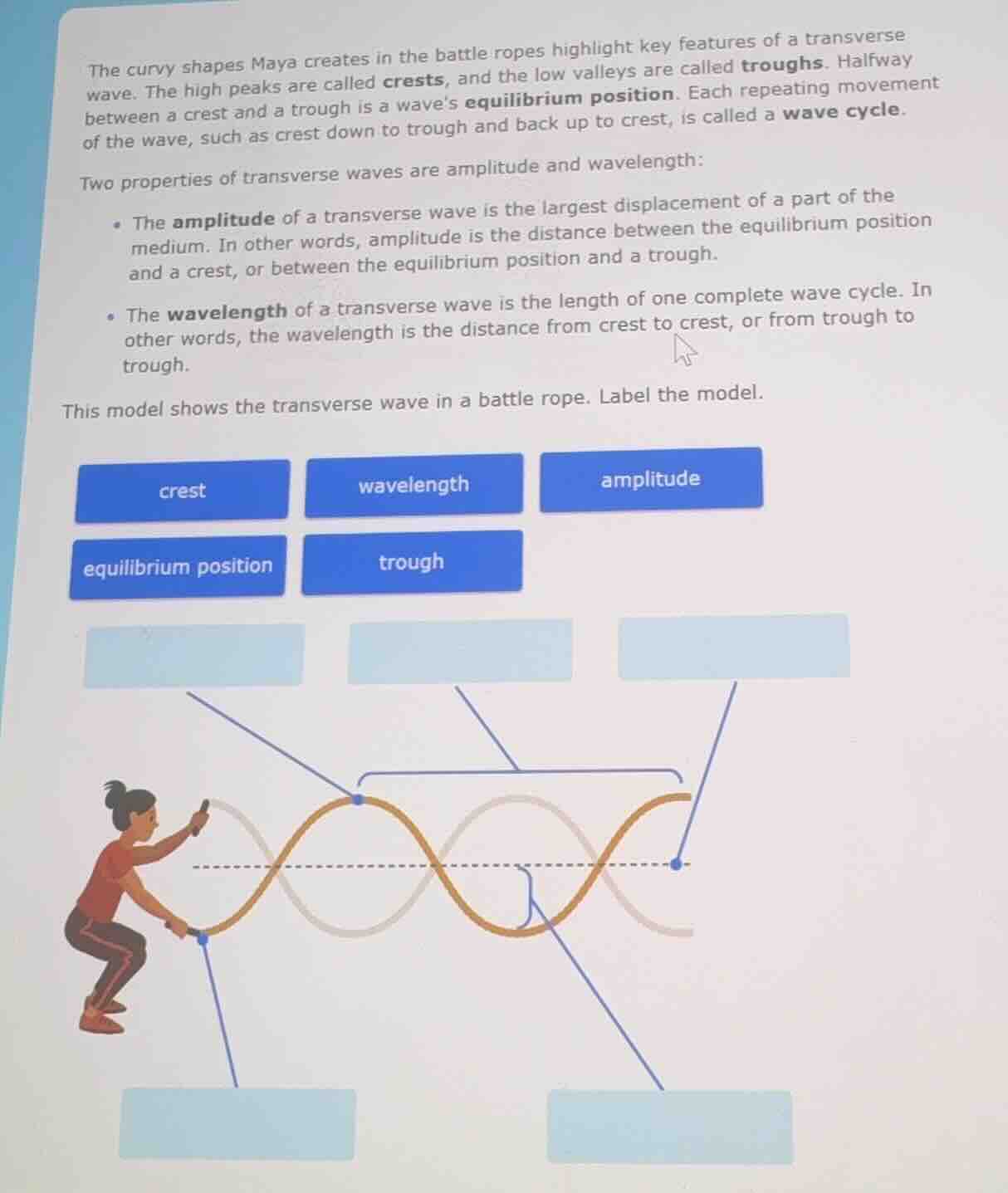
the curvy shapes maya creates in the battle ropes highlight key features of a transverse wave. the high peaks are called crests, and the low valleys are called troughs. halfway between a crest and a trough is a waves equilibrium position. each repeating movement of the wave, such as crest down to trough and back up to crest, is called a wave cycle.
two properties of transverse waves are amplitude and wavelength:
- the amplitude of a transverse wave is the largest displacement of a part of the medium. in other words, amplitude is the distance between the equilibrium position and a crest, or between the equilibrium position and a trough.
- the wavelength of a transverse wave is the length of one complete wave cycle. in other words, the wavelength is the distance from crest to crest, or from trough to trough.
this model shows the transverse wave in a battle rope. label the model.
crest
wavelength
amplitude
equilibrium position
trough
Brief Explanations
- The highest point of the wave matches the definition of a crest.
- The distance between two consecutive crests matches the definition of wavelength.
- The dashed line halfway between crests and troughs is the equilibrium position.
- The lowest point of the wave matches the definition of a trough.
- The distance from the equilibrium position to the trough matches the definition of amplitude.

Snap & solve any problem in the app
Get step-by-step solutions on Sovi AI
Photo-based solutions with guided steps
Explore more problems and detailed explanations
- Top left label (pointing to highest wave peak): crest
- Top middle label (pointing between two crests): wavelength
- Top right label (pointing to dashed line): equilibrium position
- Bottom left label (pointing to lowest wave point): trough
- Bottom right label (pointing from dashed line to trough): amplitude