QUESTION IMAGE
Question
daily life
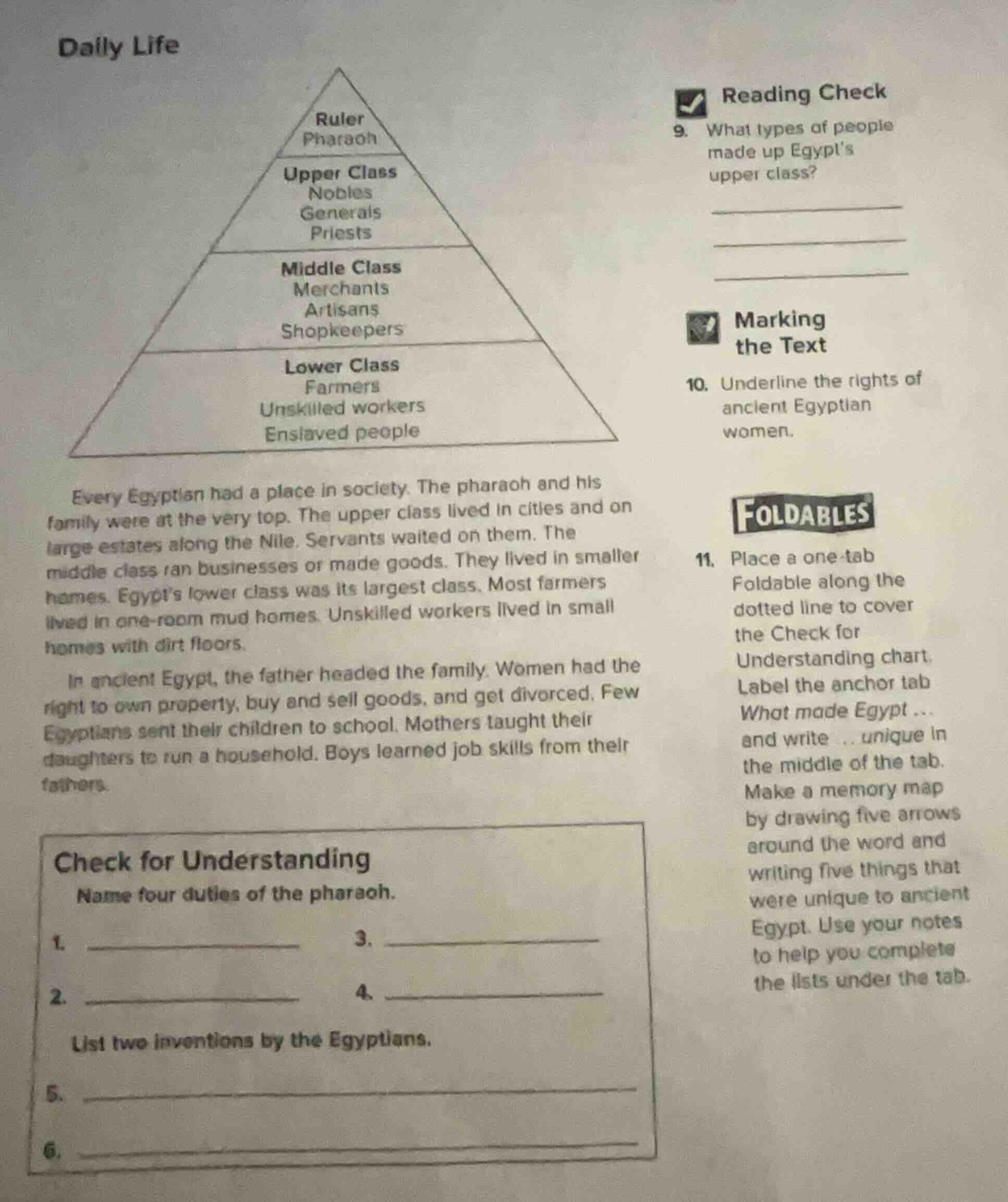
every egyptian had a place in society. the pharaoh and his family were at the very top. the upper class lived in cities and on large estates along the nile. servants waited on them. the middle class ran businesses or made goods. they lived in smaller homes. egypt’s lower class was its largest class. most farmers lived in one - room mud homes. unskilled workers lived in small homes with dirt floors.
in ancient egypt, the father headed the family. women had the right to own property, buy and sell goods, and get divorced. few egyptians sent their children to school. mothers taught their daughters to run a household. boys learned job skills from their fathers.
check for understanding
name four duties of the pharaoh.
- ______________ 3. ______________
- ______________ 4. ______________
list two inventions by the egyptians.
- ________________
- ________________
reading check
- what types of people made up egypt’s upper class?
________________
________________
________________
marking the text
- underline the rights of ancient egyptian women.
foldables
- place a one - tab foldable along the dotted line to cover the check for understanding chart. label the anchor tab what made egypt … and write … unique in the middle of the tab. make a memory map by drawing five arrows around the word and writing five things that were unique to ancient egypt. use your notes to help you complete the lists under the tab.
(chart: a pyramid showing the social classes of ancient egypt. from top to bottom: ruler (pharaoh); upper class (nobles, generals, priests); middle class (merchants, artisans, shopkeepers); lower class (farmers, unskilled workers, enslaved people))
Question 9
To determine the upper class of Egypt, we refer to the pyramid and text. The pyramid's upper class section lists Nobles, Generals, Priests, and the ruler is Pharaoh (though Pharaoh is the top ruler, the upper class includes Nobles, Generals, Priests as per the diagram and text context about upper - class residents in cities/estates with servants).
From the text: "Women had the right to own property, buy and sell goods, and get divorced." We need to underline these rights in the relevant text part.
This is a hands - on task. First, place a one - tab Foldable along the dotted line to cover the Check for Understanding chart. Then label the anchor tab "What made Egypt...", write "unique in the middle of the tab", and make a memory map by drawing five arrows around the word (presumably a key word related to Egypt's uniqueness, like "Egypt" or a related term) and writing five unique things about ancient Egypt (e.g., pyramid construction, hieroglyphics, Nile - based agriculture, mummification, social hierarchy structure) using notes.

Snap & solve any problem in the app
Get step-by-step solutions on Sovi AI
Photo-based solutions with guided steps
Explore more problems and detailed explanations
The people who made up Egypt's upper class were Nobles, Generals, Priests (and the Pharaoh was the ruler at the very top of the social structure, with the upper class including Nobles, Generals, and Priests who lived in cities and on large estates along the Nile with servants waiting on them).