QUESTION IMAGE
Question
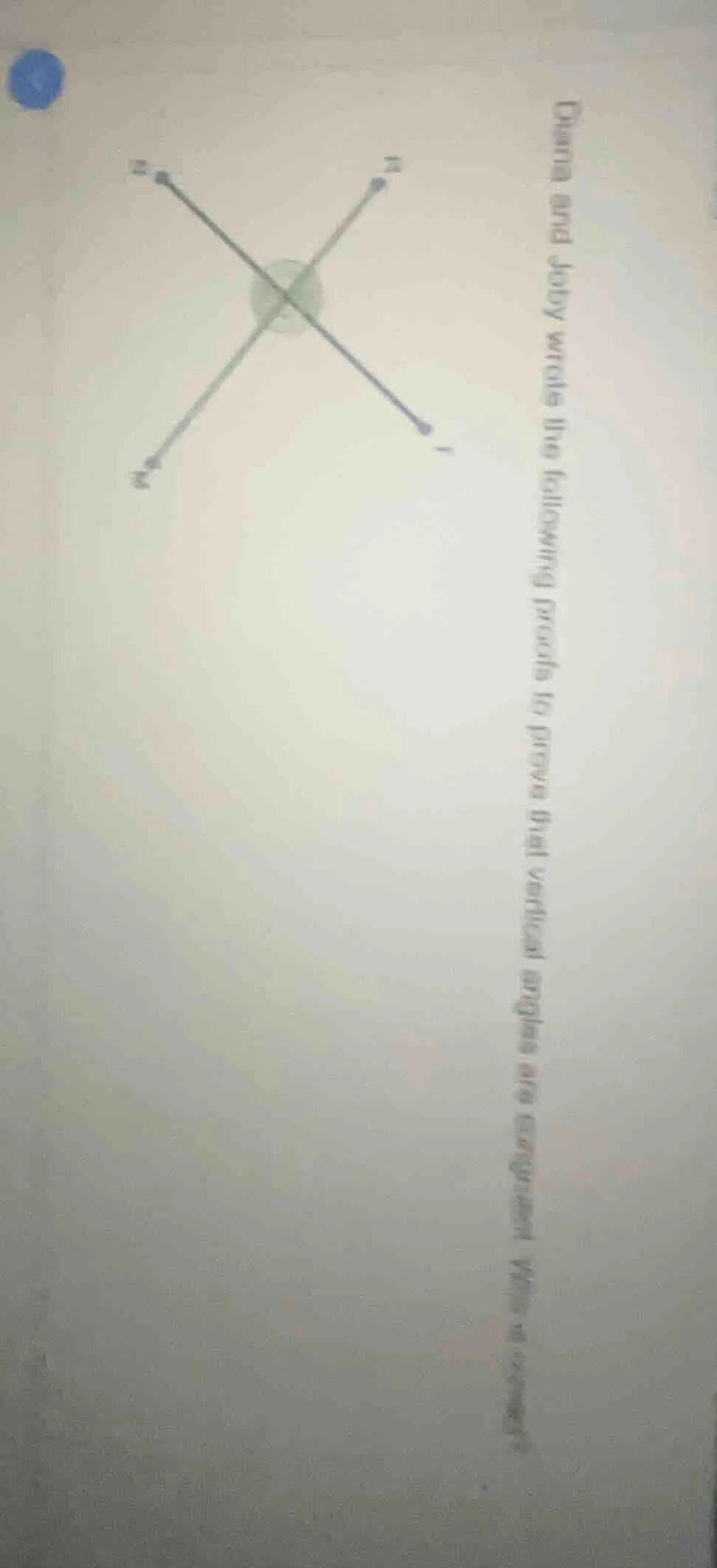
dana and joby wrote the following proofs to prove that vertical angles are congruent. which is correct?
To prove vertical angles are congruent, let's assume two lines \( l \) and \( m \) intersect at a point, forming vertical angles \( \angle 1 \) and \( \angle 2 \), and another pair \( \angle 3 \) and \( \angle 4 \).
Step 1: Linear Pair Postulate
A linear pair of angles is supplementary (their sum is \( 180^\circ \)). For \( \angle 1 \) and \( \angle 3 \):
\( \angle 1 + \angle 3 = 180^\circ \) (Linear Pair Postulate)
For \( \angle 2 \) and \( \angle 3 \):
\( \angle 2 + \angle 3 = 180^\circ \) (Linear Pair Postulate)
Step 2: Substitution Property
From Step 1, both \( \angle 1 + \angle 3 \) and \( \angle 2 + \angle 3 \) equal \( 180^\circ \). Thus:
\( \angle 1 + \angle 3 = \angle 2 + \angle 3 \)
Step 3: Subtract \( \angle 3 \) from Both Sides
Subtract \( \angle 3 \) from both sides of the equation:
\( \angle 1 + \angle 3 - \angle 3 = \angle 2 + \angle 3 - \angle 3 \)
Simplifying, we get:
\( \angle 1 = \angle 2 \)
This shows that vertical angles are congruent (equal in measure).

Snap & solve any problem in the app
Get step-by-step solutions on Sovi AI
Photo-based solutions with guided steps
Explore more problems and detailed explanations
Vertical angles are congruent (proven via linear pair postulate and substitution).