QUESTION IMAGE
Question
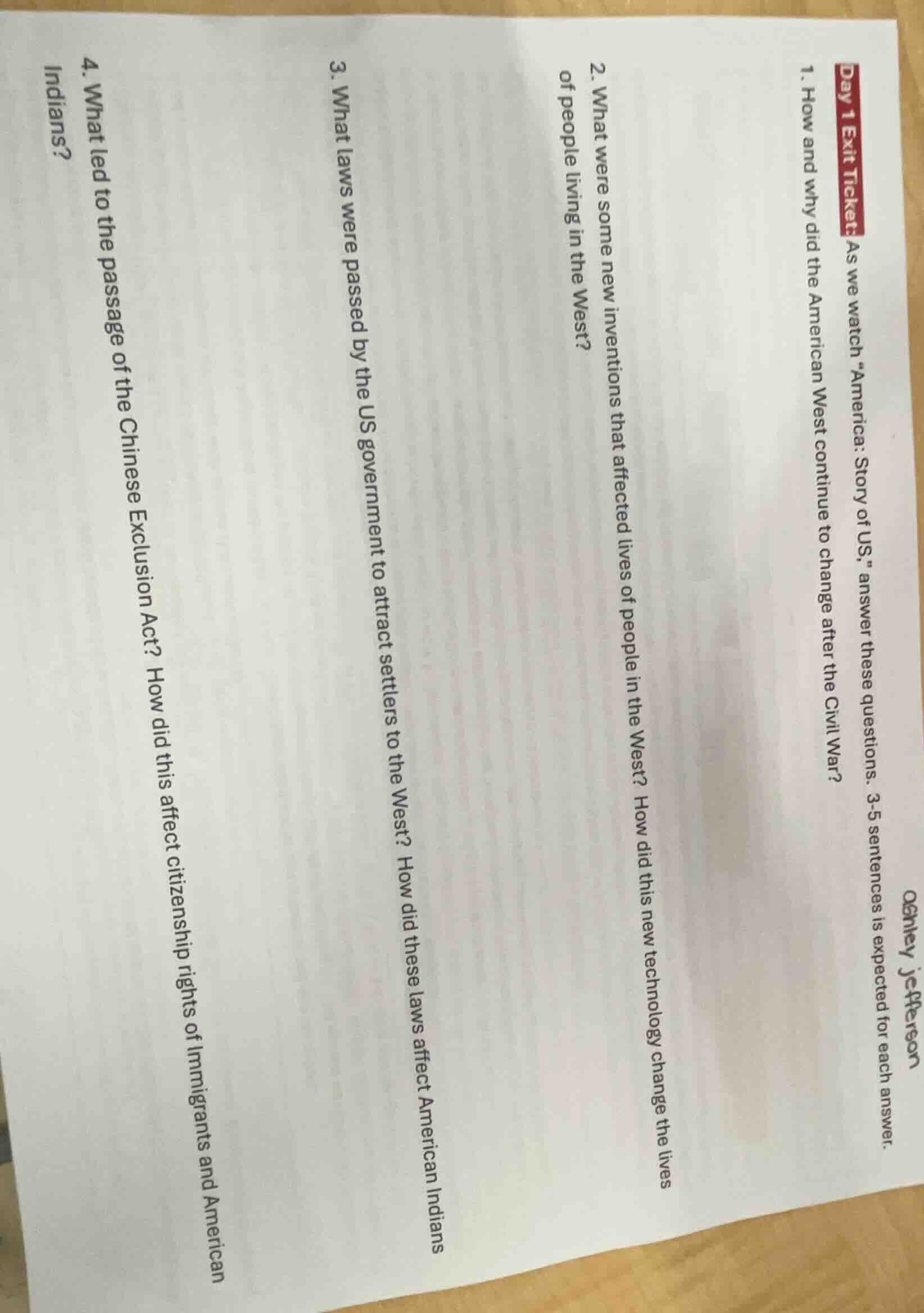
day 1 exit ticket: as we watch \america: story of us,\ answer these questions. 3-5 sentences is expected for each answer.
- how and why did the american west continue to change after the civil war?
- what were some new inventions that affected lives of people in the west? how did this new technology change the lives of people living in the west?
- what laws were passed by the us government to attract settlers to the west? how did these laws affect american indians
- what led to the passage of the chinese exclusion act? how did this affect citizenship rights of immigrants and american indians?
Brief Explanations
- After the Civil War, the American West changed due to federal policies encouraging settlement, industrialization, and displacement of Indigenous peoples. The U.S. government passed laws like the Homestead Act to give away public land to white settlers, drawing millions west to farm. Railroads, funded by federal land grants, expanded across the region, connecting the West to Eastern markets, which spurred cattle ranching and mining economies. At the same time, the government forced Indigenous nations onto smaller reservations through military action and treaties, taking over their lands for development. These shifts turned the West from a region dominated by Indigenous self-governance and subsistence economies into an integrated part of the industrializing U.S., focused on extractive industries and agricultural production.
- Key new inventions that transformed life in the West included the barbed wire, mechanical reaper, and railroad refrigerated cars. Barbed wire, invented in the 1870s, allowed farmers to cheaply fence off land, ending the open-range cattle industry and limiting access to grazing land for both ranchers and Indigenous groups. The mechanical reaper made large-scale wheat farming efficient, enabling farmers to harvest far more crops than by hand, which supported the growth of commercial agriculture in the Great Plains. Refrigerated rail cars meant perishable goods like beef could be shipped to Eastern markets, turning cattle ranching in Texas and the Plains into a profitable national industry. These technologies shifted the West from a semi-nomadic, subsistence-based region to one focused on commercial, market-linked production, while also displacing traditional ways of life for Indigenous peoples and small-scale ranchers.
- The U.S. government passed laws like the Homestead Act (1862), Pacific Railway Acts (1862-1864), and Dawes Act (1887) to attract settlers. The Homestead Act gave 160-acre plots of public land to any U.S. citizen or intended citizen who lived on and improved the land for 5 years, drawing millions of white, Black, and immigrant farmers west. The Pacific Railway Acts provided federal land grants and loans to railroad companies to build transcontinental rail lines, which made travel and shipping to the West easier, encouraging settlement and economic development. These laws severely harmed American Indians: the Homestead and Railway Acts seized millions of acres of Indigenous land, while the Dawes Act broke up tribal communal land into individual plots, forcing Indigenous peoples to adopt European-American farming practices and eroding tribal sovereignty and cultural traditions.
- The Chinese Exclusion Act of 1882 was passed due to anti-Chinese nativism, driven by economic competition and racial prejudice. Chinese immigrants had been hired for low-wage work on railroads and in mines in the West, and white settlers blamed them for economic downturns and job shortages, especially after the 1870s depression. Politicians catered to this prejudice to win white working-class votes. The Act banned all Chinese immigration for 10 years (later extended) and barred Chinese immigrants from becoming U.S. citizens. For Chinese immigrants, this stripped them of the right to naturalize, separated families, and left them vulnerable to discrimination and violence. For American Indians, the Act was part of a broader federal policy of prioritizing white settlement and excluding non-white groups; it did not directly affect their citizenship rights, but it reinforced the U.S. government's pattern of using racial exclus…

Snap & solve any problem in the app
Get step-by-step solutions on Sovi AI
Photo-based solutions with guided steps
Explore more problems and detailed explanations
- After the Civil War, the American West transformed rapidly due to federal settlement policies, industrialization, and the displacement of Indigenous peoples. The Homestead Act (1862) offered 160-acre land plots to white, Black, and immigrant settlers who improved the land, drawing millions west to establish commercial farms. Federal land grants funded transcontinental railroads, which connected the West to Eastern markets, spurring growth in cattle ranching and mining. Simultaneously, the U.S. military forced Indigenous nations onto small reservations, seizing their lands for settler use. These changes shifted the West from a region of Indigenous self-governance and semi-nomadic economies to an integrated part of the U.S.'s industrial, market-driven system, defined by commercial agriculture, extractive industries, and white demographic dominance.
- Inventions like barbed wire, the mechanical reaper, and refrigerated rail cars reshaped Western life. Barbed wire allowed farmers to cheaply fence land, ending the open cattle range and restricting access for Indigenous groups and small ranchers. The mechanical reaper enabled large-scale wheat farming, turning the Great Plains into a major commercial agricultural hub. Refrigerated rail cars let ranchers ship beef to Eastern markets, making cattle ranching a profitable national industry. These technologies shifted the West to market-focused production, displacing traditional subsistence and nomadic lifestyles, and prioritized settler economic interests over Indigenous rights.
- Laws like the Homestead Act, Pacific Railway Acts, and Dawes Act attracted settlers. The Homestead Act gave free public land to settlers who improved it, drawing millions west. Railway Acts funded transcontinental rail lines, easing travel and shipping to the region. The Dawes Act broke up tribal communal land into individual plots, forcing Indigenous peoples to adopt settler farming practices. These laws dispossessed American Indians of millions of acres of land, eroded tribal sovereignty, and destroyed traditional cultural and economic systems, as the government prioritized white settlement and economic development over Indigenous self-determination.
- The Chinese Exclusion Act (1882) was driven by anti-Chinese nativism: white settlers resented Chinese immigrants for taking low-wage railroad and mining jobs, especially during economic downturns, and politicians exploited this prejudice for votes. The Act banned Chinese immigration for a decade (later extended) and barred Chinese immigrants from U.S. citizenship. For Chinese immigrants, it separated families, stripped them of naturalization rights, and left them vulnerable to discrimination. For American Indians, it reinforced the federal policy of racial exclusion and white dominance in the West, part of a broader pattern of dispossession and marginalization of non-white groups to prioritize settler control of Western lands.