QUESTION IMAGE
Question
x =
db =
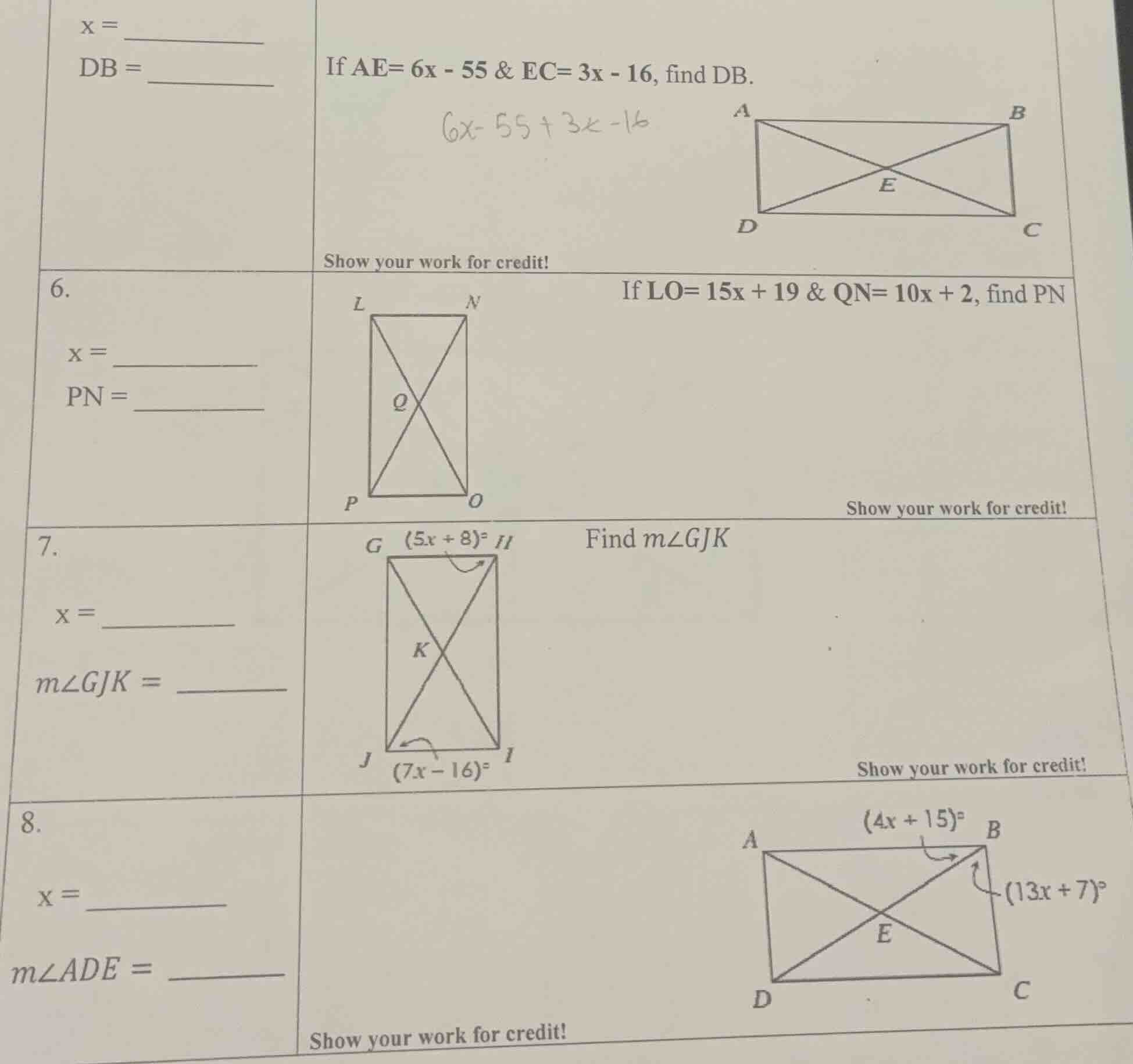
if ae= 6x - 55 & ec= 3x - 16, find db.
6x - 55 + 3x - 16
show your work for credit!
6.
if lo= 15x + 19 & qn= 10x + 2, find pn
x =
pn =
show your work for credit!
7.
find ( mangle gjk )
x =
( mangle gjk = )
show your work for credit!
8.
x =
( mangle ade = )
show your work for credit!
Problem 1 (Top - Rectangle Diagonals)
Step1: Recall Rectangle Diagonal Property
In a rectangle, the diagonals are equal and bisect each other. So \( AE = EC \) (since diagonals bisect each other).
Set \( 6x - 55=3x - 16 \)
Step2: Solve for \( x \)
Subtract \( 3x \) from both sides: \( 6x - 3x-55 = 3x - 3x-16 \)
\( 3x-55=-16 \)
Add 55 to both sides: \( 3x-55 + 55=-16 + 55 \)
\( 3x = 39 \)
Divide by 3: \( x=\frac{39}{3}=13 \)
Step3: Find \( AC \) (then \( DB \) since diagonals are equal)
First, find \( AE \): \( AE = 6(13)-55=78 - 55 = 23 \)
\( EC = 3(13)-16=39 - 16 = 23 \) (checks out)
\( AC=AE + EC=23 + 23 = 46 \)
Since \( DB = AC \) (diagonals of rectangle are equal), \( DB = 46 \)
Step1: Recall Rectangle Diagonal Property
In a rectangle, diagonals are equal and bisect each other. So \( LO=PN \) (wait, actually, diagonals are equal, so \( LO = PN \)? Wait, no, in rectangle \( LPNO \) (assuming it's a rectangle), diagonals \( LN \) and \( PO \) bisect each other at \( Q \), and \( LO \) is half of a diagonal? Wait, no, the problem says \( LO = 15x + 19 \) and \( QN=10x + 2 \). Wait, in a rectangle, diagonals are equal, so \( LN=PO \), and \( Q \) is the midpoint, so \( QN=\frac{1}{2}PO \) and \( LO=\frac{1}{2}LN \). Since \( LN = PO \), then \( LO = QN\times2 \)? Wait, no, maybe \( LO \) is a diagonal? Wait, the figure is a rectangle \( LPNO \), so diagonals \( LN \) and \( PO \) intersect at \( Q \). So \( LO \) is a side? Wait, no, the labels are \( L, N, P, O \). Let's assume \( LO \) and \( PN \) are diagonals? Wait, no, the problem says "If \( LO = 15x + 19 \) & \( QN = 10x + 2 \), find \( PN \)". In a rectangle, diagonals are equal, and the midpoint divides them into two equal parts. So \( PN \) is a diagonal, and \( QN \) is half of a diagonal? Wait, maybe \( LO \) is equal to \( PN \)? No, let's re - examine. Wait, maybe the rectangle has diagonals \( LN \) and \( PO \), and \( LO \) is a side? No, the problem is likely that in the rectangle, \( LO \) and \( PN \) are related such that \( LO = PN \) (diagonals), but \( QN \) is half of a diagonal. Wait, no, let's correct: In a rectangle, diagonals are equal, so \( LN = PO \). The midpoint \( Q \) means \( QN=\frac{1}{2}LN \) and \( QO=\frac{1}{2}PO \). Since \( LN = PO \), then \( QN = QO \), and \( LO \) is a segment. Wait, maybe the problem has a typo, but assuming that \( LO \) is equal to \( PN \) (diagonals), but no, let's use the property that diagonals are equal, so \( LO = PN \) and \( QN=\frac{1}{2}PN \). So \( LO = 2\times QN \)
So \( 15x + 19=2(10x + 2) \)
Step2: Solve for \( x \)
Expand right side: \( 15x + 19 = 20x+4 \)
Subtract \( 15x \): \( 19=5x + 4 \)
Subtract 4: \( 15 = 5x \)
Divide by 5: \( x = 3 \)
Step3: Find \( PN \)
Since \( PN=LO \) (diagonals are equal), \( PN=15(3)+19=45 + 19 = 64 \)
Step1: Recall Rectangle Properties
In a rectangle, opposite sides are parallel, so \( GJ\parallel II \) (wait, the figure has \( G, J, I, I \)? Wait, the angle at \( I \) is \( (5x + 8)^\circ \) and at \( J \) is \( (7x - 16)^\circ \). Since \( GJ\parallel II \) (assuming \( GJ \) and \( II \) are parallel, and \( JI \) is a transversal), the alternate interior angles are equal? Wait, no, in a rectangle, the triangles formed by diagonals are isosceles. Wait, the angles \( \angle GIJ=(5x + 8)^\circ \) and \( \angle GJI=(7x - 16)^\circ \). In triangle \( GJI \), since \( GJ = II \) (sides of rectangle), triangle \( GJI \) is isosceles? Wait, no, maybe the angles are equal because of parallel sides. Wait, actually, in a rectangle, the diagonals are equal and bisect each other, so the triangles formed are isosceles. But maybe the angles \( (5x + 8) \) and \( (7x - 16) \) are equal? Let's set them equal:
\( 5x + 8=7x - 16 \)
Step2: Solve for \( x \)
Subtract \( 5x \) from both sides: \( 8 = 2x-16 \)
Add 16 to both sides: \( 24 = 2x \)
Divide by 2: \( x = 12 \)
Step3: Find \( m\angle GJK \)
First, find \( \angle GJI=(7x - 16)^\circ=7(12)-16 = 84 - 16 = 68^\circ \)
Wait, \( \angle GJK \) is half of \( \angle GJI \)? No, maybe \( \angle GJK \) is related. Wait, maybe the angle \( \angle GJK \) is equal to \( \angle GIJ \) or something. Wait, no, let's re - check. If \( x = 12 \), then \( 5x + 8=5(12)+8 = 68^\circ \), \( 7x - 16=7(12)-16 = 68^\circ \). So triangle \( GJI \) is isosceles with \( \angle GIJ=\angle GJI = 68^\circ \). Then \( \angle GJK \) is half of \( \angle GJI \)? Wait, no, maybe \( K \) is the midpoint of the diagonals, so \( JK \) bisects \( \angle GJI \). So \( m\angle GJK=\frac{1}{2}\times68^\circ = 34^\circ \)? Wait, no, maybe I made a mistake. Wait, the problem says "Find \( m\angle GJK \)". If the two angles \( (5x + 8) \) and \( (7x - 16) \) are equal (since it's a rectangle, alternate interior angles), then \( x = 12 \), and then \( \angle GJK \) is equal to one of them? Wait, no, maybe the angle \( \angle GJK \) is equal to \( (5x + 8) \) or \( (7x - 16) \). Wait, when \( x = 12 \), \( 5x + 8=68 \), \( 7x - 16 = 68 \). So maybe \( m\angle GJK = 34^\circ \)? Wait, no, let's think again. In a rectangle, diagonals bisect each other and are equal, so the triangles formed are isosceles. The angle at \( J \) and \( I \) are equal, so \( \angle GJI=\angle GIJ = 68^\circ \). Then \( \angle GJK \) is half of \( \angle GJI \) because \( K \) is the intersection of diagonals, so \( JK \) bisects \( \angle GJI \). So \( m\angle GJK=\frac{68^\circ}{2}=34^\circ \)

Snap & solve any problem in the app
Get step-by-step solutions on Sovi AI
Photo-based solutions with guided steps
Explore more problems and detailed explanations
\( x = 13 \)
\( DB = 46 \)