QUESTION IMAGE
Question
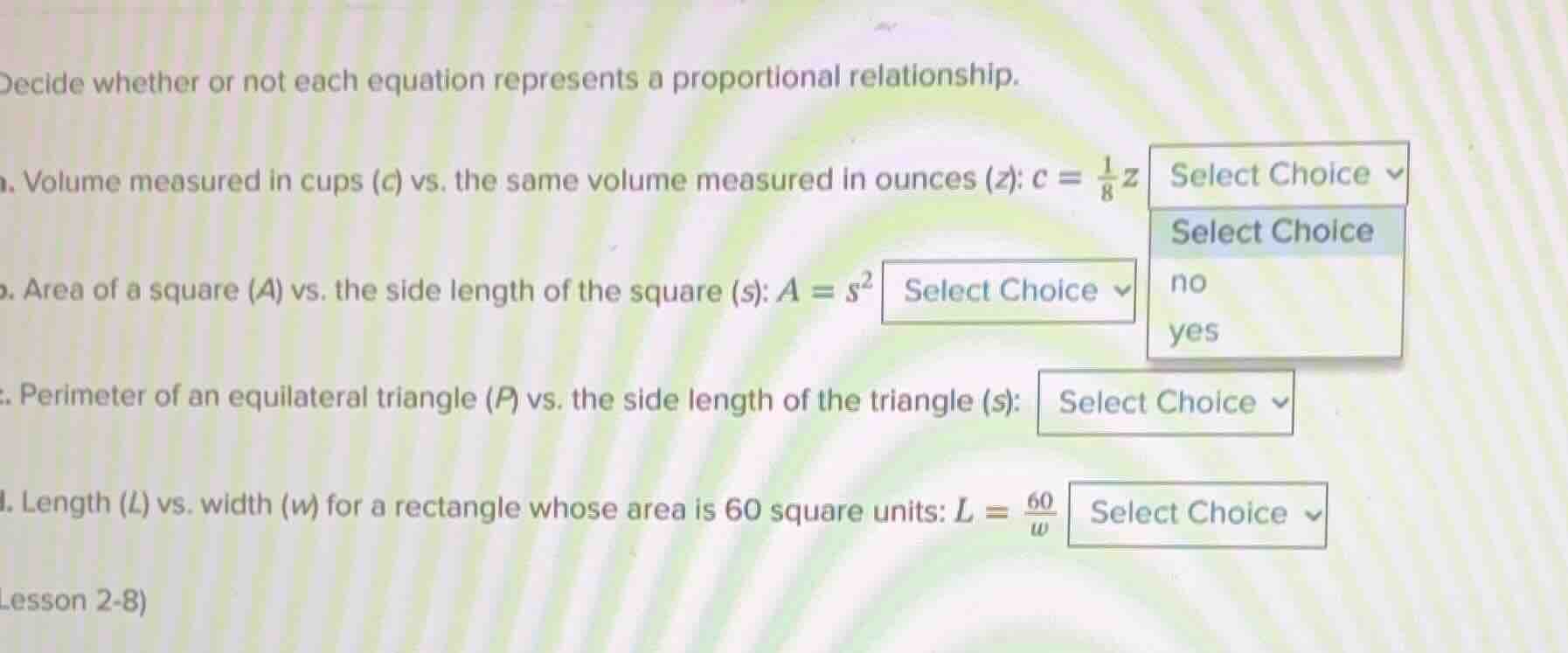
decide whether or not each equation represents a proportional relationship.
a. volume measured in cups (c) vs. the same volume measured in ounces (z): $c = \frac{1}{8}z$ select choice
select choice
no
yes
b. area of a square (a) vs. the side length of the square (s): $a = s^2$ select choice
c. perimeter of an equilateral triangle (p) vs. the side length of the triangle (s): select choice
d. length (l) vs. width (w) for a rectangle whose area is 60 square units: $l = \frac{60}{w}$ select choice
lesson 2 - 8)
Part a
Step 1: Recall proportional relationship form
A proportional relationship is of the form \( y = kx \) (or \( c = kz \) here), where \( k \) is a constant and there's no constant term added. The equation is \( c=\frac{1}{8}z \), which matches \( c = kz \) with \( k=\frac{1}{8} \).
Step 2: Determine proportionality
Since it fits the \( y = kx \) form (no additional constant), it is a proportional relationship.
Step 1: Recall proportional relationship form
A proportional relationship is linear and of the form \( y = kx \). The equation here is \( A = s^{2} \), which is a quadratic (power of 2) relationship, not linear.
Step 2: Determine proportionality
Since it's not in the \( y = kx \) form (it's a square relationship), it is not a proportional relationship.
Step 1: Recall the formula for equilateral triangle perimeter
The perimeter \( P \) of an equilateral triangle with side length \( s \) is \( P = 3s \) (since all three sides are equal, so sum of sides is \( s + s + s=3s \)).
Step 2: Check proportional relationship form
The equation \( P = 3s \) fits the \( y = kx \) form with \( k = 3 \), so it is a proportional relationship.

Snap & solve any problem in the app
Get step-by-step solutions on Sovi AI
Photo-based solutions with guided steps
Explore more problems and detailed explanations
yes