QUESTION IMAGE
Question
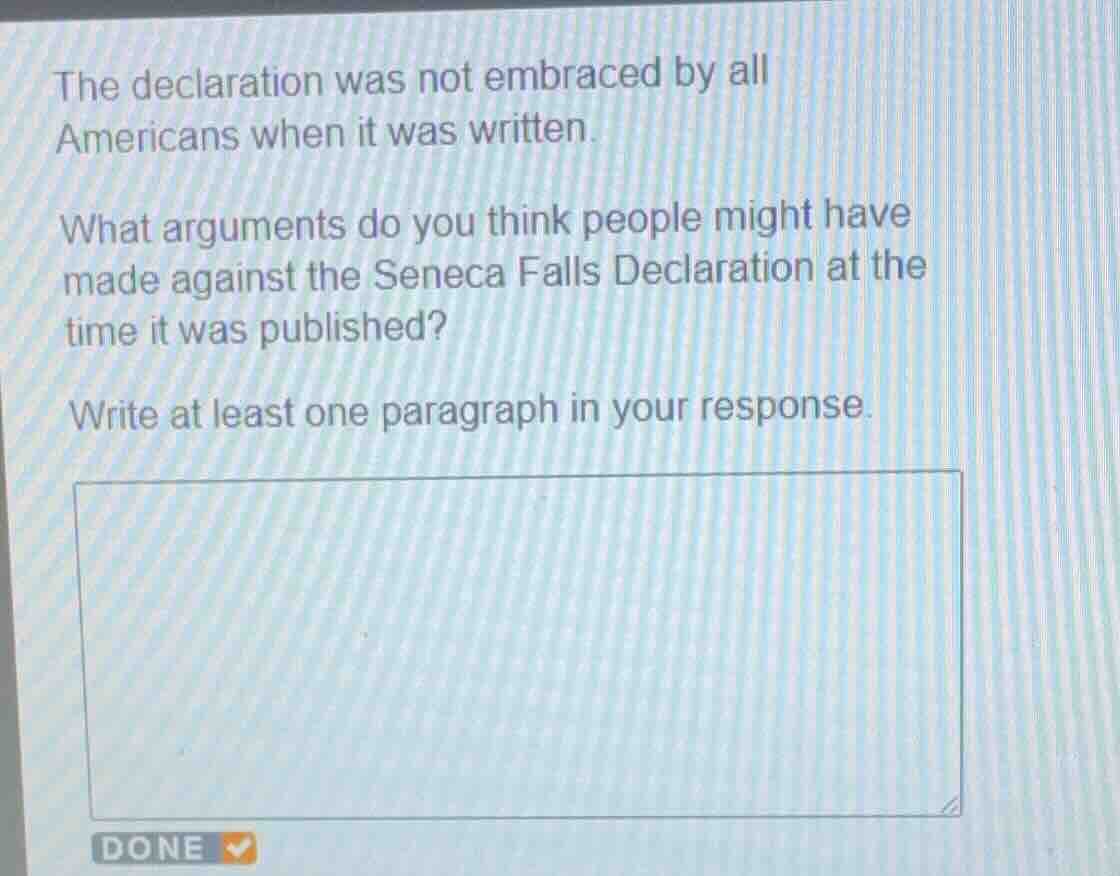
the declaration was not embraced by all americans when it was written.
what arguments do you think people might have made against the seneca falls declaration at the time it was published?
write at least one paragraph in your response.
To determine arguments against the Seneca Falls Declaration, we analyze the 1848 context. The Declaration of Sentiments demanded women’s rights, including suffrage. Many held traditional gender roles: women as caregivers, men as providers. Religious opponents cited biblical interpretations (e.g., Eve’s “sin,” Paul’s “women should be silent” in 1 Corinthians) to argue women’s “place” was home, not politics. Social conservatives feared disrupting family/community order—giving women rights (like voting, property ownership) would upend societal structure. Economic interests (e.g., employers relying on cheap female labor, or men fearing loss of authority) also fueled opposition. These arguments reflected 19th - century patriarchal norms, religious traditionalism, and resistance to social change.

Snap & solve any problem in the app
Get step-by-step solutions on Sovi AI
Photo-based solutions with guided steps
Explore more problems and detailed explanations
At the time of the Seneca Falls Declaration’s publication in 1848, many arguments arose against it, rooted in 19th - century societal norms. Traditionalists, including religious leaders, argued that the Declaration’s call for women’s rights (especially suffrage) violated “natural” gender roles: women were seen as morally and socially obligated to focus on domestic duties (child - rearing, homemaking), while men were deemed the “breadwinners” and political actors. Religious opponents cited biblical passages (e.g., interpretations of Eve’s role in the Garden of Eden, or Paul’s instructions for women to be silent in church) to claim women’s “proper” sphere was the home, not public life. Social conservatives also feared that granting women rights like voting or property ownership would destabilize family and community structures—they believed such changes would erode men’s authority and disrupt the hierarchical order of society. Additionally, economic interests played a role: some employers, who benefited from the exploitation of cheap female labor, worried that empowering women might lead to demands for fair wages or better working conditions. Meanwhile, many men feared losing their dominant social and political status if women gained equal rights, leading them to dismiss the Declaration as a threat to the established social order.