QUESTION IMAGE
Question
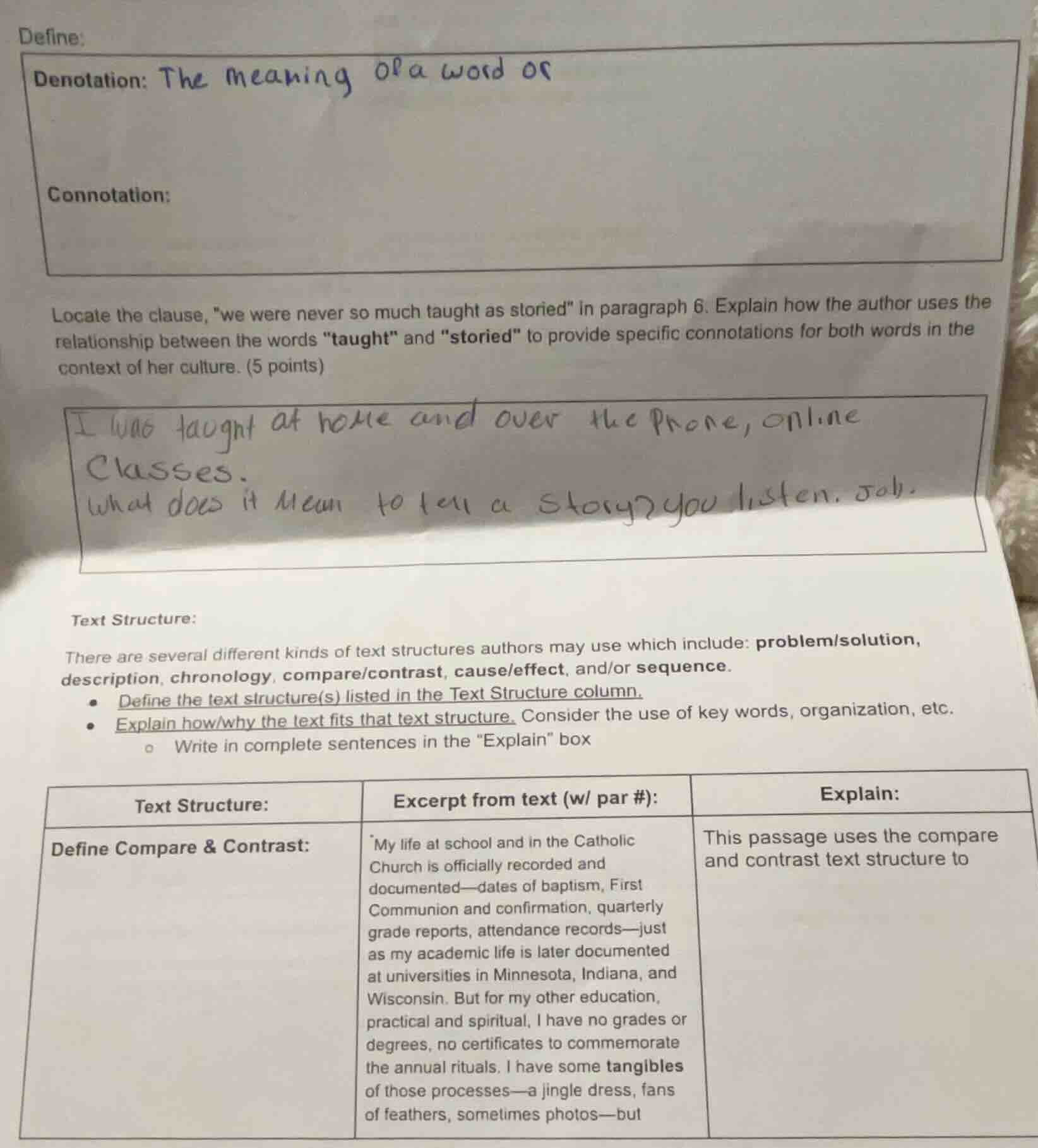
define:
denotation: the meaning of a word or
connotation:
locate the clause, \we were never so much taught as storied\ in paragraph 6. explain how the author uses the relationship between the words \taught\ and \storied\ to provide specific connotations for both words in the context of her culture. (5 points)
i was taught at home and over the phone, online classes.
what does it mean to tell a story? you listen. job.
text structure:
there are several different kinds of text structures authors may use which include: problem/solution, description, chronology, compare/contrast, cause/effect, and/or sequence.
- define the text structure(s) listed in the text structure column.
- explain how/why the text fits that text structure. consider the use of key words, organization, etc.
- write in complete sentences in the \explain\ box
text structure: | excerpt from text (w/ par #): | explain:
define compare & contrast: | my life at school and in the catholic church is officially recorded and documented—dates of baptism, first communion and confirmation, quarterly grade reports, attendance records—just as my academic life is later documented at universities in minnesota, indiana, and wisconsin. but for my other education, practical and spiritual, i have no grades or degrees, no certificates to commemorate the annual rituals. i have some tangibles of those processes—a jingle dress, fans of feathers, sometimes photos—but | this passage uses the compare and contrast text structure to
- Denotation & Connotation Definitions:
- Denotation is the literal, dictionary definition of a word, independent of context.
- Connotation refers to the implied, cultural, emotional, or contextual meanings associated with a word beyond its literal definition.
- Analysis of "taught" and "storied":
- "Taught" connotes formal, structured, often Western-style education (like the written/online learning noted) with a focus on instruction and compliance.
- "Storied" connotes a cultural, oral, communal form of learning rooted in Indigenous storytelling: it implies active listening, absorption of cultural values, history, and identity through narrative, rather than formal lessons. The author contrasts these to highlight that her cultural education was relational and experiential, not rigidly instructional.
- Compare & Contrast Definition:
- Compare & Contrast is a text structure that identifies similarities and differences between two or more subjects, ideas, or experiences.
- Text Structure Explanation Completion:
- The excerpt contrasts two types of education: the formal, documented school/religious education (with official records like grades, baptism dates) and the informal, practical/spiritual cultural education (with tangible but unrecorded markers like a jingle dress). The keyword "But" signals the contrast, showing the difference between institutionalized, tracked learning and cultural, experiential learning with no official documentation.

Snap & solve any problem in the app
Get step-by-step solutions on Sovi AI
Photo-based solutions with guided steps
Explore more problems and detailed explanations
- Denotation: The literal, dictionary meaning of a word.
- Connotation: The implied, contextual, or emotional meaning of a word beyond its literal definition.
- "taught" and "storied" analysis:
- "Taught" connotes formal, structured, rule-based instruction (like the online/home lessons noted), tied to Western educational norms.
- "Storied" connotes communal, oral, cultural learning through narrative, emphasizing listening, identity, and experiential absorption of her culture, contrasting the rigidity of "taught" to center her community's relational education style.
- Define Compare & Contrast: A text structure that explores similarities and differences between two or more subjects.
- Completed Explain box:
This passage uses the compare and contrast text structure to distinguish between two forms of the author's education. It first details her formal school and Catholic Church education, which is fully documented with official records like baptism dates, grade reports, and university transcripts. The keyword "But" shifts to contrast this with her informal practical and spiritual cultural education, which has no official grades, degrees, or certificates, only personal tangible items to mark the experiences. This highlights the difference between institutionalized, tracked learning and unrecorded, experiential cultural learning.