QUESTION IMAGE
Question
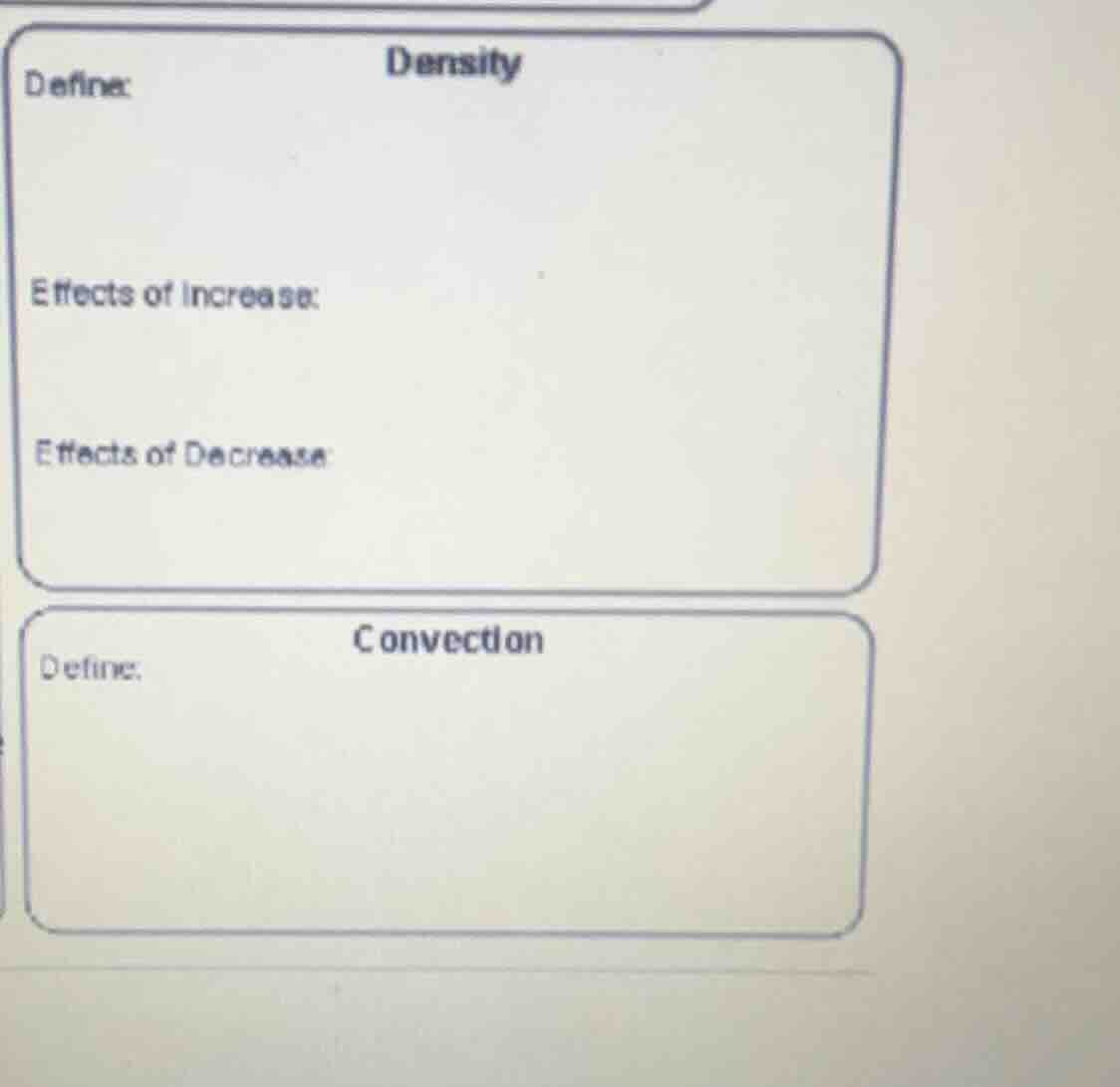
define: density effects of increase: effects of decrease define: convection
Density
Define:
Density is defined as the mass of a substance per unit volume. Mathematically, it is expressed as $
ho = \frac{m}{V}$, where $
ho$ (rho) represents density, $m$ is the mass of the substance, and $V$ is the volume it occupies.
Effects of Increase:
- In Fluid Behavior: An increase in density (for a fluid) can lead to increased buoyant force on objects submerged in it (by Archimedes' principle, $F_b=
ho g V_{displaced}$). If the density of a fluid increases, the buoyant force on a submerged object also increases, which can make it easier for denser objects to float or change the equilibrium position of floating objects.
- In Thermal Properties: For a gas, an increase in density (at constant temperature) might imply higher pressure (from the ideal gas law $PV = nRT$, and density $
ho=\frac{nM}{V}$, so $P=\frac{
ho RT}{M}$ where $M$ is molar mass). In a liquid, increased density can mean slower heat transfer rates in some cases (as the molecules are more closely packed, reducing the space for molecular motion related to heat conduction, though convection patterns can also be affected).
- In Mechanical Stability: In structures or materials, a higher - density material might be stronger (in some cases) but also heavier, which can affect the load - bearing capacity of structures using that material.
Effects of Decrease:
- In Fluid Behavior: A decrease in density (for a fluid) reduces the buoyant force on submerged objects. This can cause objects that were floating or neutrally buoyant to sink or change their floating level. For example, if the density of water in a lake decreases (due to temperature increase or mixing with less - dense water), objects like boats might sit lower in the water or require more displacement to stay afloat.
- In Thermal Properties: For a gas, a decrease in density (at constant temperature) leads to lower pressure (from $P=\frac{
ho RT}{M}$). In a liquid, a decrease in density (e.g., due to heating) can lead to increased convection currents as the less - dense (warmer) liquid rises and the denser (colder) liquid sinks.
- In Mechanical Stability: A lower - density material might be lighter, which is beneficial for applications where weight reduction is important (e.g., in aerospace materials), but it might also have lower strength or durability depending on the material.
Convection
Define:
Convection is the transfer of heat energy within a fluid (liquid or gas) due to the movement of the fluid itself. This movement occurs because of differences in density (usually caused by temperature differences). Warmer (less dense) fluid rises, and cooler (more dense) fluid sinks, creating convection currents. There are two main types: natural convection (driven by natural density differences due to temperature gradients) and forced convection (where the fluid is forced to move, e.g., by a fan or pump).

Snap & solve any problem in the app
Get step-by-step solutions on Sovi AI
Photo-based solutions with guided steps
Explore more problems and detailed explanations
Density
Define:
Density is defined as the mass of a substance per unit volume. Mathematically, it is expressed as $
ho = \frac{m}{V}$, where $
ho$ (rho) represents density, $m$ is the mass of the substance, and $V$ is the volume it occupies.
Effects of Increase:
- In Fluid Behavior: An increase in density (for a fluid) can lead to increased buoyant force on objects submerged in it (by Archimedes' principle, $F_b=
ho g V_{displaced}$). If the density of a fluid increases, the buoyant force on a submerged object also increases, which can make it easier for denser objects to float or change the equilibrium position of floating objects.
- In Thermal Properties: For a gas, an increase in density (at constant temperature) might imply higher pressure (from the ideal gas law $PV = nRT$, and density $
ho=\frac{nM}{V}$, so $P=\frac{
ho RT}{M}$ where $M$ is molar mass). In a liquid, increased density can mean slower heat transfer rates in some cases (as the molecules are more closely packed, reducing the space for molecular motion related to heat conduction, though convection patterns can also be affected).
- In Mechanical Stability: In structures or materials, a higher - density material might be stronger (in some cases) but also heavier, which can affect the load - bearing capacity of structures using that material.
Effects of Decrease:
- In Fluid Behavior: A decrease in density (for a fluid) reduces the buoyant force on submerged objects. This can cause objects that were floating or neutrally buoyant to sink or change their floating level. For example, if the density of water in a lake decreases (due to temperature increase or mixing with less - dense water), objects like boats might sit lower in the water or require more displacement to stay afloat.
- In Thermal Properties: For a gas, a decrease in density (at constant temperature) leads to lower pressure (from $P=\frac{
ho RT}{M}$). In a liquid, a decrease in density (e.g., due to heating) can lead to increased convection currents as the less - dense (warmer) liquid rises and the denser (colder) liquid sinks.
- In Mechanical Stability: A lower - density material might be lighter, which is beneficial for applications where weight reduction is important (e.g., in aerospace materials), but it might also have lower strength or durability depending on the material.
Convection
Define:
Convection is the transfer of heat energy within a fluid (liquid or gas) due to the movement of the fluid itself. This movement occurs because of differences in density (usually caused by temperature differences). Warmer (less dense) fluid rises, and cooler (more dense) fluid sinks, creating convection currents. There are two main types: natural convection (driven by natural density differences due to temperature gradients) and forced convection (where the fluid is forced to move, e.g., by a fan or pump).