QUESTION IMAGE
Question
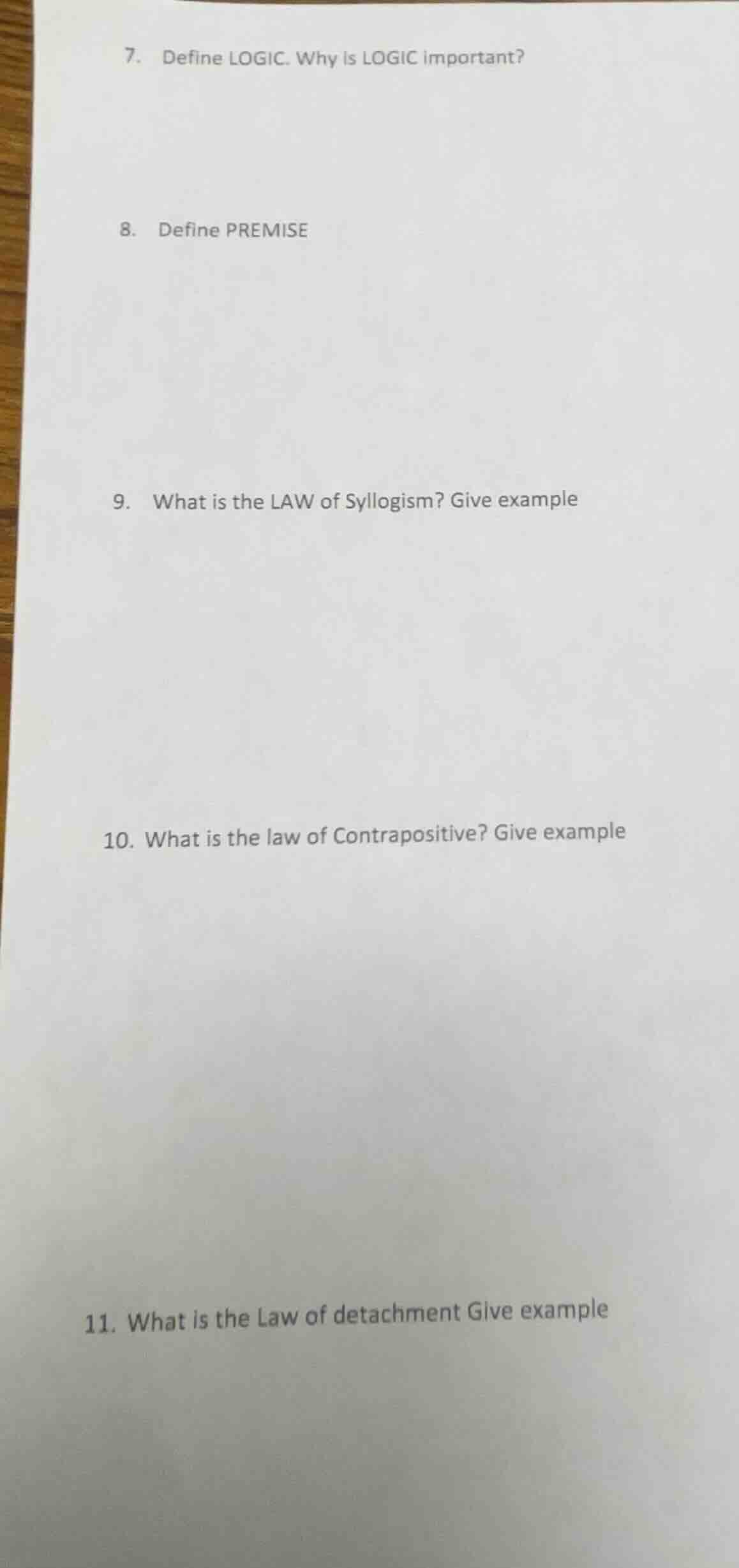
- define logic. why is logic important?
- define premise
- what is the law of syllogism? give example
- what is the law of contrapositive? give example
- what is the law of detachment give example
Question 7
- Define Logic: Logic is the study of reasoning, specifically the principles and methods of valid inference and argumentation. It deals with distinguishing correct (valid) reasoning from incorrect (invalid) reasoning.
- Importance of Logic:
- Critical Thinking: It helps in developing critical thinking skills, enabling individuals to analyze arguments, identify fallacies, and make sound judgments.
- Problem - Solving: In various fields like mathematics, science, and philosophy, logical reasoning is essential for formulating hypotheses, proving theorems, and solving complex problems.
- Communication: It enhances the clarity and coherence of communication by providing a framework for constructing valid arguments and understanding the arguments of others.
- Decision - Making: Assists in making rational decisions by evaluating different options based on logical principles.
In logic and argumentation, a premise is a statement or proposition that serves as the basis or starting point of an argument. It is a claim that is put forward to provide support or evidence for a conclusion. For example, in the argument "All men are mortal (premise 1), Socrates is a man (premise 2), therefore Socrates is mortal (conclusion)", the two statements "All men are mortal" and "Socrates is a man" are premises.
- Law of Syllogism: The Law of Syllogism is a rule of deductive reasoning. If we have two conditional statements, where the conclusion of the first conditional is the hypothesis of the second conditional, then we can derive a new conditional statement. In symbolic form, if we have \(p
ightarrow q\) (if \(p\), then \(q\)) and \(q
ightarrow r\) (if \(q\), then \(r\)), then we can conclude that \(p
ightarrow r\) (if \(p\), then \(r\)).
- Example:
- Let \(p =\) "It is raining", \(q=\) "The ground is wet", and \(r=\) "The grass will grow".
- The first conditional: If it is raining (\(p\)), then the ground is wet (\(q\)) (\(p
ightarrow q\)).
- The second conditional: If the ground is wet (\(q\)), then the grass will grow (\(r\)) (\(q
ightarrow r\)).
- By the Law of Syllogism, we can conclude: If it is raining (\(p\)), then the grass will grow (\(r\)) (\(p
ightarrow r\)).

Snap & solve any problem in the app
Get step-by-step solutions on Sovi AI
Photo-based solutions with guided steps
Explore more problems and detailed explanations
- Definition of Logic: Logic is the study of principles of valid reasoning, inference, and argumentation, focusing on distinguishing valid from invalid reasoning.
- Importance of Logic: It fosters critical thinking, aids in problem - solving across disciplines, improves communication by enabling clear argumentation, and supports rational decision - making.