QUESTION IMAGE
Question
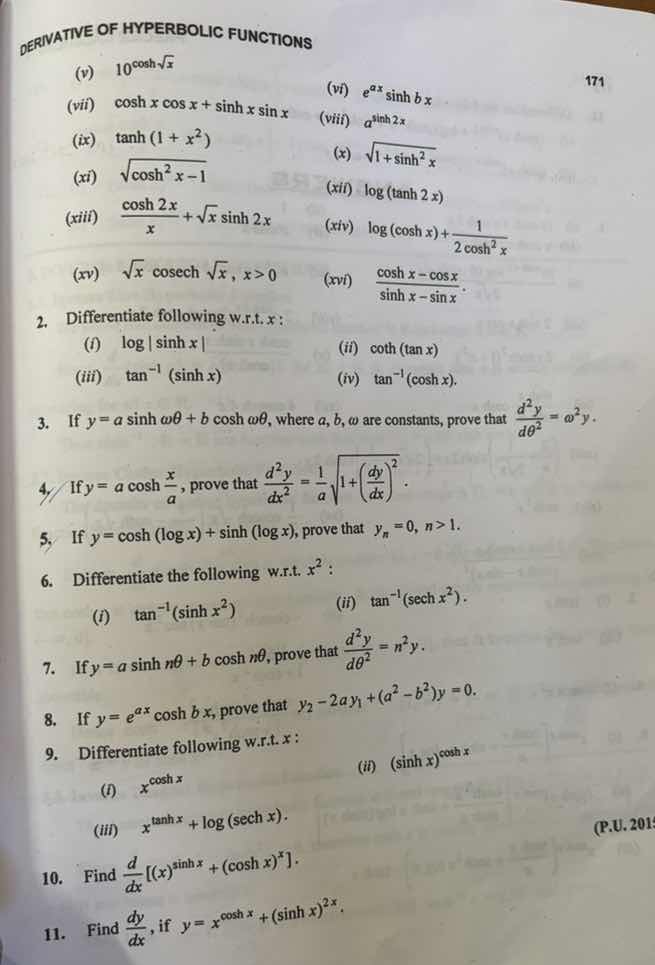
derivative of hyperbolic functions
(v) $10^{\cosh \sqrt{x}}$
(vi) $e^{ax} \sinh bx$
(vii) $\cosh x \cos x + \sinh x \sin x$
(viii) $a^{\sinh 2x}$
(ix) $\tanh (1 + x^2)$
(x) $\sqrt{1 + \sinh^2 x}$
(xi) $\sqrt{\cosh^2 x - 1}$
(xii) $\log (\tanh 2x)$
(xiii) $\frac{\cosh 2x}{x} + \sqrt{x} \sinh 2x$
(xiv) $\log (\cosh x) + \frac{1}{2 \cosh^2 x}$
(xv) $\sqrt{x} \text{cosech } \sqrt{x}, \\, x > 0$
(xvi) $\frac{\cosh x - \cos x}{\sinh x - \sin x}$.
- differentiate following w.r.t. $x$ :
(i) $\log | \sinh x |$
(ii) $\coth (\tan x)$
(iii) $\tan^{-1} (\sinh x)$
(iv) $\tan^{-1} (\cosh x)$.
- if $y = a \sinh \omega \theta + b \cosh \omega \theta$, where $a, b, \omega$ are constants, prove that $\frac{d^2 y}{d\theta^2} = \omega^2 y$.
- if $y = a \cosh \frac{x}{a}$, prove that $\frac{d^2 y}{dx^2} = \frac{1}{a} \sqrt{1 + \left( \frac{dy}{dx} \
ight)^2}$.
- if $y = \cosh (\log x) + \sinh (\log x)$, prove that $y_n = 0, \\, n > 1$.
- differentiate the following w.r.t. $x^2$ :
(i) $\tan^{-1}(\sinh x^2)$
(ii) $\tan^{-1}(\text{sech } x^2)$.
- if $y = a \sinh n\theta + b \cosh n\theta$, prove that $\frac{d^2 y}{d\theta^2} = n^2 y$.
- if $y = e^{ax} \cosh bx$, prove that $y_2 - 2a y_1 + (a^2 - b^2) y = 0$.
- differentiate following w.r.t. $x$ :
(i) $x^{\cosh x}$
(ii) $(\sinh x)^{\cosh x}$
(iii) $x^{\tanh x} + \log (\text{sech } x)$.
- find $\frac{d}{dx} \left (x)^{\sinh x} + (\cosh x)^x \
ight$.
- find $\frac{dy}{dx}$, if $y = x^{\cosh x} + (\sinh x)^{2x}$.
Let's solve problem 3: If \( y = a \sinh \omega \theta + b \cosh \omega \theta \), where \( a, b, \omega \) are constants, prove that \( \frac{d^2 y}{d \theta^2} = \omega^2 y \).
Step 1: First derivative of \( y \) with respect to \( \theta \)
Recall the derivatives of hyperbolic functions: \( \frac{d}{d x} \sinh u = \cosh u \cdot \frac{du}{dx} \) and \( \frac{d}{d x} \cosh u = \sinh u \cdot \frac{du}{dx} \).
For \( y = a \sinh (\omega \theta) + b \cosh (\omega \theta) \), differentiate term by term:
- Derivative of \( a \sinh (\omega \theta) \): Using the chain rule, \( u = \omega \theta \), so \( \frac{d}{d \theta} [a \sinh (\omega \theta)] = a \cosh (\omega \theta) \cdot \omega = a \omega \cosh (\omega \theta) \)
- Derivative of \( b \cosh (\omega \theta) \): Using the chain rule, \( u = \omega \theta \), so \( \frac{d}{d \theta} [b \cosh (\omega \theta)] = b \sinh (\omega \theta) \cdot \omega = b \omega \sinh (\omega \theta) \)
Thus, the first derivative \( y_1 = \frac{dy}{d \theta} = a \omega \cosh (\omega \theta) + b \omega \sinh (\omega \theta) \)
Step 2: Second derivative of \( y \) with respect to \( \theta \)
Differentiate \( y_1 \) with respect to \( \theta \):
- Derivative of \( a \omega \cosh (\omega \theta) \): Using the chain rule, \( u = \omega \theta \), so \( \frac{d}{d \theta} [a \omega \cosh (\omega \theta)] = a \omega \cdot \sinh (\omega \theta) \cdot \omega = a \omega^2 \sinh (\omega \theta) \)
- Derivative of \( b \omega \sinh (\omega \theta) \): Using the chain rule, \( u = \omega \theta \), so \( \frac{d}{d \theta} [b \omega \sinh (\omega \theta)] = b \omega \cdot \cosh (\omega \theta) \cdot \omega = b \omega^2 \cosh (\omega \theta) \)
Thus, the second derivative \( y_2 = \frac{d^2 y}{d \theta^2} = a \omega^2 \sinh (\omega \theta) + b \omega^2 \cosh (\omega \theta) \)
Step 3: Factor out \( \omega^2 \)
Factor \( \omega^2 \) from the right-hand side of \( y_2 \):
\( y_2 = \omega^2 [a \sinh (\omega \theta) + b \cosh (\omega \theta)] \)
But from the original equation, \( y = a \sinh (\omega \theta) + b \cosh (\omega \theta) \). Substitute \( y \) into the expression:
\( y_2 = \omega^2 y \)
Thus, we have proven that \( \frac{d^2 y}{d \theta^2} = \omega^2 y \).

Snap & solve any problem in the app
Get step-by-step solutions on Sovi AI
Photo-based solutions with guided steps
Explore more problems and detailed explanations
We have shown that if \( y = a \sinh \omega \theta + b \cosh \omega \theta \), then \( \frac{d^2 y}{d \theta^2} = \omega^2 y \), as required.