QUESTION IMAGE
Question
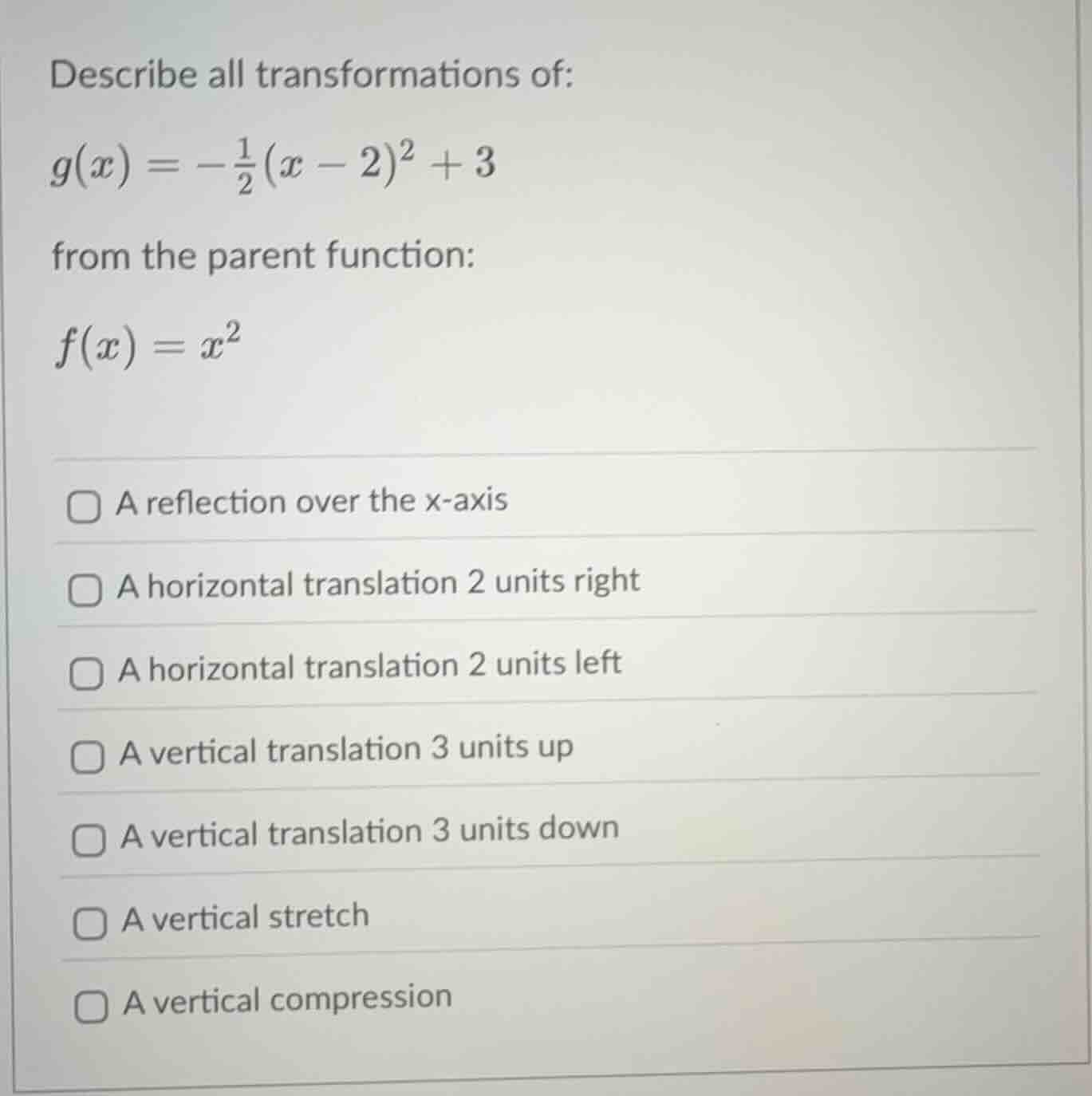
describe all transformations of:
$g(x) = -\frac{1}{2}(x - 2)^2 + 3$
from the parent function:
$f(x) = x^2$
a reflection over the x - axis
a horizontal translation 2 units right
a horizontal translation 2 units left
a vertical translation 3 units up
a vertical translation 3 units down
a vertical stretch
a vertical compression
Step1: Analyze reflection
The negative sign in front of the coefficient ($-\frac{1}{2}$) indicates a reflection over the x - axis. For a function $y = a(x - h)^2+k$, if $a<0$, it is a reflection over the x - axis. Here $a =-\frac{1}{2}<0$, so there is a reflection over the x - axis.
Step2: Analyze horizontal translation
The form of the function is $y=a(x - h)^2 + k$, where $h$ represents the horizontal shift. In $g(x)=-\frac{1}{2}(x - 2)^2+3$, $h = 2$. For the parent function $f(x)=x^{2}$, a horizontal translation of $h$ units to the right is given by $f(x - h)$. So when $h = 2$, it is a horizontal translation 2 units right.
Step3: Analyze vertical translation
In the form $y=a(x - h)^2 + k$, $k$ represents the vertical shift. Here $k = 3$, so it is a vertical translation 3 units up (since $k>0$ means up, $k < 0$ means down).
Step4: Analyze vertical stretch/compression
The coefficient $a=-\frac{1}{2}$. The absolute value of $a$, $|a|=\frac{1}{2}<1$. When $|a|<1$, it is a vertical compression (if $|a|>1$, it is a vertical stretch). So there is a vertical compression.

Snap & solve any problem in the app
Get step-by-step solutions on Sovi AI
Photo-based solutions with guided steps
Explore more problems and detailed explanations
A reflection over the x - axis, A horizontal translation 2 units right, A vertical translation 3 units up, A vertical compression