QUESTION IMAGE
Question
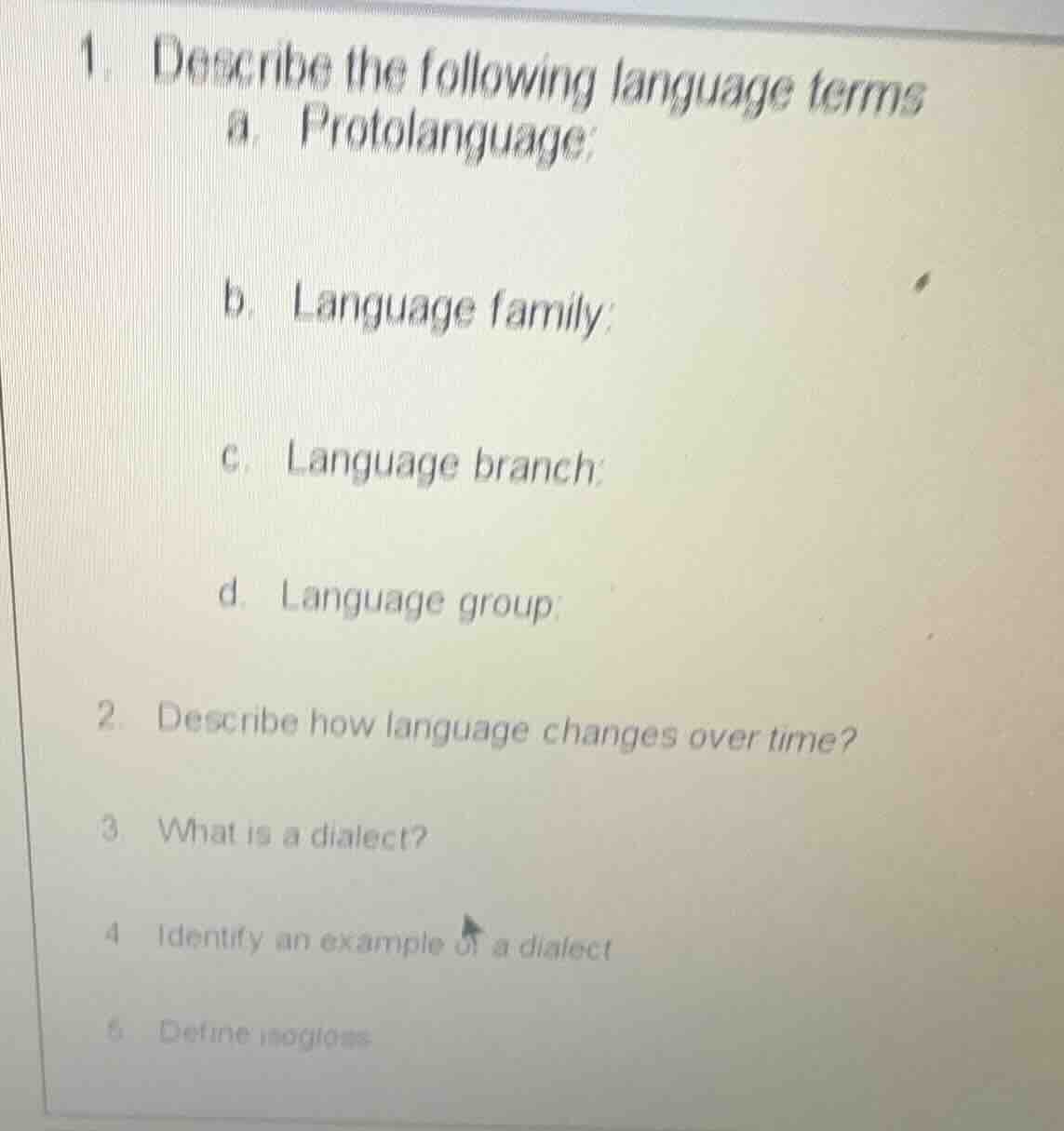
- describe the following language terms
a. protolanguage;
b. language family;
c. language branch;
d. language group;
- describe how language changes over time?
- what is a dialect?
- identify an example of a dialect
- define isogloss

Snap & solve any problem in the app
Get step-by-step solutions on Sovi AI
Photo-based solutions with guided steps
Explore more problems and detailed explanations
a. A hypothetical, reconstructed ancestral language from which related languages are believed to have descended.
b. A group of languages related through descent from a common ancestral proto-language.
c. A subset of a language family, consisting of languages more closely related to each other.
d. A smaller, more closely related subset within a language branch, with very similar languages.
Languages change over time through sound shifts, grammar modifications, vocabulary additions/obsoletion, and cultural contact influences.
A dialect is a regional or social variety of a language with distinct pronunciation, grammar, and vocabulary, mutually intelligible with other dialects of the same language.
Examples: British English, American English (or: Cantonese, a dialect of Chinese)
An isogloss is a geographic boundary line separating regions where a particular linguistic feature (e.g. pronunciation, word use) differs.