QUESTION IMAGE
Question
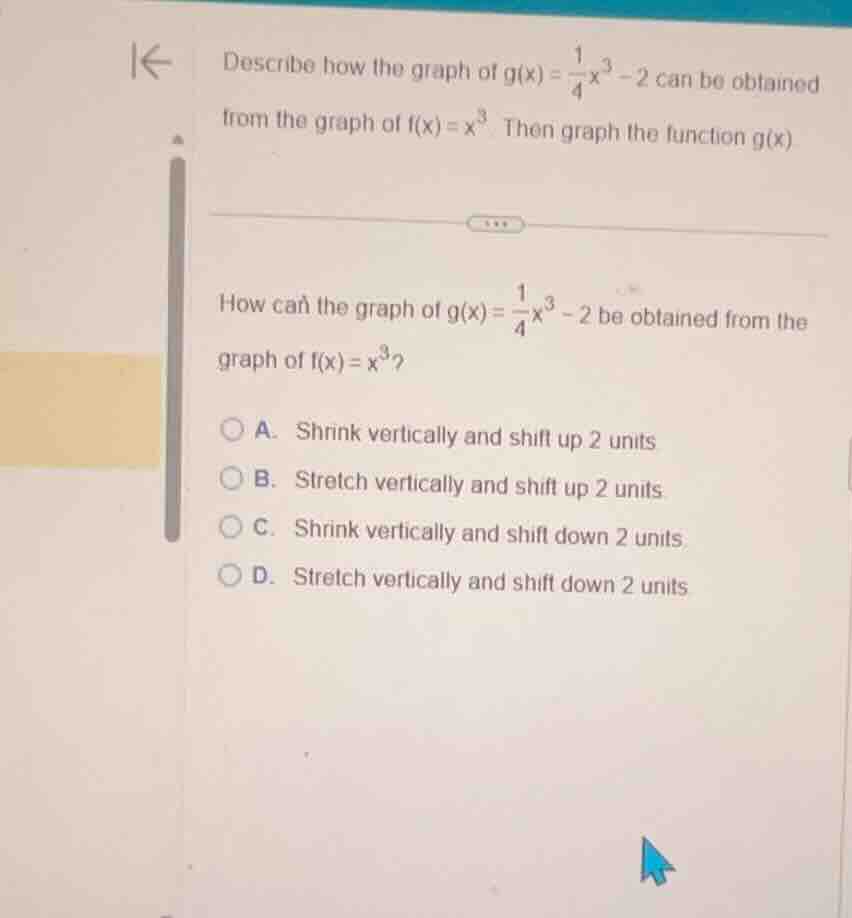
describe how the graph of $g(x)=\frac{1}{4}x^3 - 2$ can be obtained from the graph of $f(x)=x^3$. then graph the function $g(x)$.
how can the graph of $g(x)=\frac{1}{4}x^3 - 2$ be obtained from the graph of $f(x)=x^3$?
a. shrink vertically and shift up 2 units
b. stretch vertically and shift up 2 units
c. shrink vertically and shift down 2 units
d. stretch vertically and shift down 2 units
To determine the transformation from \( f(x) = x^3 \) to \( g(x)=\frac{1}{4}x^3 - 2 \), we analyze the vertical scaling and vertical shift:
- Vertical Scaling: For a function \( y = a\cdot f(x) \), if \( 0<|a|<1 \), the graph of \( f(x) \) is vertically shrunk by a factor of \( |a| \). Here, \( a=\frac{1}{4} \) (where \( 0<\frac{1}{4}<1 \)), so the graph of \( f(x)=x^3 \) is vertically shrunk by a factor of \( \frac{1}{4} \).
- Vertical Shift: For a function \( y = f(x)+k \), if \( k<0 \), the graph is shifted down by \( |k| \) units. Here, \( k = - 2 \), so the graph is shifted down by 2 units.
Combining these, the graph of \( g(x)=\frac{1}{4}x^3 - 2 \) is obtained by vertically shrinking the graph of \( f(x)=x^3 \) and shifting it down 2 units.

Snap & solve any problem in the app
Get step-by-step solutions on Sovi AI
Photo-based solutions with guided steps
Explore more problems and detailed explanations
C. Shrink vertically and shift down 2 units